

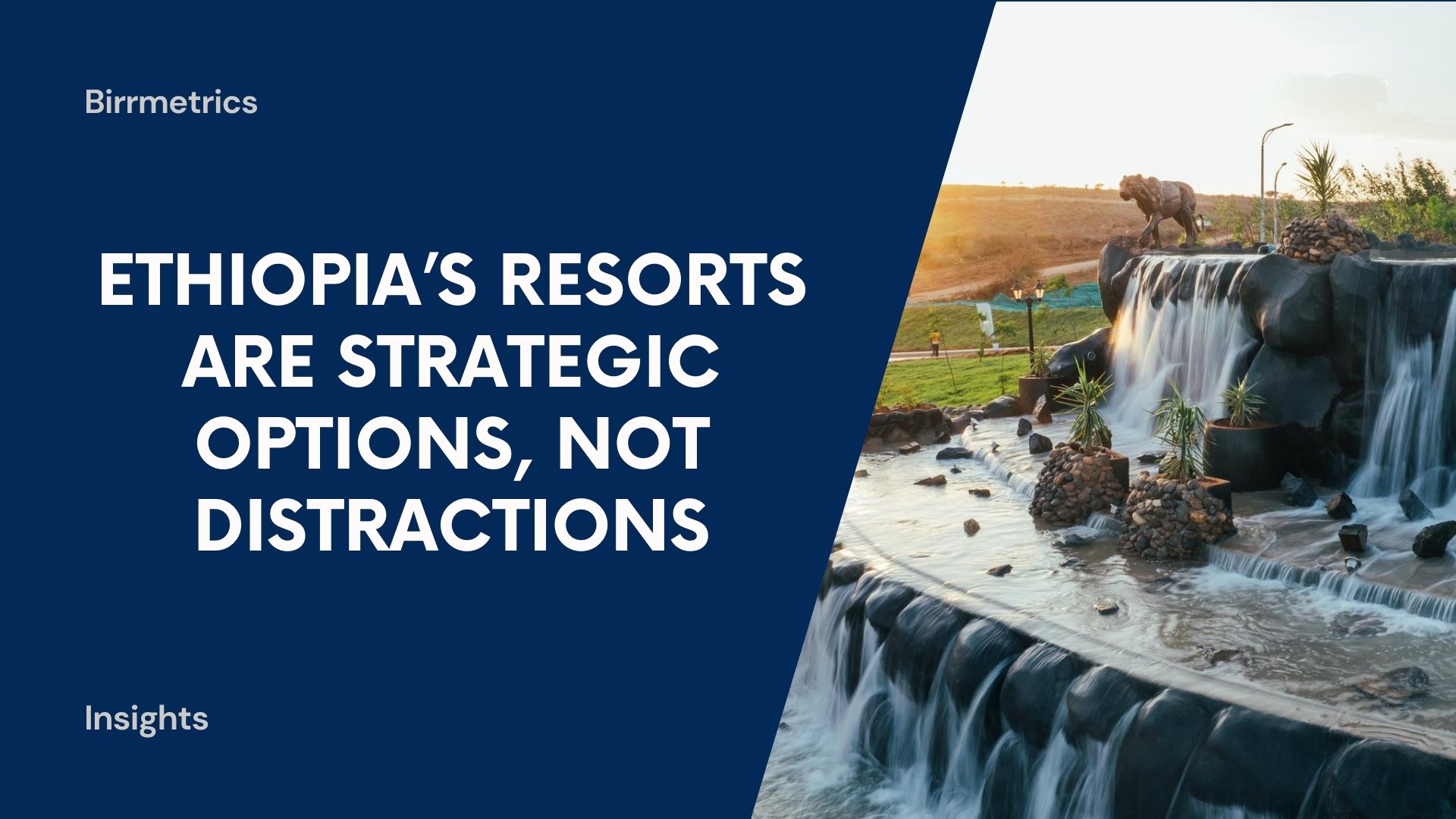
Ethiopia’s recent investments in resort developments have attracted criticism, especially at a time when the country faces debt pressure, inflation, and visible infrastructure gaps. To many observers, high-end lodges in the Somali Region or along Lake Tana appear indulgent, even irresponsible. Yet this reaction rests on a narrow view of development, one that treats public investment as a fixed pie and assumes that growth choices must always crowd each other out. For late industrialising economies, progress rarely follows such clean lines. Development advances by expanding options, not by rationing ambition.
Viewed through this lens, Ethiopia’s resorts emerge as economic instruments rather than lifestyle statements. Their locations are deliberate. Shabeely sits close to the oil and gas corridor. Wonchi Crater lies within reach of geothermal resources and agro-forestry zones. Gorgora anchors the Lake Tana basin, a strategic hydropower and freshwater system. Halala Kela and Chebera Elephant Paw sit inside biodiversity corridors already linked to carbon markets and eco-tourism concessions. These sites form a network of spatial anchors tied to productive assets that have long remained under-capitalised.
What matters is less the architecture than the institutional activity these anchors enable. Resorts provide a reason to build roads, utilities, and digital payment infrastructure in places where transaction density was previously too low to justify formal systems. They create demand for licensed suppliers, traceable employment, and bank-mediated exchange. Over time, they pull farmers, guides, transporters, and service firms into the formal economy. This is market creation through physical concentration, where economic behaviour can be observed, measured, and refined.
The approach reflects a broader pattern in Ethiopia’s development strategy. Parallel payment platforms, controlled redundancy in urban design, and phased liberalisation across sectors all point to a state willing to experiment in order to learn. Regional resort developments follow the same logic. By placing multiple anchors across diverse ecological and economic settings, the state allows different models to reveal themselves. Some will scale faster than others. Some will formalise supply chains more efficiently. Some will retain skilled labour better. The value lies in discovery, not immediate uniform success.
The cost of inaction in peripheral regions is often understated. Where no formal anchors exist, informality becomes the default. Rural economies remain dependent on cash exchange, subsistence production, and opaque trade networks that generate little fiscal or financial data. Even in Addis Ababa, a large share of economic activity remains informal while contributing minimally to tax revenue. Spatial anchors change this equilibrium by making formality useful. Registration becomes a requirement for participation, and digital transactions become normal rather than exceptional.
Ethiopia’s land ownership regime strengthens this strategy. Public control over land leases allows the state to shape how value is captured locally. Procurement rules, wage thresholds, and digital payment requirements can be embedded directly into operating conditions. The challenge is execution and transparency. Without clear reporting, local inclusion risks becoming symbolic. With it, resorts can function as enforceable platforms for regional value capture.
International investors respond less to scenery than to systems. Firms involved in construction, logistics, or energy are drawn to places where infrastructure works, contracts clear, and payments settle reliably. Once these conditions are demonstrated, adjacent sectors tend to follow. Agro-processing, cold storage, transport services, and light manufacturing gravitate toward proven nodes. This is how seemingly peripheral locations begin to integrate into wider economic circuits.
Patience is essential. Countries that now treat tourism as a major growth engine took years to build credibility and density. Early returns were modest, and payoffs only became visible once indirect effects were counted. Ethiopia’s corridor projects already show that formalisation and spillovers significantly alter investment returns over time. Resort developments are likely to follow similar trajectories, with slow beginnings and accelerating gains as linkages deepen.
The true measure of success will not be room occupancy or visitor counts. It will be whether participation in a resort supply chain allows a farmer, a transporter, or a service worker to become bankable within a few years. When that transition occurs repeatedly, economic gravity forms.
Investors are not persuaded by aesthetics. They commit when systems demonstrate reliability. In Ethiopia’s case, resorts serve as early proof points, places where markets can take shape before spreading outward. In an economy still assembling its institutional foundations, creating such options is not a distraction. It is a strategy.
Bayu Samuel is a Strategy & Investment Analyst with experience across Ethiopia’s public and private sectors. He holds a BSc from Addis Ababa University and applies expertise in securities, financial modeling, and game theory to guide investment decisions. He is currently an Associate at ACE Investment and Impact Advisors and previously served as a Senior Analyst at the FDRE Land Bank and Development Corporation.




