

Why dismissing urban infrastructure as economically irrelevant misunderstands how modern cities generate productivity
“Cities do not become productive simply because economic activity happens inside them. They become productive when the systems that connect people, capital and opportunity function efficiently.”
A recurring argument in recent discussions on different platforms claims that corridor development does little to strengthen the Ethiopian economy. The reasoning is simple and superficially compelling: economies grow through production — through agriculture, manufacturing, exports and innovation — while corridor projects appear to be primarily urban construction programs.
From this perspective, investment in urban corridors is portrayed as a diversion of scarce resources away from sectors that produce tradable goods and generate foreign exchange.
The logic, however, rests on a narrow interpretation of how economic systems actually operate. Economic activity is not merely the production of goods. It is also the coordination of people, capital and markets across space. Cities are the primary arenas where this coordination occurs. When the spatial systems that allow cities to function efficiently break down, productivity across sectors quietly declines.
Understanding this distinction is critical if debates about infrastructure and development are to move beyond simplified narratives.
THE HIDDEN COST OF URBAN FRICTION
Economists often describe the barriers that slow down economic exchange as transaction costs: the time, effort and resources required for markets to function.
In cities, these costs appear in everyday forms. Workers lose hours stuck in traffic congestion. Businesses struggle with unreliable logistics. Customers find commercial areas difficult to access. Investors hesitate in environments where infrastructure systems appear fragmented or unpredictable. Individually, these inefficiencies may seem minor. Collectively, they impose significant economic penalties.
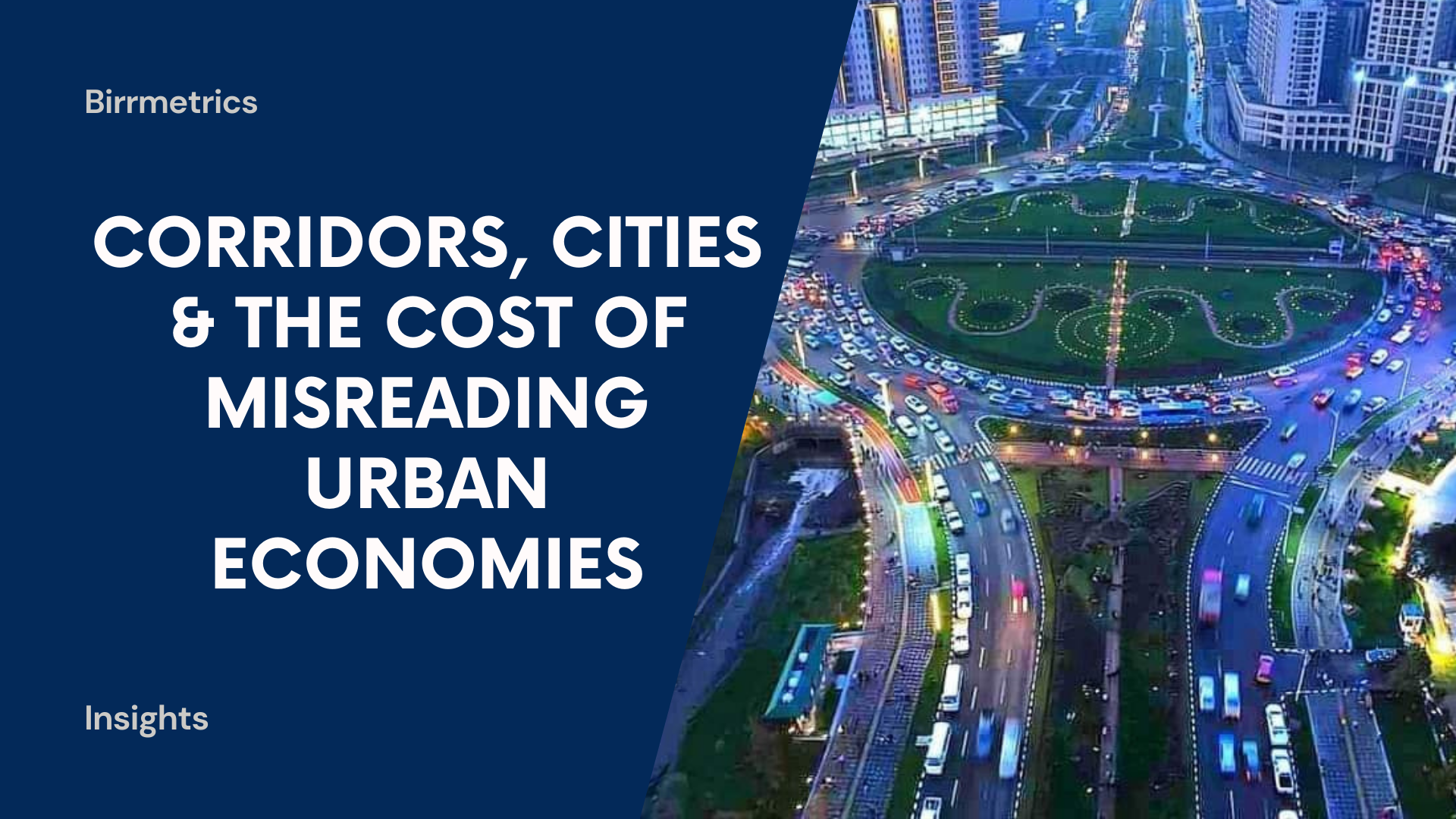
Urban corridors are one attempt to address these spatial frictions. By reorganizing mobility networks, improving accessibility and structuring the movement of people and goods across the city, they aim to reduce the hidden costs that constrain urban productivity.
The benefits rarely appear immediately in macroeconomic indicators. Instead, they accumulate gradually as travel times decline, accessibility improves and economic activity reorganizes around more efficient spatial patterns.
CITIES AS ENGINES OF COORDINATION
Development debates often treat cities simply as locations where economic activity occurs. In reality, cities operate as coordination systems.
Businesses cluster in cities because proximity lowers the cost of interaction. Skilled workers concentrate there because large labor markets offer more opportunities. Financial services, logistics firms and technology sectors thrive in environments where constant interaction between industries is possible.
These advantages, often described in economic literature as agglomeration effects, depend not only on proximity but also on mobility.
A city where movement is constrained by congestion and spatial fragmentation quickly loses the productivity benefits associated with urban concentration. Workers cannot reach jobs efficiently, businesses cannot access markets easily and investment becomes harder to coordinate.
Urban infrastructure therefore plays a critical role in sustaining these networks of interaction.
INFRASTRUCTURE AND ECONOMIC SEQUENCING
The debate surrounding corridor projects often assumes that governments must choose between investing in productive sectors and investing in urban infrastructure. In practice, the relationship is far more interconnected.
Industrial zones require transport links to reach labor markets and supply chains. Commercial districts depend on accessibility to attract customers and investment. Service industries thrive in environments where mobility allows rapid interaction between firms and clients.
Infrastructure does not substitute for production. It shapes the environment in which production becomes possible. When that environment remains inefficient, productive sectors struggle to scale regardless of policy ambition.
THE RISK OF IGNORING URBAN SYSTEMS
Across Africa, urban populations are expanding rapidly. Ethiopia is already experiencing this shift as economic activity increasingly concentrates in major cities.
Urban growth without structured infrastructure typically produces predictable outcomes: severe congestion, fragmented development patterns and rising costs of doing business.
Over time, these conditions transform cities from potential engines of growth into structural bottlenecks.
Investments in urban systems — including corridors, transport networks and integrated infrastructure — are attempts to prevent this outcome by introducing order into rapid urban expansion.
MOVING THE DEBATE FORWARD
The claim that corridor development does not build economies ultimately reflects a broader tendency in development discourse: the search for a single intervention capable of delivering economic transformation. History suggests that such simplicity rarely exists.
Economic development emerges from a combination of productive sectors, institutions, infrastructure systems and spatial organization. Urban corridors are not substitutes for agricultural productivity, industrial policy or export development. But they are part of the enabling environment within which these sectors operate.
The more constructive policy question is therefore not whether corridor development contributes to economic growth. It is whether urban infrastructure investments are being integrated into broader strategies that support production, investment and competitiveness.
Cities are complex systems. Their productivity depends not only on what they produce, but also on how efficiently they function. Recognizing that distinction is essential if discussions about development are to move beyond slogans and toward policies capable of supporting long-term economic transformation.
Wondimu Seta is Addis Ababa City Manager, With the Rank of Deputy Mayor.




