

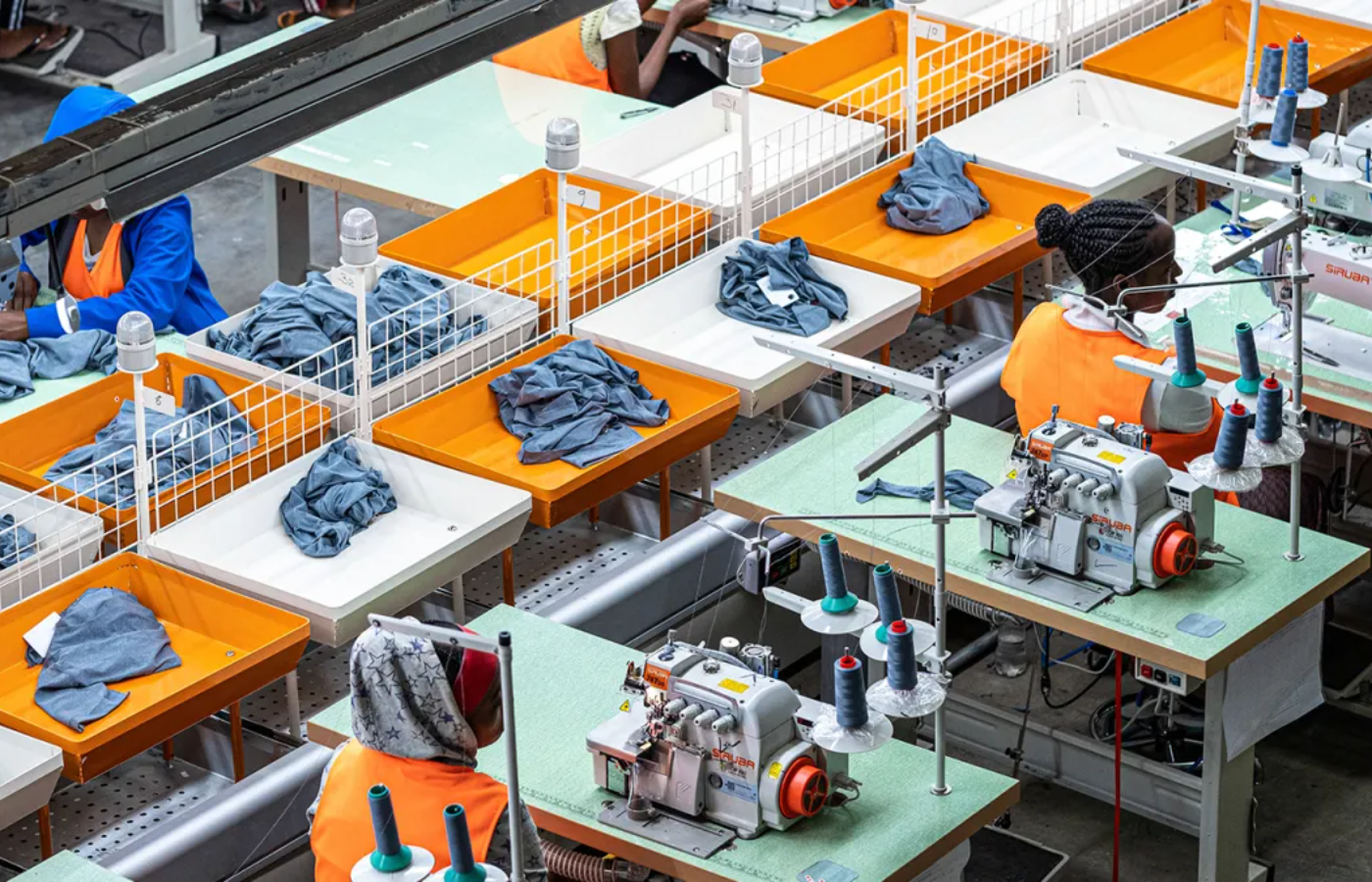
Workers are gradually leaving Ethiopia’s manufacturing sector despite steady economic growth, raising questions about the pace of the country’s industrial transformation.
A Mid-Term Review of the Country Strategy Paper by the African Development Bank (AfDB) Ethiopia shows Ethiopia recorded average real GDP growth of about 7.2 percent between 2022 and 2024. Yet the shift of labour from agriculture into industry, widely regarded as a central feature of structural transformation, has slowed.
Employment in manufacturing declined from 17.6 percent of the workforce to 15.6 percent during the period assessed by the bank. The broader industrial sector has also remained largely stagnant as a source of jobs, with its share of total employment edging down from 6.6 percent in 2020 to 6.5 percent by the 2023/24 fiscal year.
Over the same period, agriculture’s share of employment fell from 64.2 percent in 2020 to 62.4 percent as labour moved toward services and industry.
“However, much of the labour that left agriculture was absorbed by services rather than industry… This points to the fact that, although structural change is happening, it is not driven by labour productivity,” the report warned.
The findings indicate that workers leaving agriculture are not moving into factories in significant numbers. Instead, many are entering lower productivity service activities, a pattern that could complicate efforts to expand the country’s industrial base.
The AfDB review notes that the trend is not linked to weak industrial productivity. Value added per worker in industry remains relatively strong compared with parts of the services sector. However, manufacturers are struggling to attract and retain labour as structural constraints continue to weigh on the sector.
Among the challenges cited are infrastructure gaps that increase production costs, particularly in transport and energy. Manufacturers also face persistent shortages of foreign currency, limiting their ability to import machinery and raw materials.
The report also highlights a mismatch between the skills demanded by industrial firms and those available in the labour market, leaving many job seekers unprepared for specialised factory roles. Security concerns in parts of the country have added further pressure, disrupting supply chains and affecting investor confidence in some industrial zones.
The trend presents a challenge for Ethiopia’s Ten-Year Development Plan, which aims to raise manufacturing’s contribution to gross domestic product from seven percent to 15 percent by 2027.
Youth unemployment remains high at 23.1 percent of the labour force, compared with 8 percent for overall unemployment. Skills mismatches, limited job opportunities, particularly for youth and women, inadequate physical and digital infrastructure, reliance on traditional recruitment practices and the prevalence of informal labour markets continue to constrain employment creation.
“Ethiopia’s education system faced serious disruption and crisis, with at least 8 million children out of school because of emergencies, including drought, flooding and conflicts,” the report said.
Beyond the labour shift, the AfDB notes that fiscal pressures have eased somewhat. The fiscal deficit narrowed to 3.0 percent of GDP in 2024 from 4.0 percent in 2022, supported by fiscal consolidation and lower defence spending following the end of civil conflict. Defence expenditure fell to 0.6 percent of GDP in 2024 from 0.9 percent in 2023. The deficit is projected to narrow further to 1.5 percent of GDP in 2025 and 2026.
The review also points to broader development constraints. Internal conflict and geopolitical tensions with neighbouring countries continue to pose risks to stability. Climate change driven droughts and erratic rainfall threaten agricultural production and rural livelihoods, while limited access to clean water in arid and semi-arid areas places pressure on communities.
Infrastructure gaps persist across several sectors. Limited electricity access in rural areas constrains economic activity, while insufficient transport connectivity affects trade and access to services. The financial sector remains underdeveloped, with restricted access to capital markets limiting private sector expansion.
Despite these challenges, the bank notes that continued infrastructure investment, economic reforms and large-scale social protection programmes have helped support resilience among vulnerable populations.
As Ethiopia moves into the second half of the AfDB’s 2023–2027 country strategy, the lender says expanding private sector participation will be central to sustaining industrial growth.
Between 2023 and 2025, the bank committed about 538.8 million US dollars to projects in Ethiopia across energy, transport, agriculture and governance. Of this amount, 61.1 million US dollars supported projects under Priority Area I, while 477.7 million US dollars financed Priority Area II initiatives.
The total commitment fell short of the 827.46 million US dollars initially planned. The shortfall reflects lower than expected allocations under the African Development Fund cycle, deductions related to the Multilateral Debt Relief Initiative and weaker performance in non-sovereign operations, as none of the five private sector projects initially planned were realised.




