

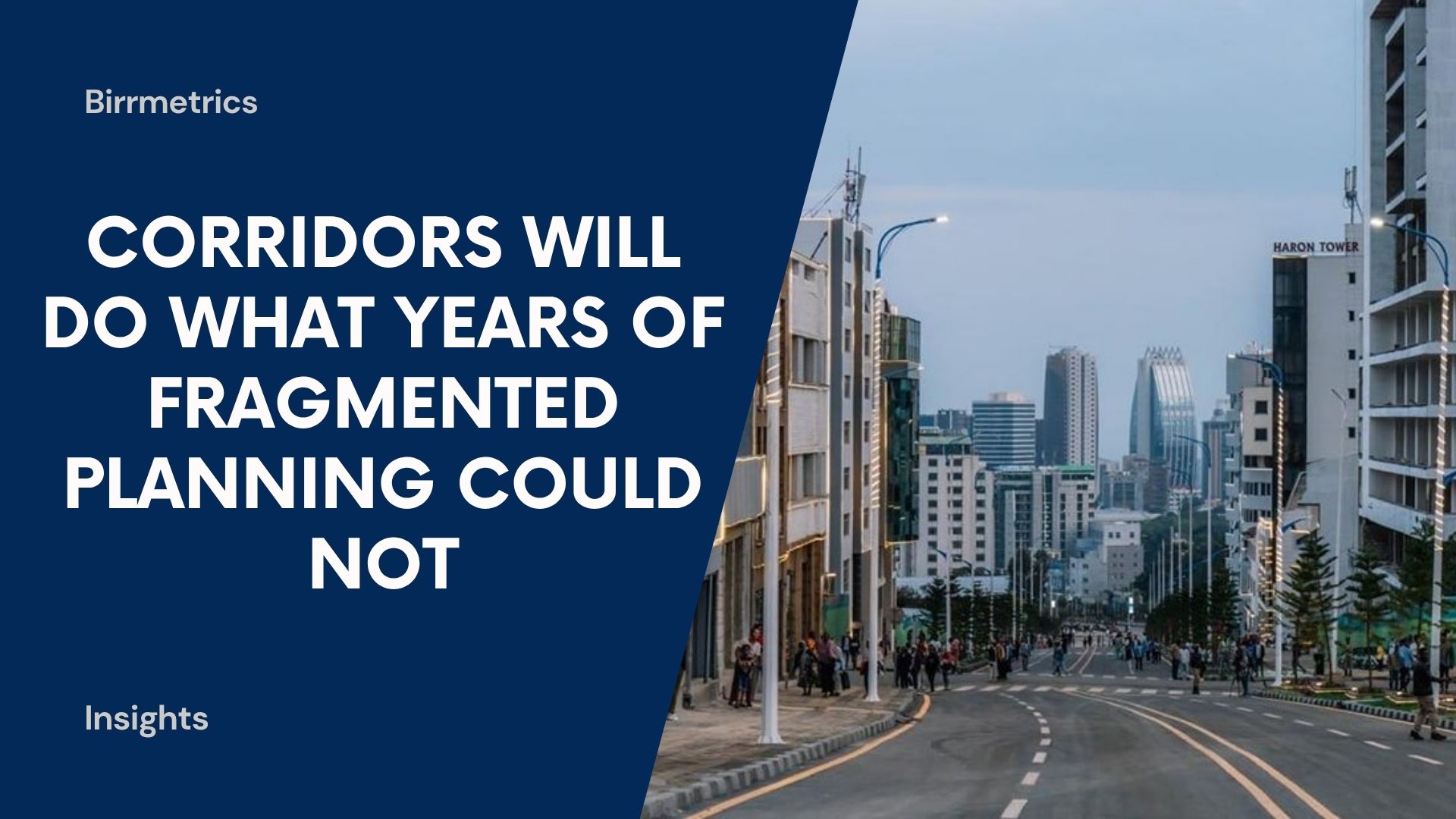
The debate over “pencil buildings” and urban restructuring is often presented as a contest between two competing visions of the city. In reality, both point to the same underlying challenge: how a fast-growing capital can move from fragmented plot-based growth toward more coordinated urban systems.
A false choice has come to shape urban debate in Addis Ababa. One side argues that narrow high-rise “pencil buildings” are simply the natural answer to land scarcity, rising demand and the pressure of growth. Another treats resistance to redevelopment as the only serious way to protect continuity, fairness and community life. Both arguments contain something real. But both also miss the larger point.
The city’s challenge is not to choose between density and redevelopment. It is to make sure that urban growth is no longer governed by fragmentation.
That matters because Addis Ababa is no longer a city that can rely on plot-by-plot improvisation and still expect coherent outcomes. It is growing too quickly, carrying too much pressure, and asking too much of its land and infrastructure for that. A modern capital has to think not only in terms of what can be built on an individual parcel, but in terms of how streets, utilities, access, drainage, emergency movement and public space work together.
That is where the discussion should begin.
The debate around pencil buildings is a useful example. These structures did not appear in a vacuum. They are a response to real market pressures, especially in areas where land is valuable and demand is strong. In that sense, they tell us something important. They show where pressure is accumulating. They show how developers are trying to respond within the options available to them.
But they also raise a legitimate urban question. Can every narrow parcel carry the same development intensity simply because demand exists? Often, the answer is more complicated. A building is never only a building. It is also frontage, access, setback, service connection, fire access, circulation and its relationship to the wider block and street network. So the issue is not height by itself. The issue is whether height is being inserted into a functioning urban system or into a fragmented one.
That same logic applies on the other side of the debate. Concerns about continuity, fairness and the effect of change on long-established areas should not be dismissed. Any serious city government has to pay attention to them. But it is also true that not every inherited land pattern can remain frozen forever, especially in strategic parts of a growing capital. At a certain stage of urban development, the public interest requires a broader view. Land has to be considered not only as individual holding, but as part of a larger city that must move, connect, serve and function.
That is why the current framing is too narrow. It suggests a confrontation where there should really be a transition.
The better way to think about it is this: Addis Ababa is moving from fragmented urban growth toward more coordinated urban growth. That transition is not about rejecting density. Nor is it about denying the importance of community and continuity. It is about bringing growth, standards and public purpose into better alignment.
In fact, that shift is already visible.
The government’s current direction deserves to be recognized for what it is: an effort to move beyond reactive urbanism and toward a more system-based approach. The growing emphasis on corridor development, stronger development controls, block-level thinking, land assembly and integrated infrastructure planning reflects a more mature reading of the city’s needs. These are not isolated interventions. They point to a broader understanding that the quality of urban growth depends not only on how much is built, but on how well that growth is connected.
This is especially important because fragmentation does not always announce itself dramatically. More often, it appears quietly: in awkward access, in misaligned infrastructure, in the difficulty of upgrading services at scale, in traffic pressure, in the tension between what individual plots can support and what the wider urban system requires. A city can continue to grow under those conditions, but it grows with more friction than it should.
That is precisely why stronger standards matter.
Minimum requirements for plot size, frontage and setbacks are sometimes described as technical restrictions, but that is too narrow a reading. They are better understood as practical safeguards for urban coherence. They help define the conditions under which development can be safer, more functional and more compatible with surrounding systems. They do not block progress. They help make progress more durable.
The same can be said for the growing emphasis on block-level planning and coordinated redevelopment. For many years, much urban land was handled in smaller, disconnected pieces, with the hope that larger coherence would somehow emerge later. That was always difficult. What is happening now is more forward-looking.
By working at the level of corridors, blocks and integrated networks, the city is beginning to create conditions in which density can be more efficient, redevelopment can be more orderly, and public investment can have greater long-term value.
Corridor development is central to this. It should not be understood only as beautification or traffic management, important as those are. Its deeper significance is structural. Corridors help regularize frontage, improve access, align infrastructure, enforce setbacks and gradually connect fragmented parcels into more coherent urban form. In that sense, they are part of a wider effort to help the city function better as a system.
This is also why moderation matters in the debate itself.
Addis Ababa does not benefit from exaggerated contrasts. It is not facing a choice between uncontrolled verticality and total preservation. Nor must it reject one urban value in order to advance another. The city can pursue density while insisting on standards. It can undertake redevelopment while remaining orderly, lawful and publicly accountable. It can modernize while still paying attention to social balance. In fact, serious urban governance depends on holding those objectives together rather than setting them against one another.
That is the real point. The question is not whether change should happen. Change is already happening. The question is whether Addis Ababa will allow fragmentation to continue setting the terms of that change, or whether it will increasingly guide growth through a clearer metropolitan logic.
Encouragingly, the answer is already taking shape. The city is moving, step by step, toward a model in which system logic matters more: where density works best when coordinated, where redevelopment is strongest when transparent and orderly, and where standards serve not as obstacles but as instruments of long-term urban quality.
The debate over pencil buildings and redevelopment should therefore be read with more calm and more perspective. These are not rival destinies for Addis Ababa. They are signs of a city in transition; a city learning, sometimes imperfectly but increasingly deliberately, how to align growth with infrastructure, land with function, and urban ambition with public purpose.
That is the direction worth strengthening.
A city cannot depend forever on parcel-by-parcel exceptions and still expect system-wide coherence. Sooner or later, coordinated urban logic has to lead. For Addis Ababa, that is no longer a distant principle. It is becoming the practical work of the present.
By Wondimu Seta, Addis Ababa City Manager, with the rank of Deputy Mayor




