

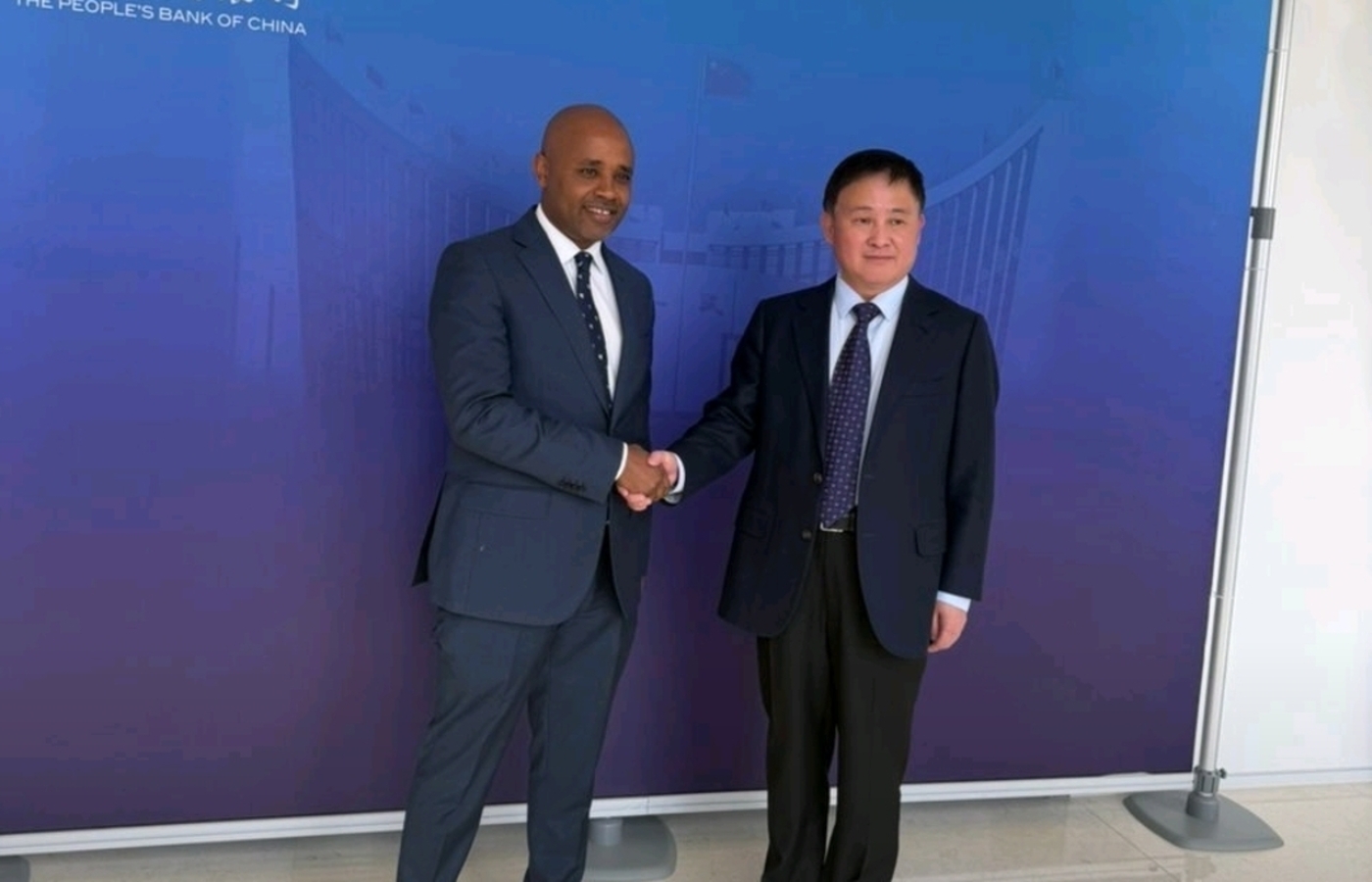
Ethiopia is exploring ways to expand its renminbi reserves and deepen financial cooperation with China following a meeting between the National Bank of Ethiopia (NBE) and the People's Bank of China (PBOC).
Governor Eyob Tekalign and PBOC Governor Pan Gongsheng discussed bilateral currency swap lines, trade financing facilities, and the potential for key Ethiopian exports to settle in renminbi. The initiative is aimed at supporting Chinese businesses operating in Ethiopia and attracting new foreign direct investment.
The discussion also focused on modernising cross-border payments, including linking national payment systems, joining the Cross-Border Interbank Payment System (CIPS), and expanding China UnionPay for retail and commercial transactions. Central Bank Digital Currencies (CBDCs) were another point of focus, with China offering technical support and capacity-building to accelerate Ethiopia’s digital finance infrastructure.
Governor Pan praised Ethiopia’s recent macroeconomic reforms and proactive debt management. Both sides reaffirmed a long-term partnership designed to facilitate trade, investment, and digital payments.
China’s broader push to internationalise the renminbi is part of a strategy that combines currency-settlement networks, selective capital account integration, and digital currency innovation. Governor Pan has previously warned of the financial risks stemming from global dependence on a single national currency and promoted China’s digital RMB as a step toward a more diversified monetary system.
Last year, Ethiopia entered preliminary talks with Chinese lenders, including the Export‑Import Bank of China and the PBOC, to convert portions of its dollar-denominated loans into yuan, following Kenya’s precedent. Analysts note such swaps can reduce interest costs and extend maturities, though they expose borrowers to currency risk if the local unit weakens against the yuan and may complicate coordination with multilateral creditors.
On the same day as the NBE‑PBOC meeting, Ethiopia’s finance officials also engaged with China’s international development agency to explore expanded concessional financing, technical assistance, and capacity building across infrastructure, agriculture, and digital development, signalling coordinated alignment across policy and development priorities.




