

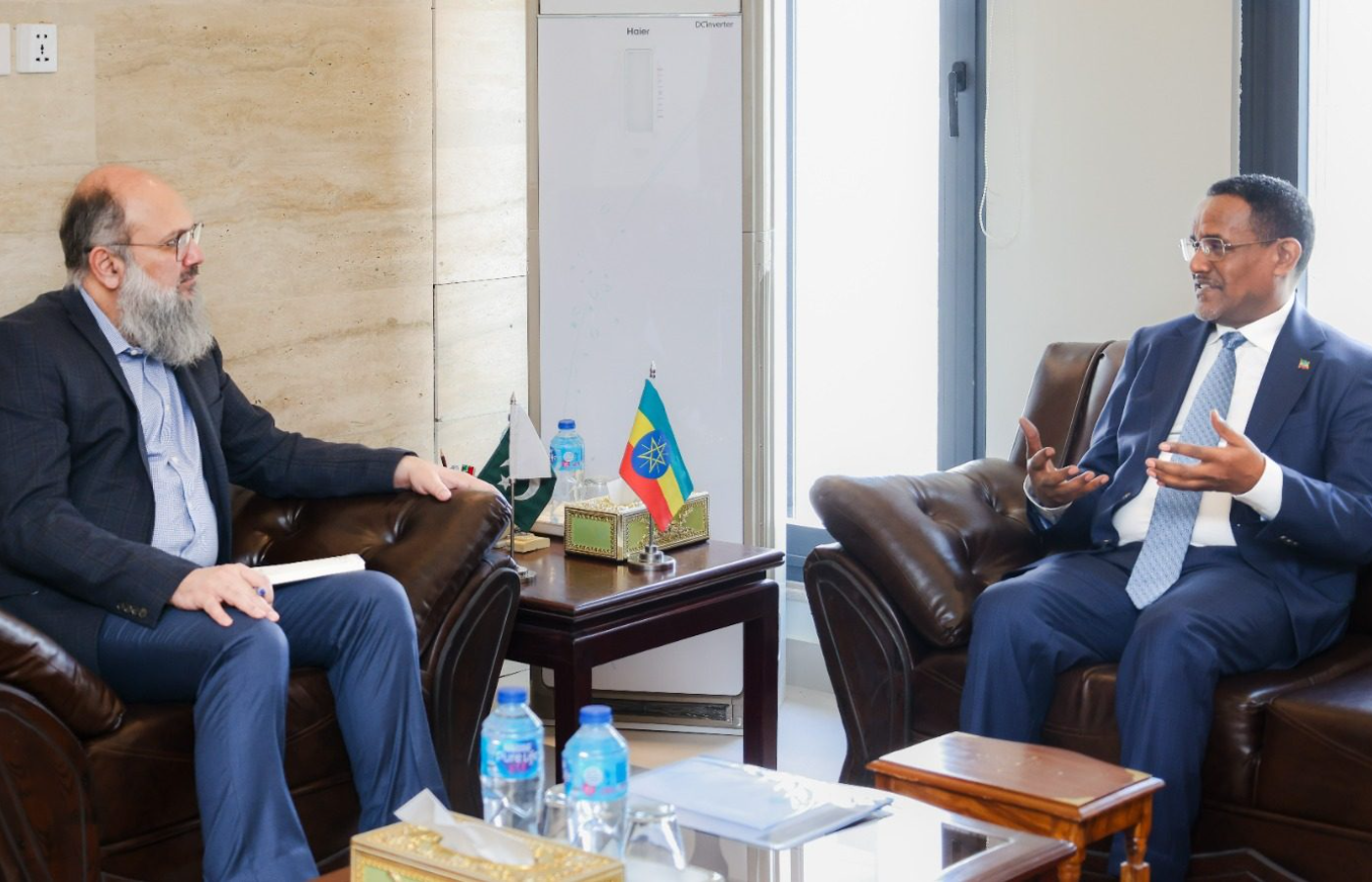
Ethiopia and Pakistan have agreed to establish a Joint Trade Committee aimed at strengthening cooperation in trade, investment and connectivity, in a move designed to provide a more structured framework for bilateral economic engagement.
The agreement was reached during a meeting in Islamabad between Ethiopia’s ambassador, Oumer Hussien Oba (PhD), and Pakistan’s Federal Minister for Commerce, Jam Kamal Khan, at the Ministry of Commerce, according to an official statement.
The proposed committee will be formed in line with a bilateral trade agreement signed in 2023. It is expected to serve as an institutional mechanism to coordinate commercial relations, address bottlenecks and support the expansion of economic ties between the two countries.
During the discussions, both sides reviewed a broad set of cooperation areas, including trade, investment, connectivity, tourism and cultural exchange, as part of efforts to widen the scope of bilateral engagement.
Oumer (PhD) underlined the importance of improving connectivity between Ethiopia and Pakistan, saying that logistics constraints remain a key factor limiting the scale of trade. He noted that enhanced transport and supply chain links would be critical to expanding trade, investment flows and tourism exchange.
He also highlighted Ethiopia’s investment landscape, pointing to opportunities in agriculture, manufacturing, information and communication technology, and mining, and encouraged Pakistani businesses to consider participation in these sectors.
Jam Kamal Khan acknowledged the potential for deeper cooperation and referred to his earlier visit to Ethiopia during Pakistan’s Single Country Exhibition held in Addis Ababa in 2025. He expressed support for efforts to develop a more integrated economic partnership.
Bilateral trade between Ethiopia and Pakistan remains relatively limited, with exchanges largely centred on textiles, agricultural products, pharmaceuticals, leather goods and basic manufactured items. Trade volumes have fluctuated in recent years, with logistics challenges and indirect shipping routes continuing to affect efficiency.
The absence of direct maritime or air cargo connectivity has been identified as a key constraint, with goods typically routed through third-country hubs such as the United Arab Emirates or regional logistics corridors linked to Djibouti. This has contributed to higher transport costs and longer delivery times.
Both countries have also engaged through wider South–South cooperation frameworks that encourage expanded trade relations among developing economies, providing an additional layer of context to the new committee structure.




