

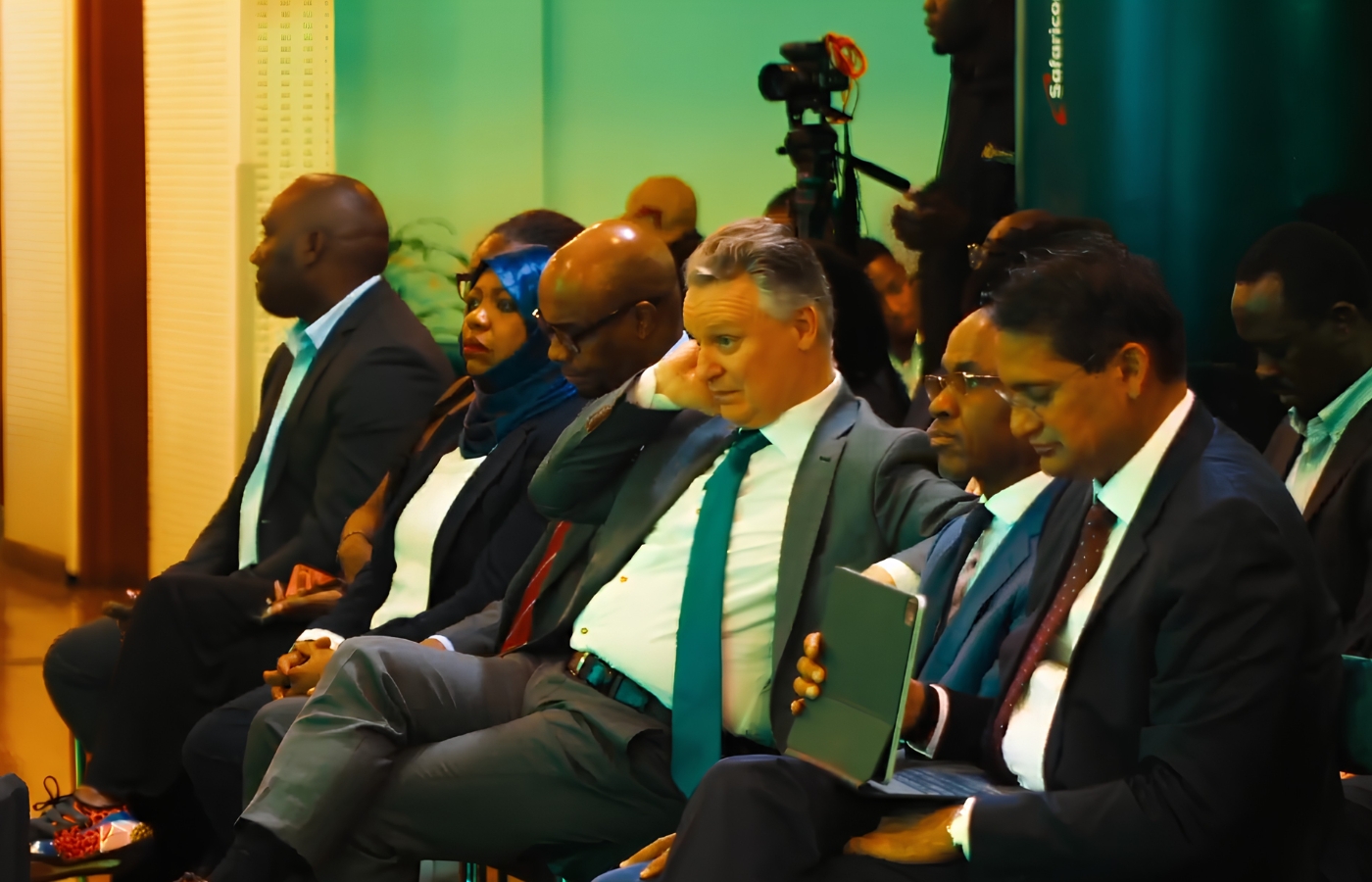
Safaricom Group reported a sharp rise in earnings for the year ended March 2026, as strong growth in Kenya and a reduction in start-up losses in Ethiopia lifted profitability and strengthened investor confidence in one of Africa’s most closely watched telecom expansion stories.
The Kenyan telecoms group said service revenue rose to 414.1 billion Kenyan shillings, about 3.21 billion US dollars, while normalised net income increased by 67.3 percent to 99.7 billion Kenyan shillings, or about 772 million US dollars. Group EBIT, excluding the impact of IAS 29 hyperinflation accounting, rose by 58.5 percent to 153.9 billion Kenyan shillings, about 1.19 billion US dollars, beating the company’s guidance range of 144 billion to 150 billion Kenyan shillings, or roughly 1.12 billion to 1.16 billion US dollars.
The results were driven mainly by Safaricom Kenya, which remains the group’s core profit engine. The Kenyan business generated 400.8 billion Kenyan shillings, about 3.10 billion US dollars, in service revenue, up 10 percent year-on-year, while net income rose by 24.7 percent to 119.1 billion Kenyan shillings, or about 922 million US dollars. EBITDA increased by 13.7 percent to 233.9 billion Kenyan shillings, about 1.81 billion US dollars, supported by continued growth in M-PESA, mobile data and fixed services.
But the more politically and strategically significant story is Ethiopia, where Safaricom’s loss-making operation showed signs of moving from heavy start-up burn toward early scale. Safaricom Ethiopia’s service revenue rose by 58.3 percent to 14.1 billion Kenyan shillings, about 109 million US dollars, driven by customer growth, deeper market penetration and higher use of voice, data and mobile money services.
Mobile data remained the largest revenue source, accounting for 67.9 percent of Safaricom Ethiopia’s service revenue, while voice rose to 21.4 percent.
"We have operated commercially in Ethiopia for three and a half years. This has been a period characterized by multiple challenges and learnings, both micro and macro, as we navigated the establishment of a green field operation," Dilip Pal, Group Chief Finance and Innovation Officer, said. "We are pleased with the results for FY26. Ethiopia demonstrated a stronger performance in the second half relative to the first half on all the key financial lines."
Safaricom Ethiopia’s 90-day active customer base increased by 54.2 percent to 13.63 million, while one-month active customers rose by 48.3 percent to 10.75 million. The company’s M-PESA operation in Ethiopia also gained traction, with 90-day active M-PESA users rising to 5.2 million from 2.37 million a year earlier. The value of transactions reached 28.6 billion Kenyan shillings, about 221 million US dollars, while transaction volume rose to 442.2 million.
The improvement has reduced the drag of Ethiopia on the wider group. Safaricom Ethiopia’s EBITDA loss narrowed to about 15.1 billion Kenyan shillings, or around 117 million US dollars, from 43 billion Kenyan shillings, about 333 million US dollars, on a normalised basis. Its operating loss fell to 30.1 billion Kenyan shillings, about 233 million US dollars, from 61.1 billion Kenyan shillings, or roughly 473 million US dollars.
Safaricom Ethiopia’s net loss also declined to 21.2 billion Kenyan shillings, about 164 million US dollars, improving by 41.2 percent year-on-year.
"Profitability is taking shape." Pal added.
The figures mark a major shift for Safaricom’s Ethiopia venture, which began as one of the largest foreign direct investments in the country’s history but was quickly exposed to high capital costs, foreign exchange volatility, inflation, security risks and the difficulty of competing against a deeply entrenched state operator.
Safaricom entered Ethiopia after the government awarded a telecom licence in 2021 to the Global Partnership for Ethiopia, a consortium that included Safaricom, Vodafone, Vodacom, Sumitomo and development finance partners. Ethiopian authorities said at the time that the licence ended a decades-long state telecom monopoly and that the consortium would invest eight billion US dollars over 10 years.
"Safaricom Ethiopia is now starting to become a material part of our group with a 15 percent contribution to the group revenue growth in FY26," said Peter Ndegwa, CEO of Safaricom Group. "We expect this business to have greater impact in future as it matures."
Safaricom Ethiopia became the country’s first private telecom operator and launched commercial operations in October 2022, introducing 4G services in cities and towns across the country. As of March 2025, the company said its network covered 50 percent of Ethiopia’s population, with more than 3,000 active sites and 2.6 billion US dollars in investment.
The company’s expansion has unfolded in a market still dominated by Ethio telecom. The state-owned operator reported 87.1 million telecom customers in the first half of the 2025/26 fiscal year, including 84 million mobile voice users and 49 million mobile data and internet users. Ethio telecom also reported 58.61 million telebirr users and 1.94 trillion birr in telebirr transactions during the same six-month period.
The broader macroeconomic environment remains a key risk for Safaricom. Ethiopia shifted to a market-based foreign exchange regime in July 2024, allowing banks to buy and sell foreign currencies at freely negotiated rates and ending surrender requirements to the National Bank of Ethiopia. While the reform was intended to improve foreign exchange supply and support private-sector activity, it also exposed companies with foreign currency obligations to sharper exchange-rate movements.
The IMF said Ethiopia’s reform programme is aimed at addressing macroeconomic imbalances, restoring external debt sustainability and laying the foundation for private-sector-led growth. But it also said tight monetary policy and prudent fiscal management would be needed to contain inflation and support implementation of the market-determined exchange rate.
Safaricom has signalled that Ethiopia’s losses will continue to narrow. For FY27, the company expects group EBIT of 180 billion to 187 billion Kenyan shillings, about 1.39 billion to 1.45 billion US dollars, with Kenya expected to generate EBIT of 195 billion to 199 billion Kenyan shillings, or about 1.51 billion to 1.54 billion US dollars. Ethiopia is projected to record an EBIT loss of 12 billion to 15 billion Kenyan shillings, about 93 million to 116 million US dollars, down sharply from FY26.
Market reaction was positive after the results, as investors responded to the better-than-expected operating profit and the narrowing losses in Ethiopia. The company also recommended a dividend of 2.00 Kenyan shillings per share, up 67 percent from the previous year.
Safaricom Ethiopia has not yet turned profitable. The latest numbers show a business moving in the right direction, not one that has completed its turnaround. The operation remains dependent on heavy network investment, customer acquisition, regulatory stability and the ability to scale M-PESA in a market where Ethio telecom already has a large digital finance base through telebirr.




