


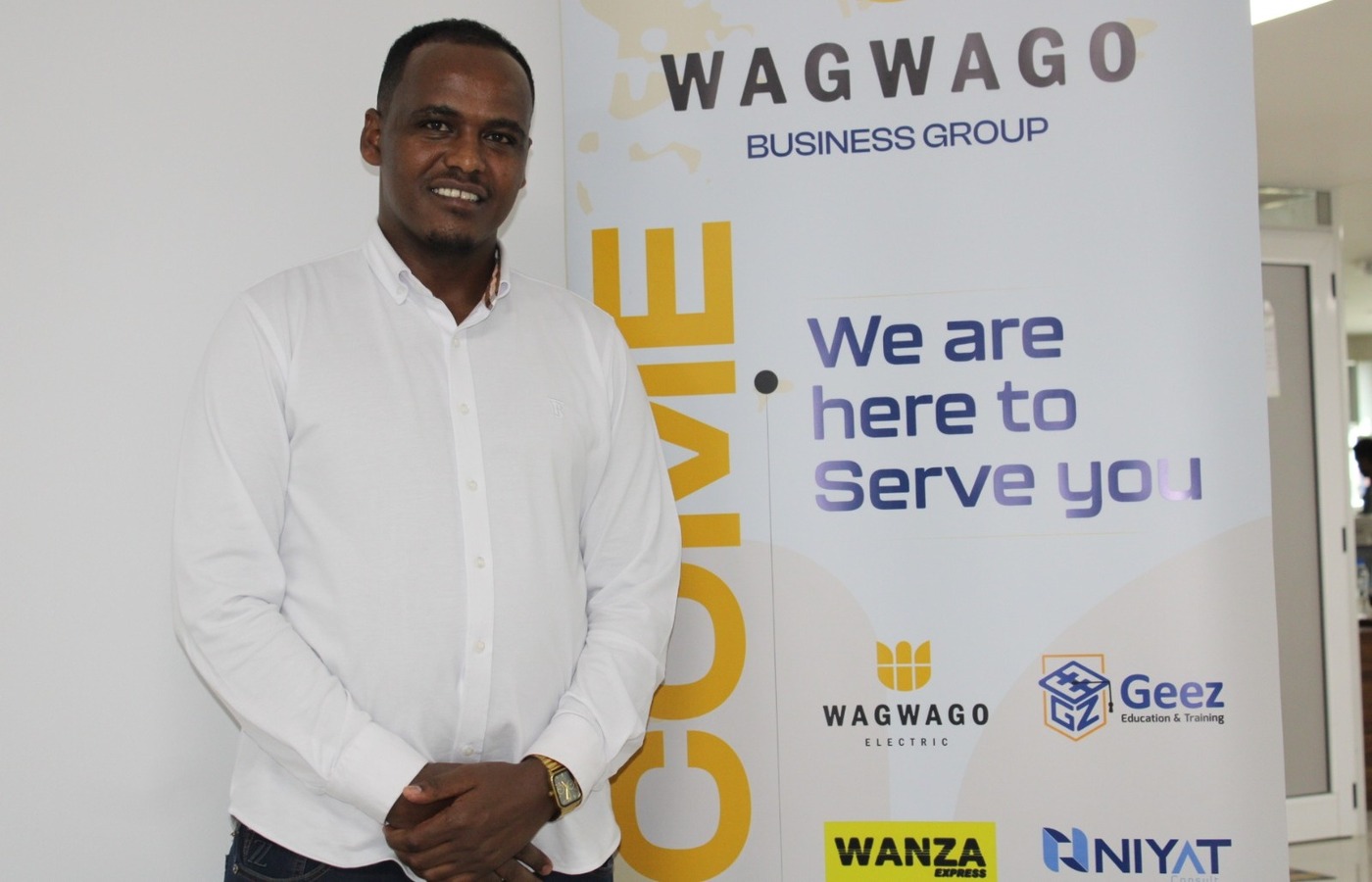
Tewelde Zemichael is the co-founder and chief executive of Geez Education and Training (Geez EdTech), an education and skills firm under Wagwago Group, a diversified business with interests spanning industry, electrical manufacturing, trading and education.
Geez EdTech sits in Ethiopia’s still-early EdTech space, blending digital learning with more traditional academic support from KG to Grade 12, alongside model exams and short-cycle training aimed at employability, particularly in technology and business. It has also expanded into workforce development, graduate training and consultancy.
Wagwago Group, long rooted in industrial and electrical businesses, has in recent years broadened its footprint into services, adding e-commerce and logistics activities alongside its existing operations. The group reported revenue of over 2 billion birr last fiscal year and employs around 480 people.
In a sit-down with Birrmetrics’ Mintesinot Nigussie, Tewelde traced Geez EdTech’s trajectory from a crisis-response initiative during a period of civil unrest to a more structured education platform. He pointed to familiar bottlenecks in Ethiopia’s EdTech landscape: patchy infrastructure, uneven teacher readiness, policy uncertainty and limited institutional backing for startups. Artificial intelligence, he argued, is better seen as a tool that supports teaching rather than replaces it, with the real constraint lying in whether schools and systems can build the capacity to absorb it.
Take me through the early days of your company. What was it like establishing an EdTech firm in a country where the sector is still in its infancy?
We started the company during a period of civil unrest, when many students were forced out of school. At the time, our focus was simply to find a way to help them continue learning and get back on track.
From there, the work evolved. What began as a response to disruption has grown into a broader set of services, including workforce development, programmes for fresh graduates, as well as training and consultancy. More recently, we have also moved into gamified learning and the development of our own education platforms.
What strategies did you introduce to fill that gap during the crisis, and what footprint did it leave?
Since the sector was still in its early stages, our first step was to run awareness campaigns to introduce the concept of EdTech and build trust among students, parents, and educators.
The next challenge we faced was talent. While many teachers were strong in traditional classroom settings, the shift to digital teaching proved difficult. There was a clear gap in the skills required to deliver lessons effectively online, from using digital tools to engaging students in a virtual environment.
To address this, we trained selected teachers in digital pedagogy, basic content production, and how to engage students in online settings.
We believe this work helped shift perceptions of digital education in Mekelle, where the initiative first took shape.
We then shifted into content and platform development, which became a defining phase of the work. Content up to Grade eight was developed in the local mother tongue of the company’s place of inception, aligned with curriculum requirements and learning realities on the ground. For Grades nine to twelve, we expanded the scope to a nationwide curriculum approach, designed to serve students across regions while staying aligned with national education standards.
The platform also offers personalised areas for improvement based on students’ performance in model examinations. It includes a pattern analysis feature that identifies core competency areas relevant to national exams.
Today, the platform hosts more than 1,000 learning contents, mainly in video format. It also includes over 70,000 model exam items and serves more than 15,000 students. The company is now expanding its reach to Addis Ababa and parts of southern Ethiopia.
From your experience working with schools and as an industry player, what are the key bottlenecks slowing the adoption of EdTech in Ethiopia?
It largely comes down to the sector’s overall readiness. On the teachers’ side, there is still a level of apprehension, with some fearing that technology could replace their role. As a result, adoption is often approached with caution or, in some cases, avoided altogether. This is followed by the preparedness of schools themselves, which varies significantly.
Another key challenge is the absence of a clear policy framework for the sector. Without standard definitions or regulatory guidance on what qualifies as EdTech, there is little consistency in how the space is structured. This has led to a situation where many startups label themselves as EdTech companies without necessarily meeting baseline criteria.
At a minimum, EdTech solutions should demonstrate inclusivity, including accessibility for learners in low-bandwidth areas and for students with disabilities. They should also go beyond digitisation by offering engaging, gamified learning experiences that are contextually relevant to local learning environments.
In addition, the lack of state-supported incubation and acceleration centres for EdTech startups has limited structured support for innovation and scaling. Even when policies are approved, implementation remains a challenge, as it often takes time for them to be put into practice and deliver results on the ground.
You also engage with corporate partners. From that experience, are companies generally satisfied with the current labour market, and how is the culture of skills development evolving over time?
We are still far from where we need to be in terms of skill development. In many organisations, training has become more of a routine exercise centred on attendance and certification rather than measurable outcomes. The conversation around return on investment is still limited, whether the training is translating into stronger performance or better productivity in the workplace.
As the economy opens further to foreign players, this could place local industries in a vulnerable position. These companies do not arrive with capital alone, they also come with skilled talent, systems, and experience. Without stronger investment in local skill development, there is a risk that domestic players will find themselves watching opportunities being captured by others rather than competing on equal footing.
At the same time, this growing competition, along with the rise of freelance and remote work, is beginning to shift attitudes. More young people, particularly in technology-related fields, are starting to recognise the value of practical skills and continuous learning as pathways to opportunity and global competitiveness.
The government has declared digital transformation a national priority. What has actually changed in schools since that declaration?
Surprisingly, the Digital Ethiopia Strategy aligns closely with our priorities. When investment is concentrated in urban areas without equal focus on rural communities, it risks widening the digital divide rather than closing it.
The strategy, however, places emphasis on key pillars such as inclusivity, solutions that work in low-bandwidth environments, and locally contextualised digital services.
On paper, it is strong and has the potential to attract more international players into the market. The real question, however, is execution. That responsibility sits with all stakeholders, from public institutions to private investors, including ourselves. Without effective implementation, there is a risk that local investors will struggle to compete with international players in tapping into emerging demand.
With AI altering how young people learn and online creators reshaping perceptions of success and income, some analysts argue that traditional education is under growing pressure to remain relevant. In Ethiopia, ongoing education reforms have also fuelled debate over access to higher education and student outcomes. Is the sector facing a genuine risk of disruption?
The traditional education system is indeed under pressure. Its relevance increasingly depends on how far it adapts; without meaningful upgrading, it risks falling behind shifting realities.
AI should not be viewed purely as a threat. It can take on basic “what” questions, while teachers focus on deeper cognitive work, the “why” and “how”. In that sense, AI becomes a support layer rather than a substitute. Those who understand the scale of this shift are more likely to adapt and remain relevant. The focus, increasingly, is on three Ps: people, process, and platforms.
That transition is not without friction. Concerns are emerging among parents, teachers and schools about the integration of AI in education. Some parents fear it could weaken students’ critical thinking skills, which in turn is slowing acceptance and creating resistance in parts of the system.
However, where schools are properly equipped and prepared, the outcome could be quite different. Rather than replacing thinking, AI can be used to enhance productivity, support learning processes, and strengthen students’ cognitive skills when integrated thoughtfully into teaching practice.
Estimates from the World Economic Forum’s Future of Jobs Report 2025 suggest about 92 million jobs could become obsolete by 2030, even as roughly 170 million new roles are created, implying a net gain of 78 million positions. The figures point to a shift in the nature of work rather than a simple loss of employment. Demand is expected to tilt towards skills such as data analysis, cybersecurity, critical thinking, digital literacy and AI, while more routine administrative roles face greater exposure to displacement.
That, however, reflects a period still largely shaped by narrow AI systems designed for specific tasks. Beyond that horizon, attention increasingly turns to the potential emergence of artificial general intelligence, which could reshape the labour market in ways that remain difficult to predict or quantify.

Isn’t deploying such a system costly in Ethiopia, and is the country ready for it at present?
Yes, it is viable, and in some cases it is already happening in institutions like ours. The real requirement is not only funding the technology itself, but building the capacity of schools and teachers to use it effectively, particularly within public institutions.
Even without developing local language models at this stage, the immediate priority is to master the effective use of existing AI tools. That foundation is essential. It helps build familiarity with the underlying systems and, over time, can create the technical and institutional base needed to develop homegrown solutions.
How can the skills gap be closed when it is already proving difficult to bridge, even before AI intensifies the pressure?
The perception of internships needs to change. They should be made mandatory across both public and private institutions, with clear objectives and a stronger focus on practical, hands-on experience rather than formality.
It also requires a shift in both system and mindset. If properly structured, internships can bridge the gap between education and the labour market, helping students become more competent not only in Ethiopia but also in a global context.
You are also in fintech. What does it mean for an economy when firms operate through personal accounts?
This suggests the business is not really built for scale. At its core, it ties operations to one person, which makes the setup fragile and hard to sustain over time. What’s missing is institutionalisation, a structure that allows the business to function beyond individuals and scale in a more stable way. It also complicates something as basic as clean financial record-keeping.
More broadly, relying on personal accounts quietly pushes firms outside the formal financial system. It leaves little trace for credit scoring, where a company’s own transaction history is essential. Without that footprint, access to finance becomes thinner, and growth more constrained. Over time, this does not just affect individual firms; it limits how much the financial system itself can evolve.
In many cases, this happens because some businesses still see formalisation as restrictive or burdensome, which keeps them operating informally.




