

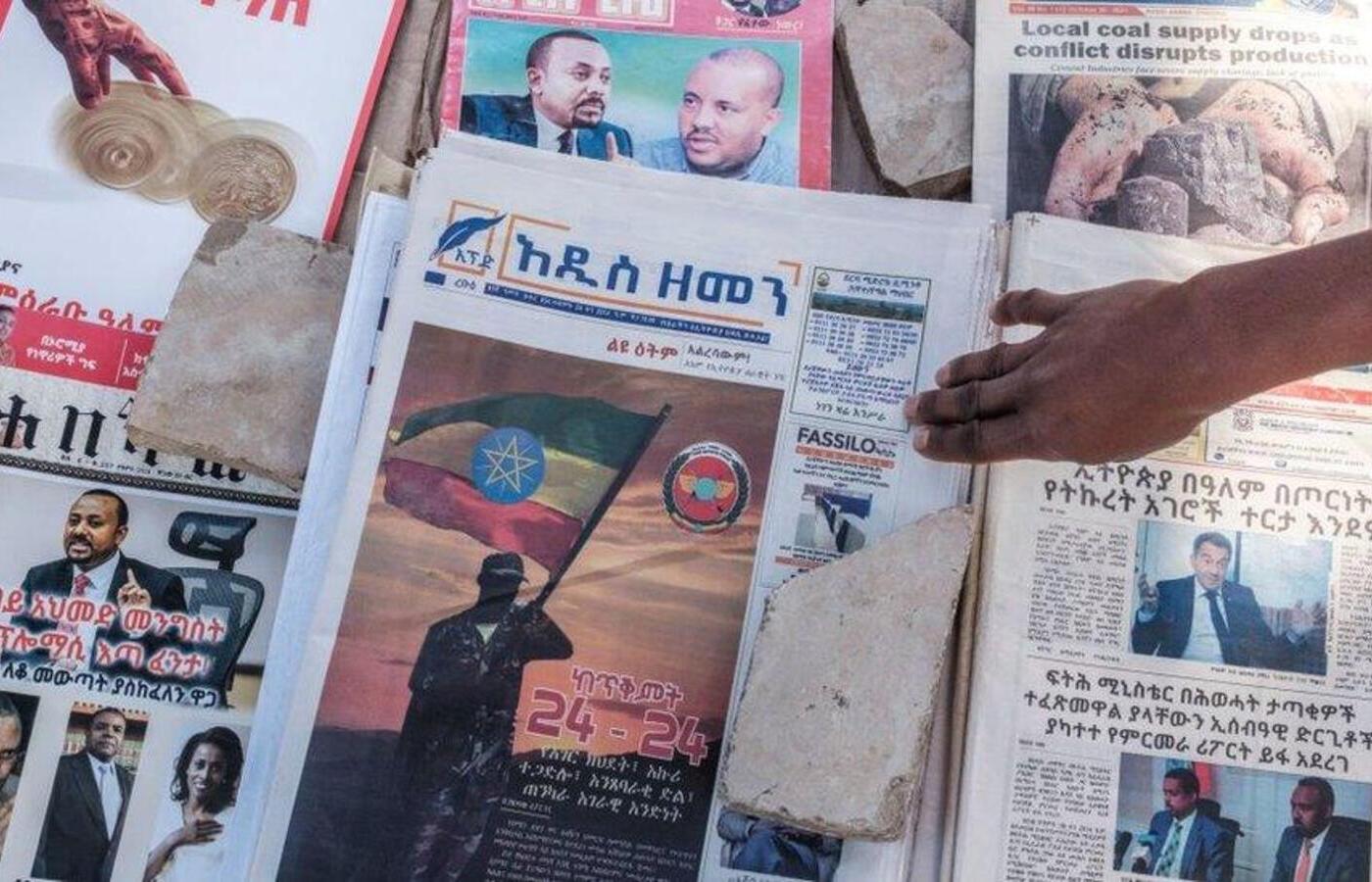
Ethiopia has the audience, the politics and the digital momentum. What it lacks is the media industry that serious investors can trust.
In theory, Ethiopia should be one of Africa’s most attractive media markets. It has scale, political relevance, a young population and a public sphere that matters far beyond its borders. It is the seat of the African Union, a diplomatic capital for the continent and one of the few African countries whose domestic political debates routinely travel into regional and global conversations.
The numbers appear to strengthen the case. Ethiopia’s population is now estimated at about 136 million, making it Africa’s second-most populous country after Nigeria. DataReportal’s Digital 2026 country report estimates that 29.5 million Ethiopians were using the internet by the end of 2025, while the country had 93.2 million cellular mobile connections and 9.8 million social media user identities. A market of that size, even with low internet penetration, should be difficult for media investors to ignore.
Yet the expected wave of investment has not arrived. No major international media group has built a serious Ethiopian news operation. No global broadcaster has rushed to acquire or partner with an Ethiopian newsroom. No large regional media house has treated Addis Ababa as the next Nairobi, Johannesburg or Lagos.
The problem is not whether Ethiopia has an audience. It does. The problem is whether the country has built an investable media industry around that audience.
Ethiopia has more media outlets than its old state-dominated image suggests. But regional comparison shows why raw outlet count can be misleading: licensing numbers, operational status, audience measurement, revenue depth and ownership transparency all matter.
| Market | Reported/licensed media presence | What the figure shows |
| Ethiopia | 309 active licensed outlets, according to a report citing the Ethiopian Media Authority. EMA’s public online list separately shows categories including public, commercial, community, educational and religious media. | A larger media space than the old monopoly era, but the figure needs direct regulatory confirmation before publication and does not show investability. |
| Kenya | 710 licensed broadcasting service providers as of March 31, 2025; 253 TV stations and 265 FM stations operational. | A deeper licensed broadcasting market with more visible commercial players and stronger advertising culture. |
| South Africa | Licensed broadcast ecosystem includes 218 community radio stations, 27 commercial radio stations, 15 public radio stations, five free-to-air TV stations, five subscription TV stations and five community TV stations. | A mature market where broadcasting sits within a larger advertising, pay-TV and capital-market ecosystem. |
| Rwanda | 39 radio stations, 24 TV stations, five print media outlets and 169 licensed online media houses. | A much smaller country, but one with clearer institutional documentation and media-sector measurement. |
Note: The categories above are not identical across countries. They should be read as a directional comparison, not a strict one-to-one ranking.
Part of the confusion begins with the law. Ethiopia’s wider investment regime has moved from a restrictive positive-list approach to a more liberal negative-list system in which many sectors are presumed open unless specifically reserved. But media remains a special case. Under the Media Proclamation No. 1238/2021, foreign participation in broadcasting is constrained, with the law barring licences using limited radio spectrum where more than 25 percent of capital shares are owned by foreign nationals. A legal analysis in the Journal of Ethiopian Law notes that the same proclamation limits even Ethiopian diaspora participation in media and broadcasting to a maximum share ownership cap of 25 percent.
For Kebour Ghenna, co-founder of Capital newspaper and a long-time economy commentator, this is where the stagnation begins. He argues that Ethiopia’s media ecosystem requires substantial reform and that, from the perspective of an external investor, the country is not currently seen as an attractive media market. The core issue, he says, lies within the media law itself, which he describes as complex and marked by multifaceted conditions. One example is the 25 percent cap on investor participation, which Kebour considers problematic because it may not provide enough confidence for potential investors.
That argument cuts to the centre of Ethiopia’s unfinished media reform. The issue is not merely whether foreign capital is technically allowed. It is whether an investor is allowed enough ownership, influence and operational control to justify the risk.
A minority position may appeal to a passive financial investor in a stable industry. It is less attractive in a politically sensitive sector where success depends on editorial systems, technology, audience analytics, advertising relationships and long-term brand building. Investors who cannot control strategy, protect governance standards or shape the business model may decide that the risk is not worth the exposure.
The stagnation of Ethiopia’s media sector is not only a market failure. It is also a reform failure.
Over the past decade, the country has seen new broadcasters, YouTube-based commentators, online newsrooms, digital magazines, diaspora-linked media spaces and personality-driven political platforms. But much of this expansion has been numerical rather than institutional. Ethiopia has more outlets, more voices and more platforms. It does not yet have enough durable media companies.
Kebour sees the same pattern in the sector’s recent evolution. Ethiopia has witnessed new activity over the past decade, including domestic initiatives and the expansion of digital media, but he argues that this has not produced a fundamental shift in mindset. The result, in his view, is a lack of meaningful domestic reform, made worse by what he calls the government’s stagnant approach to the media sector, which has significantly weakened the industry.
That is the distinction investors care about. A crowded media space can still be commercially weak. A noisy public sphere can still lack professional institutions. A digital boom can still produce fragile outlets whose survival depends on one founder, one donor grant, one government mood or one social-media algorithm.
Foreign capital is not sentimental. It does not enter a market because the country is large or politically important. It enters when the rules are clear, the risks are manageable and the business case is credible.
Samson Berhane, a business and economy analyst and media communications expert, reaches a similar conclusion from the institutional side. He says Ethiopia’s media sector is not yet prepared to attract serious foreign investment, not because the market lacks potential, but because the basic institutional foundations remain weak.
Those foundations are not abstract. Investors look for clean ownership structures, audited accounts, functioning boards, professional management, stable editorial systems, predictable tax treatment and reliable revenue data. In Ethiopia, Samson says, very few outlets meet that standard outside state-owned media and a handful of established broadcasters.
A media investor is not simply buying a licence, a studio or a social media page. They are buying credibility, audience trust, repeatable production capacity, sales discipline, talent and institutional continuity. If an outlet cannot prove its revenues, explain its ownership, retain its editors or survive political pressure, its value is fragile.
This is where Ethiopia’s media market differs sharply from more mature ecosystems. Kenya’s Nation Media Group and Royal Media Services operate within a competitive commercial media environment supported by advertising agencies, telecoms, banks, consumer brands and more reliable audience habits. South Africa’s MultiChoice grew out of a larger pay-TV, sports-rights, advertising and subscription economy. Nigeria’s entertainment and media investments benefit from population scale, English-language reach and a powerful creative industry. Ethiopia has scale, but it lacks many of the commercial and institutional layers that convert scale into investment.
The central weakness is the advertising market.
A healthy media industry depends on companies that see visibility, reputation, public communication and brand positioning as strategic business functions. In Ethiopia, that culture is still developing. Many companies remain cautious about public messaging. Marketing budgets are thin. Corporate communication is often treated as an event-based expense rather than a long-term investment. State-owned enterprises and banks spend, but their spending does not always create a competitive advertising market for independent journalism.
Without advertising depth, media outlets struggle to hire experienced editors, pay specialised reporters, invest in data journalism, build audience research systems or maintain editorial independence. The result is a cycle: weak revenues produce weak institutions; weak institutions fail to attract investors; the absence of investors keeps the market undercapitalised.
The global lesson is clear. Media freedom alone does not create a media industry. The United States built national media brands on a vast advertising economy. South Africa’s commercial broadcasters grew alongside corporate advertising and subscription television. Kenya’s private media benefited from banks, telecoms, consumer goods companies and political advertising competing for audience attention. Ethiopia’s private sector is growing, but its advertising culture has not yet caught up with its population size.
Capital also follows competence. On that front, Ethiopia faces a newsroom crisis. Samson notes that journalists in Ethiopia can become news editors or even editors-in-chief within two or three years, while in mature markets such as Kenya, similar positions typically require decades of newsroom experience.
This is not an argument against young journalists. Many Ethiopian reporters are energetic, multilingual, digitally adaptive and politically aware. The problem is the absence of deep editorial apprenticeship.
Strong journalism is a craft. It requires editors who can interrogate data, challenge assumptions, verify claims, manage reporters, protect legal standards and resist pressure from state and non-state actors. When editors rise too quickly, newsrooms lose the middle layer where professional judgement is formed. That weakens fact-checking, story framing, investigative discipline and institutional memory.
It also affects investor confidence. A serious media investor wants to know not only whether an outlet has an audience, but whether it has an editorial system capable of producing credible journalism repeatedly.
No discussion of media investment in Ethiopia can avoid politics.
The sector operates in a country where journalism is often pulled into conflict, nationalism, identity politics and state security concerns. For investors, this creates what might be called a fear premium. They do not only calculate the cost of entry. They calculate the cost of political exposure.
What happens if a newsroom publishes an investigation that angers officials? Can a licence be suspended? Can accreditation be withdrawn? Can journalists be detained? Can advertising be quietly discouraged? Can the rules change after capital has been committed?
The concern is not theoretical. In February 2026, Reuters reported that the Ethiopian Media Authority declined to renew accreditation for three Addis Ababa-based Reuters journalists and revoked the agency’s accreditation to cover the African Union summit. The same month, the Committee to Protect Journalists said Ethiopian authorities had revoked Addis Standard’s online media registration certificate, a decision CPJ described as part of an escalating crackdown on independent media. Reporters Without Borders placed Ethiopia 148th in its 2026 World Press Freedom Index, citing the detention of journalists and a deteriorating environment for independent reporting.
Kebour says the problem is not merely legal. It is also editorial. In his assessment, genuine editorial freedom does not exist. The current environment, he argues, encourages self-censorship among media outlets while also exposing them to distinct external pressures. For investors, this deepens the concern: they doubt not only the media law, but the overall landscape in which media businesses are expected to operate.
Tesfaye Weldyohannes, a media investment advisor, reaches a similar conclusion from an investor’s perspective. Kenya, South Africa and Rwanda, he says, offer more stable business environments with better entry and exit options. Ethiopia’s media sector, by contrast, wavers between balance and emotionalism, depending on the government’s current state and the regulator’s whims, he warns.
That perception matters. Investors can tolerate regulation. What they fear is unpredictability. A difficult rule can be priced into a business plan. An unpredictable rule cannot.
There is another structural challenge: language.
Ethiopia’s linguistic diversity is one of its cultural strengths, but it complicates the economics of media. A single outlet rarely reaches the whole country with one language. Amharic offers national reach, but not universal reach. Afaan Oromo, Tigrigna, Somali, Afar and other languages are essential for audience inclusion, but each requires separate editorial capacity, distribution strategy and audience development.
Abdisa Zeraye, a journalism and communication scholar at Addis Ababa University, says this affects return on investment. Ethiopia’s linguistic diversity, he notes, delays the expected return on investment.
Foreign investors often prefer Anglophone markets because content scales more easily. A Kenyan or Nigerian media product can travel across borders, diasporas, streaming platforms and advertising markets in English. Ethiopian content is more nationally rooted. That does not make it less valuable, but it changes the business model. It requires patient capital, local editorial depth and multilingual production systems.
The strongest argument for investing in Ethiopian media is digital growth. Young audiences are moving online. Facebook, YouTube, Telegram, TikTok and other platforms have become central to public conversation. Even with only 21.7 percent internet penetration, Ethiopia’s 29.5 million internet users represent a larger online population than the total population of many African countries.
But digital growth does not automatically produce media revenue. Across the world, digital advertising has often been captured by global technology platforms rather than local newsrooms. Google, Meta, TikTok and other platforms take much of the advertising value, while local publishers carry the cost of content production. This has weakened newspapers in the United States, Europe and parts of Africa. Ethiopia is entering the digital media economy at a time when the old advertising model has already been disrupted.
That means Ethiopian media cannot simply copy the newspaper-to-digital transition of older markets. It must build hybrid models: subscriptions where possible, events, research products, data services, branded content with safeguards, donor-supported public-interest journalism, training, syndication and specialised business intelligence.
This is where Ethiopia may have an opening. Its economy is complex, under-reported and data-poor. Investors, banks, development agencies, manufacturers, exporters, importers and policymakers need reliable information. A professional media company that combines journalism, data, research, events and analysis could serve a market that conventional newsrooms have not captured.
If Ethiopia wants real media investment, it must move beyond the idea that licensing reform alone is enough. The sector needs a reform package that treats media as an industry, not merely as a political space to be managed.
The first step is legal clarity. Investors need to know the ownership rules, the licensing process, the appeal mechanism, the limits of regulatory discretion and the standards for sanctioning media houses. If the 25 percent cap remains, Ethiopia should be honest about the consequence: it is inviting minority investors, not serious strategic operators. If the ambition is to attract strategic media capital, the law must allow a level of participation that gives investors confidence without sacrificing national safeguards.
The second step is transparency in licensing and enforcement. Decisions to grant, suspend or revoke licences should be governed by clear procedures, published reasons and credible appeal channels. The regulator should be seen as an institution of due process, not as an extension of political mood.
The third step is commercial development. Government and state-owned enterprises can help build the market without controlling the press by placing advertising, research and communication contracts transparently with credible outlets. Public-interest campaigns, data-driven reporting projects, policy explainers and civic communication work can create revenue streams for professional media without turning them into propaganda vehicles.
Samson believes the government can start practically, by commissioning credible media organisations to carry out work within their professional scope: data-driven analysis, policy reporting, research, public communication and specialised media production.
There is also a case for patient capital. Ethiopian Investment Holdings, the country’s sovereign investment arm, could establish a media development fund to support data journalism, media technology, research-based reporting and independent information companies. But such a fund would only help if it is governed independently, with transparent criteria, professional boards and non-interference rules. Without safeguards, it could become another instrument of influence.
Finally, Ethiopia needs a talent strategy. Journalism schools, media houses, regulators, donors and private companies should invest in editors, not just reporters. The country needs business editors, data journalists, investigative producers, media lawyers, audience researchers, subscription managers and advertising strategists. A media industry is not built by licences alone. It is built by people who know how to run credible institutions.
Abdisa offers the most concise diagnosis. To attract foreign investors, he says, Ethiopia needs more than laws. It requires a stable policy environment, a transparent licensing system, improved infrastructure, including internet and electricity, and a developed advertising market.
Until those foundations are laid, he adds, it is not surprising that foreign investors prioritise other African markets.
Ethiopia’s media sector is therefore caught in a contradiction. It is too important to ignore, but too uncertain to attract serious investment. It is large in audience potential, but weak in commercial structure. It has more outlets than before, but not enough durable institutions. It speaks the language of reform, but still carries the habits of control.
Kebour’s critique is a reminder that the problem is not simply the absence of foreign investors. It is the absence of a credible investment proposition.
Investors do not enter markets because the door is slightly open. They enter when the floor is stable, the rules are clear, the books are clean, the audience can be monetised and the institutions can survive political weather.
Ethiopia has the audience. It has the political relevance. It has the public appetite for information. What it has not yet built is the media industry.
The revolution, for now, remains unfinished.




