

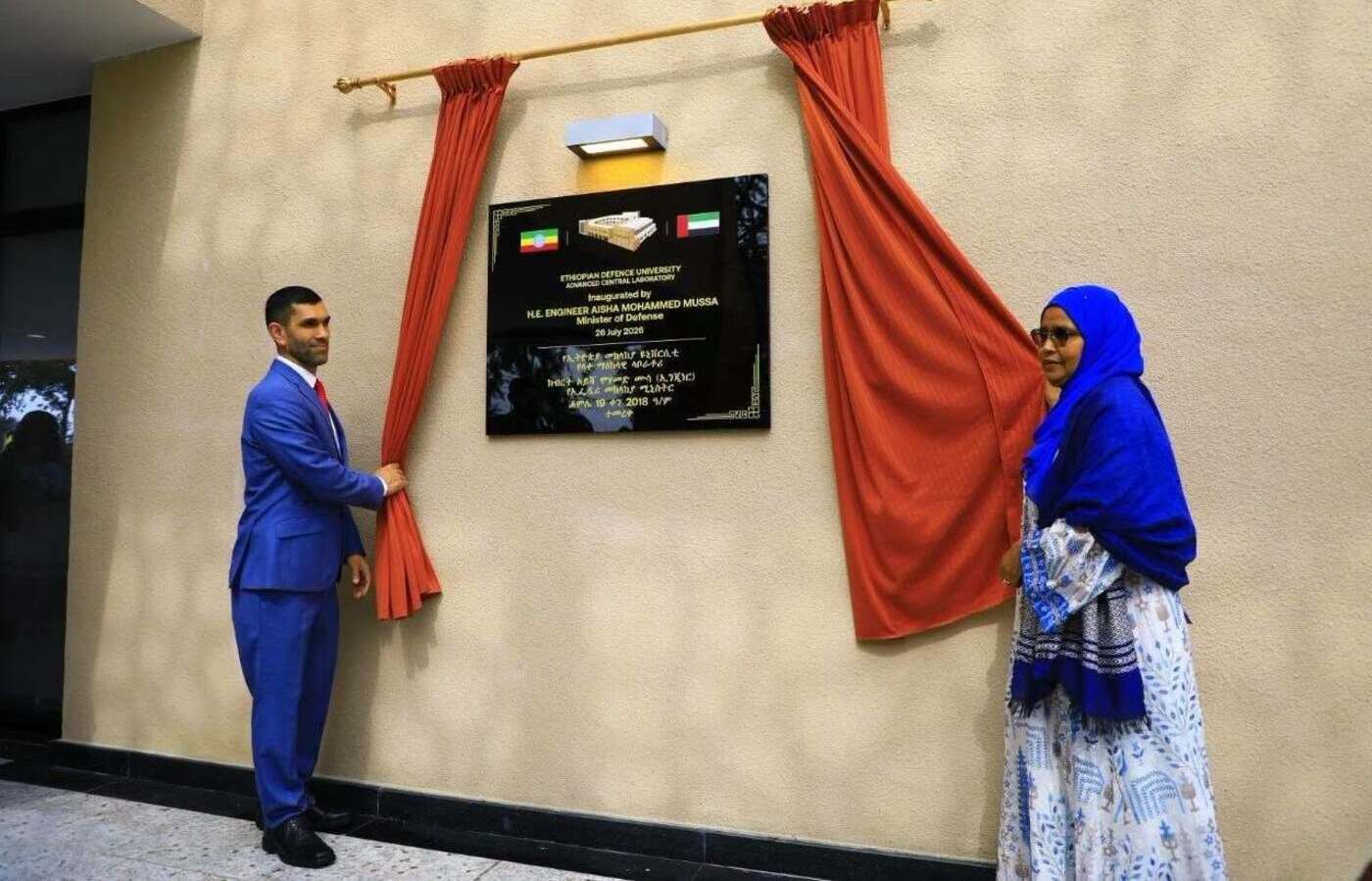
The facility promises locally developed expertise in artificial intelligence, cybersecurity and advanced manufacturing, but its inauguration also draws attention to the expanding security partnership between Ethiopia and an increasingly influential—and controversial—Gulf power.
Ethiopia has inaugurated an advanced defence research laboratory financed with support from the United Arab Emirates, deepening a strategic partnership that now stretches from investment and logistics to military technology and regional security.
The Advanced Central Laboratory, opened at the Ethiopian Defence University on Sunday, occupies a 20,850-square-metre site and contains specialised facilities for artificial intelligence, cybersecurity, communications, automation, electrical power systems, three-dimensional printing, computer numerical control machining and prototype development.
Officials presented the laboratory as part of Ethiopia’s attempt to develop military and industrial technologies domestically, reduce dependence on imported equipment and retain sensitive technical knowledge within the country. The centre also includes nursing simulation and training facilities, giving it applications beyond weapons development.
Solar panels, battery-storage systems and conventional electricity have been integrated to provide more reliable power. Authorities said the renewable-energy system could help meet the university’s electricity needs for up to eight hours a day, protecting research and training from recurring grid interruptions while lowering operating costs.
Defence Minister Aisha Mohammed described the laboratory as the beginning of a new phase in which scientific research would be converted into operational capacity and locally developed solutions.
Colonel Khalid Alzarooni, speaking on behalf of the UAE defence attaché, called the project a milestone in bilateral relations and said it could open the way for deeper cooperation in technological development and innovation.
The university plans to use the facility for professional training, technical mentorship and consultancy services in cybersecurity, logistics engineering and power infrastructure. It is also intended to connect military researchers with universities, government institutions and industry.
Although the project has been presented principally as an educational and scientific facility, its significance extends beyond research.
Ethiopia is seeking greater control over the technologies underpinning modern warfare at a time when drones, cyber operations, electronic surveillance and artificial intelligence are reshaping conflicts across the Horn of Africa.
The country has historically relied on foreign suppliers for aircraft, weapons, spare parts and sophisticated electronic systems. Domestic research and production could reduce foreign-currency expenditure, shorten military supply chains and make Ethiopia less vulnerable to export restrictions or political pressure from weapons-producing countries.
The laboratory is seen as an institutional foundation for self-reliance.
The centre forms part of a wider government campaign to rebuild Ethiopia’s defence-manufacturing capacity.
Prime Minister Abiy Ahmed (PhD) inaugurated SkyWin Aeronautics Industries in March 2025, saying the state-owned company would manufacture unmanned aerial vehicles for civilian and military purposes. The facility was promoted as evidence that Ethiopian engineers could produce technologies that had previously been imported.
In a separate visit to the Homicho Ammunition Engineering Complex that month, Abiy said Ethiopia had secured ammunition export contracts exceeding 30 million US dollars over the preceding three months. The complex manufactures ammunition for assault rifles, machine guns, sniper rifles and artillery systems.
Relations between Ethiopia and the UAE accelerated after Abiy became prime minister in 2018.
That year, Abu Dhabi announced a 3 billion US dollar support package, including a one billion US dollar deposit at the National Bank of Ethiopia intended to ease severe foreign-exchange shortages and an additional two billion US dollars for investment. The intervention gave the new administration immediate financial support during a period of political and economic transition.
The UAE also supported the diplomatic process that produced the 2018 rapprochement between Ethiopia and Eritrea after nearly two decades of hostility. Ethiopian and Eritrean leaders publicly recognised the contribution of the UAE and Saudi Arabia to the peace initiative.
The two countries signed a defence-cooperation memorandum at the Dubai Airshow in November 2019. That framework was expanded during the 2025 Dubai Airshow, where their air forces agreed to closer military and technical cooperation.
Their economic relationship has broadened at the same time. Ethiopia and the UAE signed a series of agreements in 2023 covering agriculture, investment, finance, customs, government modernisation and industry. Their central banks later agreed to a currency-swap arrangement valued at up to three billion UAE dirhams, equivalent at the time to about 817 million US dollars.
For Ethiopia, the UAE offers capital, foreign-exchange support, access to sophisticated logistics businesses and a partner willing to finance projects without the lengthy procedures often associated with Western institutions.
For the UAE, Ethiopia offers a large market, political influence in Addis Ababa—home to the African Union—and a strategic position linking the Gulf, the Red Sea and East Africa.
The relationship is also connected to Ethiopia’s long-standing search for diversified maritime access.
Ethiopia has depended heavily on Djibouti since becoming landlocked following Eritrea’s independence. UAE-owned DP World has developed Berbera Port and an economic zone in Somaliland, presenting the corridor linking Berbera with Ethiopia as an alternative route for Ethiopian trade.
DP World and Ethiopia’s transport ministry signed an agreement in 2021 to explore development of the Ethiopian section of the Berbera corridor, with potential investments of up to one billion US dollars in logistics infrastructure.
The arrangement offers potential benefits to Ethiopia by reducing dependence on a single port and improving competition in transport services.
But it is also geopolitically sensitive. Somalia considers Somaliland part of its sovereign territory and has repeatedly objected to foreign agreements signed directly with authorities in Hargeisa. The UAE’s relations with Somaliland and Ethiopia intersect with one of the Horn’s most contentious sovereignty disputes.
The UAE has emerged as one of Africa’s most active investors, financing ports, renewable energy, mining, agriculture, logistics, telecommunications and real estate.
Its state-owned companies can mobilise capital quickly, and its experience in digital government, aviation, artificial intelligence and logistics gives it technical capabilities that Ethiopia wants to acquire.
The UAE has also supported counterterrorism operations, humanitarian initiatives and diplomatic mediation in parts of the Horn.
Yet its growing influence has generated concerns that commercial projects, port investments and military partnerships are components of a broader strategy to control trade routes and shape political outcomes across the Red Sea basin.
The Gulf state has been accused of supporting armed actors in Libya, Yemen and Sudan, while positioning ports and security partnerships across East Africa. The UAE rejects accusations that it supplies weapons to Sudan’s Rapid Support Forces.
Ethiopia’s security environment remains complicated by the war in Sudan, tensions with Eritrea, instability in Somalia, competition over Red Sea ports and its unresolved dispute with Egypt over the Grand Ethiopian Renaissance Dam.
The UAE maintains relationships with several sides across these disputes, giving it diplomatic reach but also exposing it to accusations that it is pursuing influence through competing political and military partnerships.




