

The National Bank of Ethiopia is developing Sharia-compliant liquidity instruments, including a lender-of-last-resort facility and deposit insurance, as it seeks to strengthen the country’s growing interest-free banking sector.
Firezer Ayalew, director of supervision at the central bank, said the instruments would allow interest-free banks to manage liquidity more effectively and access facilities comparable with those available to conventional banks.
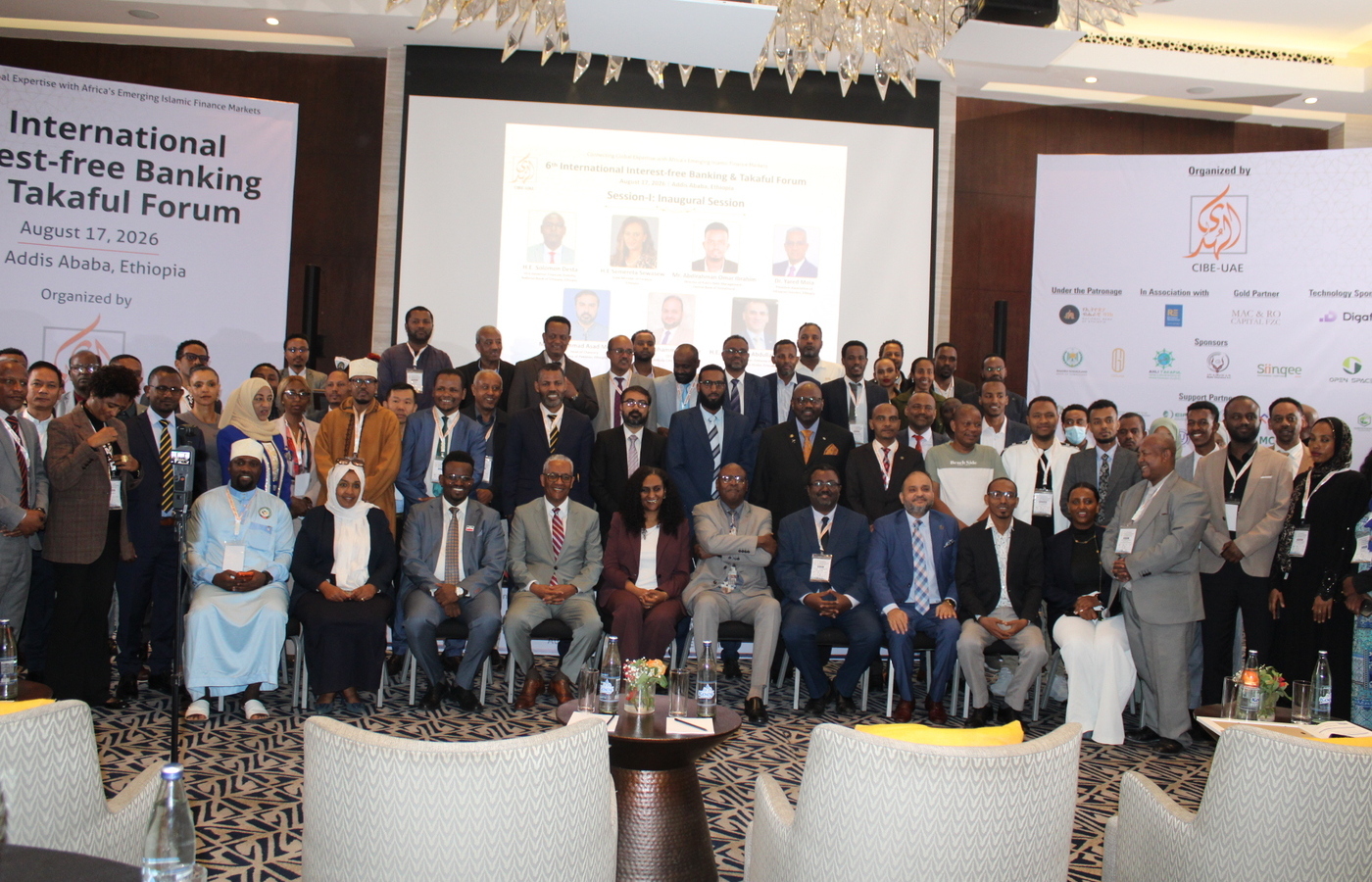
Firezer made the remarks at the sixth International Interest-Free Banking and Takaful Forum, held in Addis Ababa on Monday under the patronage of the National Bank of Ethiopia. The forum brought together regulators, policymakers and industry leaders to discuss the development of interest-free finance in Ethiopia and across Africa.
Among those taking part were Solomon Desta, vice-governor for financial stability at the central bank, Semereta Sewasew, state minister of finance for economic cooperation, and Muhammad Zubair Mughal, chief executive officer and managing director of AlHuda Centre of Islamic Banking and Economics, which organised the forum.
The planned liquidity facilities address one of the constraints facing the sector. Industry analysts have identified liquidity management as a challenge to the development of interest-free banking, particularly because banks have limited mechanisms for transferring excess liquidity between institutions.
Abdella Adem, vice-president of banking and business at ZamZam Bank, said during a panel discussion at the forum that the absence of a framework and instruments for interbank liquidity management was constraining the sector.
“If, for instance, we have excess liquidity, there is no way for us to share it with another bank,” he told participants.
The absence of such mechanisms can leave an interest-free bank with excess liquidity while another institution faces a shortage, without a Sharia-compliant market infrastructure through which the two can transact.
The initiative is part of a wider effort to build the regulatory and institutional infrastructure for interest-free finance, which the central bank wants to develop as a parallel component of the financial system.
“We need to introduce Sharia-compliant liquidity instruments including discount window, lender of last resort facilities, deposit insurance, and the like,” Firezer said at the forum.
The central bank is currently developing the instruments, he said, without providing a timetable for their introduction.
The move comes as interest-free banking has expanded rapidly. Ethiopia has four full-fledged interest-free banks, while 24 conventional banks now offer interest-free services through dedicated windows.
Interest-free banking deposits have reached 567.1 billion birr, equivalent to about 3.2 billion US dollars, with roughly 33 million deposit accounts. Financing extended through the system stood at 237.2 billion birr, or about 1.3 billion US dollars, across 86,000 financing accounts.
Interest-free deposits account for more than 10 percent of total deposits in the financial system, the director said.
Despite the growth, the sector lacks some of the financial infrastructure available to conventional banks, particularly mechanisms for managing liquidity under stress. The proposed facilities are intended to address that gap while maintaining compliance with Sharia principles.
The central bank is also working on a central Sharia advisory board and a wider Sharia governance framework. A customised regulatory framework is being developed for activities that cannot be adequately addressed under conventional banking rules.
These measures form part of the first National Interest-Free Finance Strategy, which remains at draft stage. Firezer said the central bank planned to hold another stakeholder consultation before issuing the strategy for implementation.
The strategy is intended to provide a long-term framework for interest-free finance and coordinate regulators, financial institutions, government agencies, fintech companies and other participants.
The central bank's broader strategy is to develop a dual financial system in which conventional financial institutions have corresponding Sharia-compliant players across the financial industry, including the capital market.
Firezer said interest-free finance could contribute to financial inclusion, resource mobilisation and access to finance, but identified limited public awareness, shortages of specialised human capital, weak Sharia governance and limited product diversification as continuing constraints.
Interest-free banks currently focus heavily on trade-based financing, although the regulatory framework permits trade, leasing, partnership and service-based financing models.
The development of Sharia-compliant liquidity facilities would give the sector another piece of the infrastructure needed to expand beyond its current scale, allowing interest-free banks to manage liquidity in a way that is consistent with the principles governing their operations.




