

Ethiopia’s cheap renewable electricity has attracted a fast-growing crypto-mining industry. But with millions still lacking reliable power, the country is approaching a harder question: where does each additional megawatt create the most economic value?
Ethiopia’s emergence as an African hub for cryptocurrency mining has largely been presented as a story about abundance.
Cheap hydropower, rising generation capacity and the gradual commissioning of the Grand Ethiopian Renaissance Dam created something Ethiopia has historically struggled to monetise: large quantities of renewable electricity capable of generating foreign currency.
Crypto miners appeared to offer an unusually simple customer.
They could locate next to major substations, consume electricity continuously, pay in foreign currency and require far less physical infrastructure than factories or millions of new household connections.
But Ethiopia’s own energy projections reveal the scale to which that experiment could grow, and why electricity allocation may increasingly become an economic-policy question rather than simply an energy one.
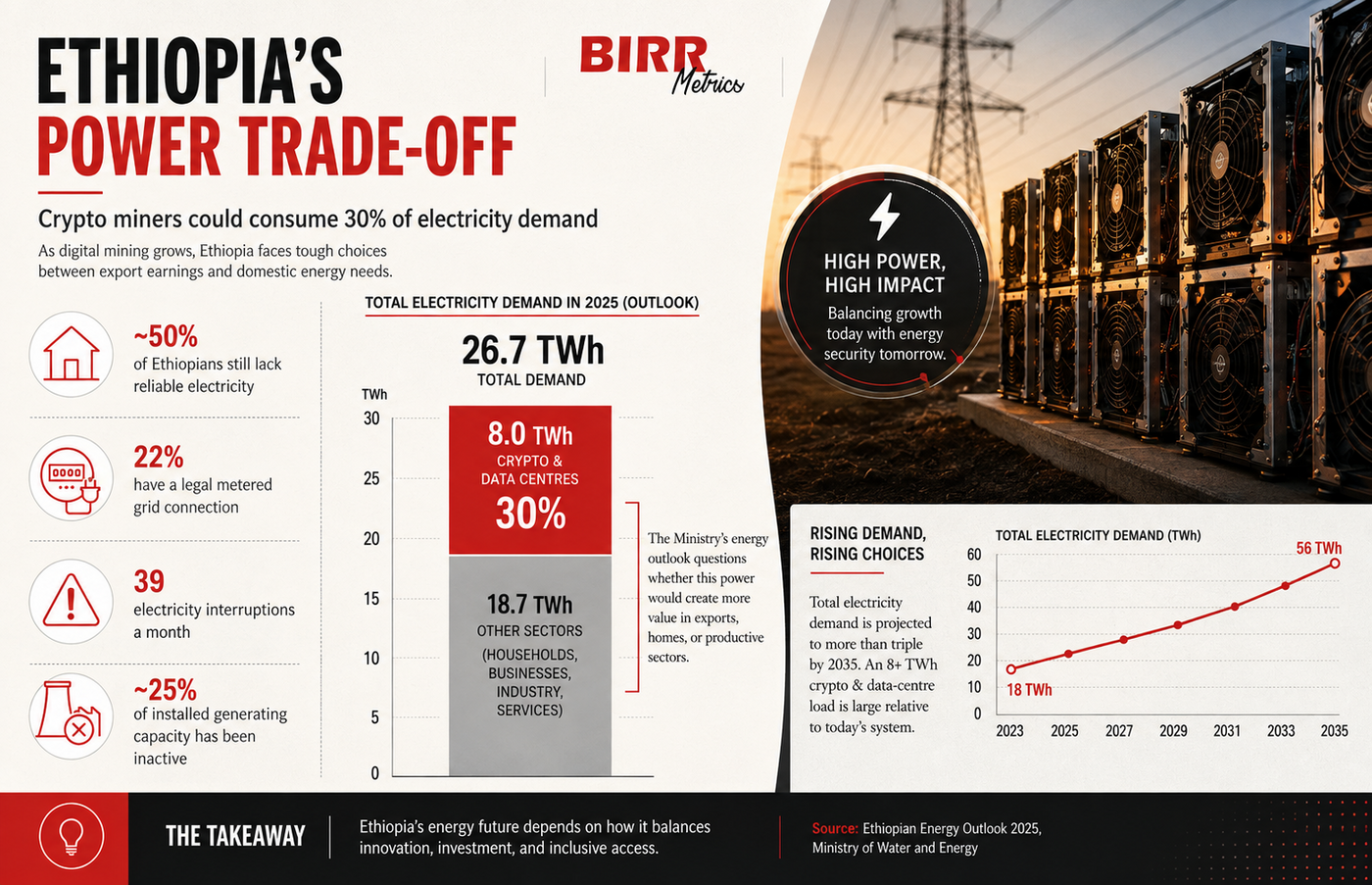
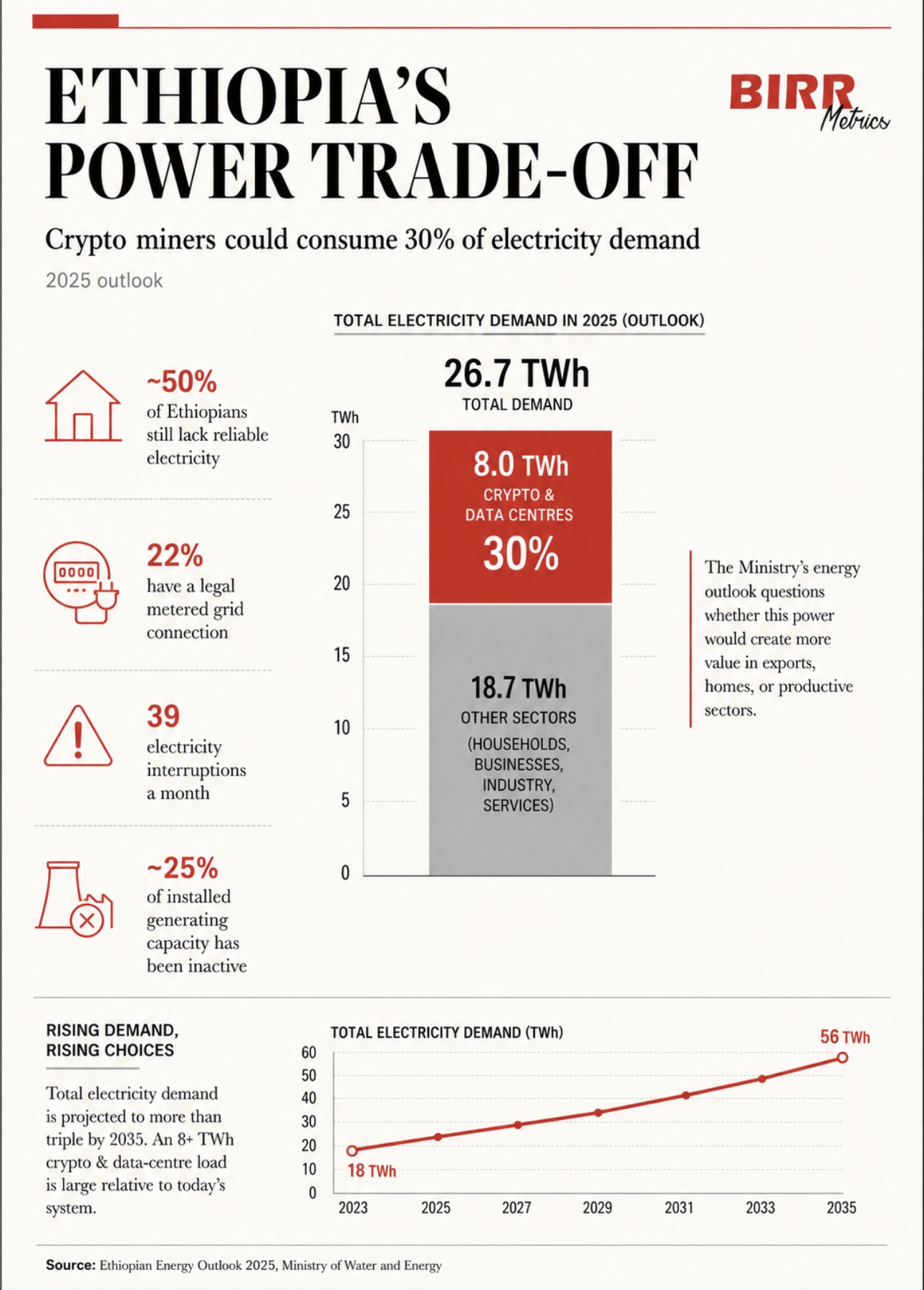
The Ethiopian Energy Outlook 2025 projects that electricity consumed by data centres, principally cryptocurrency mining operations, could exceed 8 terawatt-hours in 2025, equivalent to approximately 30 percent of the country’s total electricity demand.
Put differently, almost one-third of projected demand could come from an industry that barely existed in Ethiopia several years ago.
That is an extraordinary shift.
And it is occurring in a power system where nearly half the population still lacks reliable electricity.
Eight terawatt-hours is not merely a large number in Ethiopia’s electricity system.
For comparison, total national electricity demand stood at about 18 TWh in 2023. The government’s outlook expects that figure to increase to approximately 56 TWh by 2035 as electrification, industrialisation and population growth increase consumption.
Crypto and data-centre demand of more than 8 TWh would therefore be equivalent to almost 45 percent of Ethiopia’s entire 2023 electricity demand.
That scale fundamentally changes the debate.
The relevant question is no longer whether Bitcoin mining can provide Ethiopian Electric Power with an additional source of revenue.
It is whether electricity sold to miners generates greater economic returns than the alternatives competing for the same power.
The government’s own Energy Outlook raises precisely that issue, questioning whether electricity allocated to crypto mining might instead produce greater value through exports, general electrification or productive activities such as agricultural water pumping.
That trade-off is becoming more important because Ethiopia does not yet have an electricity system in which every unit of theoretical generating capacity can easily reach every potential consumer.
Abundant generation does not mean abundant electricity.
Ethiopia possesses enormous renewable-energy resources and has continued adding generation capacity.
Yet generation is only one part of an electricity system.
Transmission lines, substations, distribution networks, maintenance, foreign currency for spare parts and the ability of consumers to pay for connections determine whether that electricity actually reaches households and businesses.
The Energy Outlook estimates that approximately 25 percent of installed electricity-generation capacity has remained inactive, largely because foreign-exchange constraints made it difficult to obtain spare parts required for maintenance.
At the consumer end, the situation is similarly constrained.
Nearly 50 percent of Ethiopians still lack reliable electricity, while only 22 percent of households had legal metered grid connections in 2024.
Even connected businesses frequently do not receive continuous supply. Statistics cited in the Outlook show large users experiencing an average of 39 interruptions per month, amounting to roughly 21 hours without electricity.
This creates an apparent paradox.
Ethiopia can simultaneously have electricity available for large crypto-mining facilities and millions of people without adequate power.
The explanation is largely infrastructure.
A mining facility consuming tens or hundreds of megawatts can be connected directly to high-voltage infrastructure far more easily than hundreds of thousands of dispersed households can be connected through distribution networks.
Selling electricity to one industrial-scale customer can therefore be financially and technically easier than delivering the same amount of electricity to an entire region.
But easier does not necessarily mean economically superior.
Ethiopia increasingly has at least four competing uses for additional electricity.
The first is domestic electrification.
Connecting households improves living standards, enables businesses and expands demand for appliances, communications and digital services. Yet household electricity tariffs have historically been heavily subsidised, meaning the immediate financial return to utilities can be low.
The second is industrialisation.
Manufacturers can transform electricity into goods, employment, tax revenue and exports. Electricity used by a textile factory, cement plant, agro-processing facility or industrial park may therefore generate economic activity well beyond the price paid for the power itself.
The third is electricity exports.
Ethiopia already supplies neighbouring markets including Kenya, Djibouti and others. The Energy Outlook cites Kenya export tariffs of about 6.5 US cents per kilowatt-hour, while describing regional electricity trade as an important source of foreign currency.
The fourth is the rapidly expanding data-centre and crypto-mining industry.
There is another complication.
The electricity prices that initially made Ethiopia particularly attractive to miners are changing.
The government has begun implementing a multi-year tariff reform aimed at moving electricity prices closer to the actual cost of providing power. Nominal tariffs are expected to rise substantially through 2028, with the Energy Outlook describing increases of around 400 percent over the reform period.
The report explicitly acknowledges what that could mean for cryptocurrency operations: higher electricity prices are likely to reduce the incentive for miners to invest in Ethiopia.
The latest corporate developments provide another reason to watch the sector closely.
Nasdaq-listed Bitcoin-mining company Canaan disclosed this month that it had paused its mining operations in Ethiopia, while continuing to classify 4.96 exahashes per second of Ethiopian computing capacity as installed capacity.
Canaan has not publicly linked the pause to Ethiopia’s tariff reforms, and it would be premature to draw that conclusion.
But the development illustrates an important vulnerability in the model.
Crypto miners are unusually mobile.
A factory built around local suppliers and workers cannot easily relocate because electricity becomes slightly more expensive. Thousands of mining machines can.
That means Ethiopia must balance two competing objectives: extracting greater value from its electricity without eliminating the price advantage that attracted mining investment in the first place.
Demand is projected to more than triple from 18 TWh in 2023 to 56 TWh by 2035.




