


The Birr has remained remarkably stable around 160.21 birr per US dollar in the National Bank of Ethiopia’s latest foreign-exchange auctions, but broader market data tell a less comfortable story. Over the latest 90 days, depreciation has accelerated against the dollar, yuan, dirham, riyal and Kenyan shilling, with much of the new pressure emerging in just the past month.
The Ethiopian Birr appeared to have found a floor.
After weakening sharply earlier in August, the National Bank of Ethiopia injected 500 million US dollars into the foreign-exchange market on August 20, followed six days later by another regular auction of 125 million US dollars.
The result was striking.
The August 26 auction cleared at a weighted average of 160.2070 birr per US dollar, almost exactly unchanged from the 160.2144 birr recorded in the extraordinary 500 million US dollars auction six days earlier. It was also nearly one percent stronger than the 161.7994 birr weighted average recorded at the August 12 auction. On the surface, the Birr’s depreciation was slowing. But updated market data through August 28 complicate that conclusion.
A fresh BirrMetrics calculation across seven economically relevant currencies shows that the Birr’s latest 90-day deterioration has accelerated against five of them compared with the preceding 90-day period. Even against the US dollar, where the official auction rate has stabilized, the broader historical market series now shows a 3.60 percent increase over the latest 90 days, compared with 1.98 percent during the preceding 90 days.
That means the latest 90-day depreciation pace against the dollar was roughly 1.8 times the previous period. And the acceleration is considerably stronger against some other currencies.
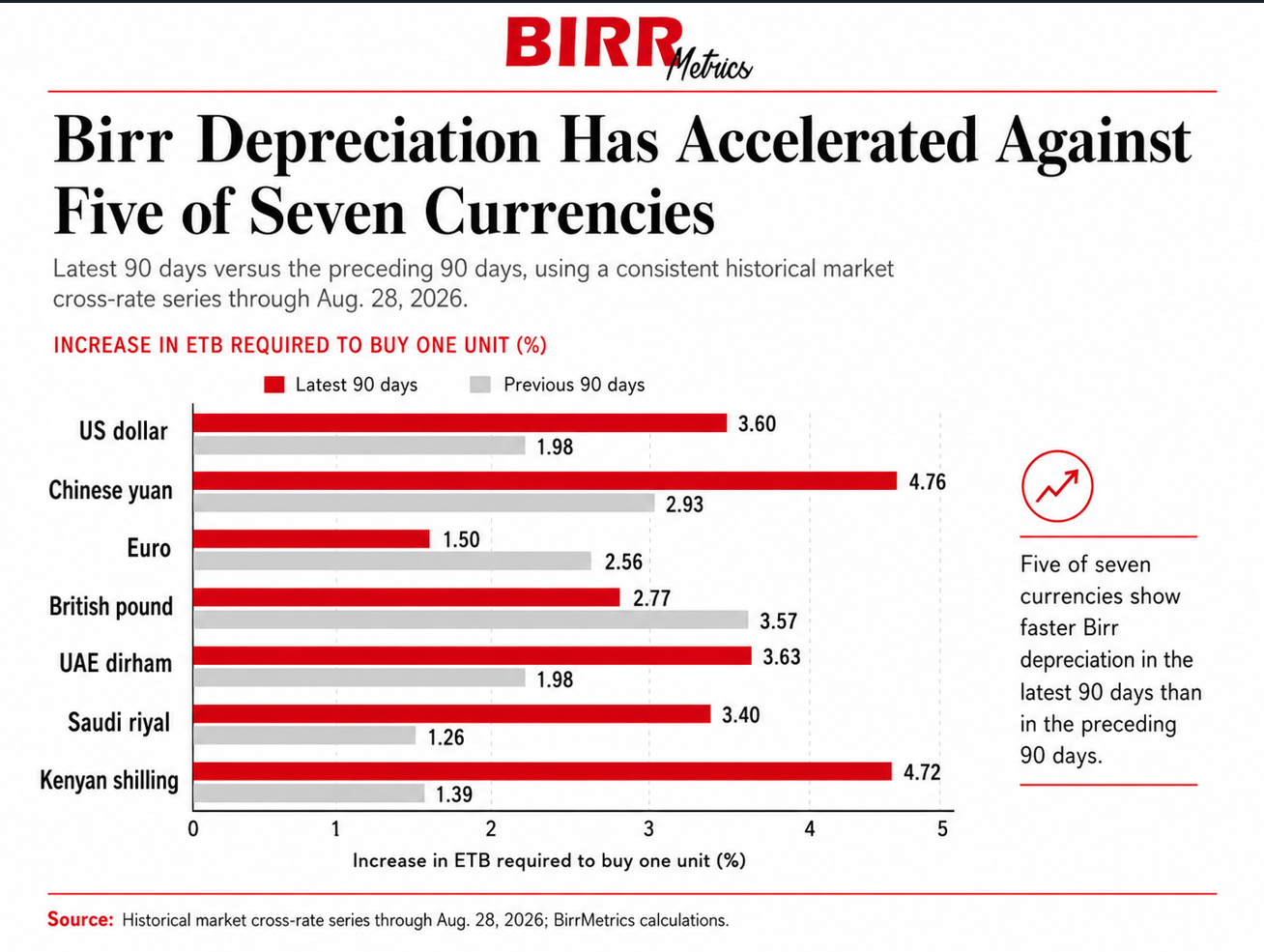
BirrMetrics calculations measure the increase in Birr required to purchase one unit of each foreign currency using a consistent historical market cross-rate series through August 28, 2026. The NBE auction and indicative rates are analysed separately as official-market benchmarks.
What Changed in Just Two Days?
The previous analysis suggested that the Birr’s depreciation against the dollar had almost stalled. The updated data no longer support that conclusion for the broader market. USD/ETB has risen about 2.69 percent over the latest 30-day comparison. That is significant because the entire one-year increase stands at roughly 15.08 percent.
In other words, almost one-fifth of the dollar’s one-year increase against the Birr has occurred within approximately the latest month.
The 90-day picture is equally important. The Birr weakened 1.98 percent against the dollar during the earlier 90-day window. The latest 90-day deterioration is now 3.60 percent. The direction has changed from mild depreciation to a noticeably faster pace.
But there is a complication. That acceleration is not clearly visible in NBE’s official auction results. The central bank’s August 26 regular auction produced one of the clearest signs of official-market stabilization. NBE offered 125 million US dollars and received bids worth 170.51 million US dollars from only five banks. Two banks ultimately received allocations. The marginal and weighted average successful rate was 160.2070 birr per US dollar.
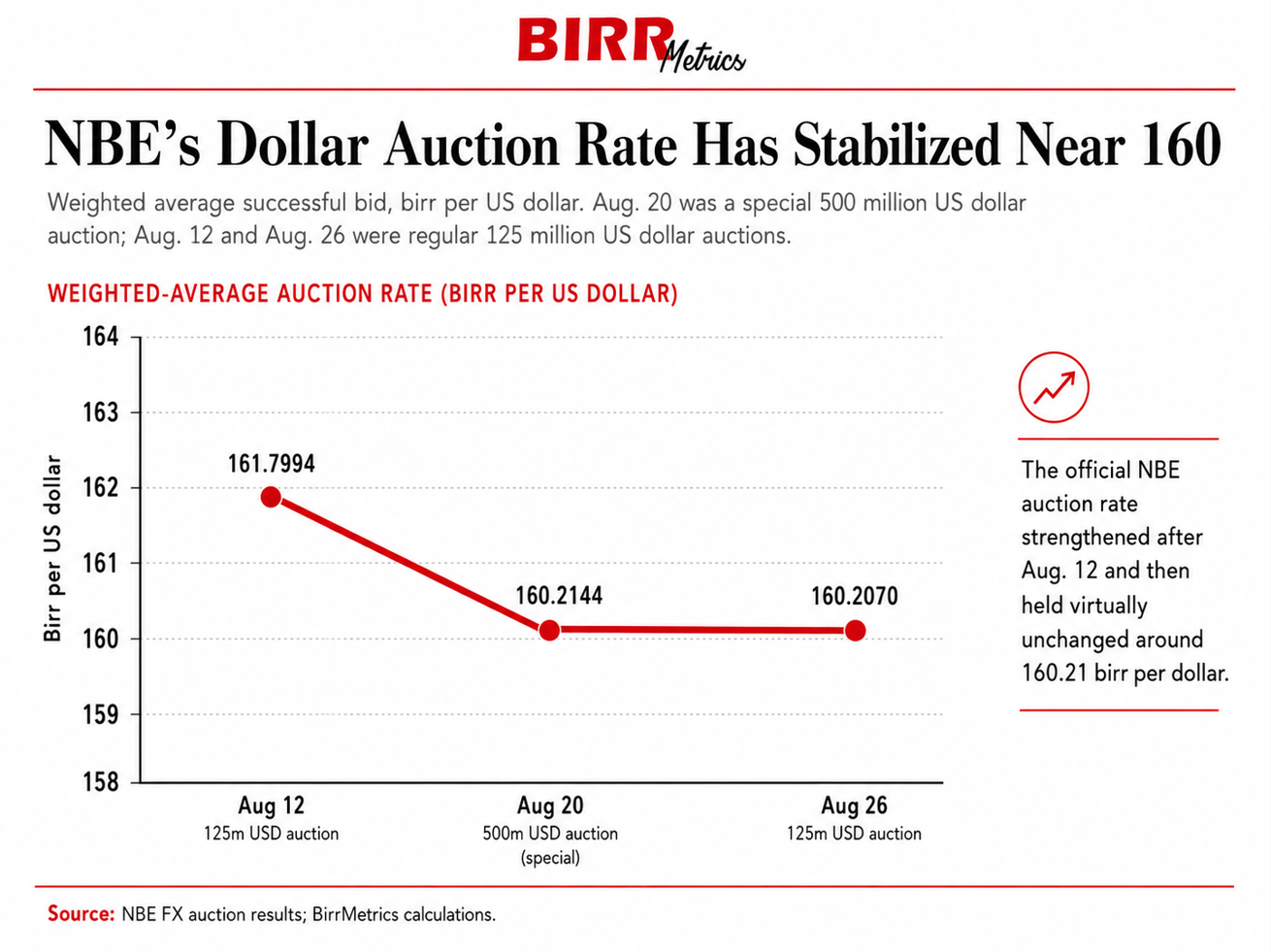
The August 26 result was effectively unchanged from the special auction six days earlier. NBE’s August 28 indicative data reinforce that picture. Its USD reference buying rate stood at 160.2081 birr, with the rate collected directly from the central bank’s API. Officially, the dollar rate looks remarkably stable.
But commercial banks rates tell a somewhat different story. On August 28, several banks were quoting dollar selling rates in the 163 to 165 birr range, compared with the NBE reference rate near 160.21 birr.
For example, Commercial Bank of Ethiopia was quoting around 163.44 birr per dollar on the sell side, Rammis Bank about 163.42 birr, Tsedey Bank about 164.12 birr, Sidama Bank about 164.60 birr, and Wegagen Bank close to 164.96 birr.
This distinction matters. The NBE auction rate reflects where successful central-bank FX allocations clear. Commercial-bank selling rates reflect the price customers may encounter when buying foreign currency from banks. The two measures do not need to be identical. But when the gap widens, an apparently stable official reference rate can coexist with higher effective FX costs elsewhere in the banking system.
There is an even wider gap outside the regulated market. On August 27, exchange.et tracked parallel-market USD selling at around 182.49 birr, although such unregulated rates should be treated separately from official banking-market prices. The emerging picture is not one of uniform exchange-rate stability.
It is one of different prices moving at different speeds in different segments of the market. The Yuan is becoming the more important warning signal. The Chinese yuan provides an even clearer acceleration signal. The Birr has weakened about 4.76 percent against the yuan during the latest 90 days, compared with 2.93 percent during the preceding 90 days.
That represents roughly a 63 percent acceleration in the pace of deterioration. The latest 30-day change alone is 3.49 percent. Over one year, the yuan has risen around 22.12 percent against the Birr, substantially more than the dollar’s 15.08 percent increase. For Ethiopia, that may ultimately be more economically significant than movements against many other currencies.
China remains deeply integrated into Ethiopia’s import structure through machinery, electrical equipment, industrial inputs, vehicles, construction materials and consumer products. The NBE’s indicative CNY rates on August 28 were 23.8377 birr buying and 24.0760 birr selling, while commercial-bank quotes varied substantially around that benchmark.
A weaker Birr against the yuan can raise domestic costs even during periods when USD/ETB appears comparatively stable. The Kenyan shilling remains the most dramatic momentum shift in the group. During the preceding 90-day period, KES/ETB increased only 1.39 percent.
During the latest 90 days, it climbed 4.72 percent. That means the Birr’s depreciation pace against the Kenyan shilling is now around 3.4 times faster than it was during the preceding 90 days. Even more strikingly, KES/ETB has increased around 5.51 percent over the latest 30-day comparison.
For Ethiopian businesses, travellers, regional institutions and students with Kenyan-shilling expenses, that is a materially different exchange-rate environment from the one suggested by the stable NBE dollar auction rate. NBE’s latest indicative Kenyan-shilling quote stood at 1.2367 birr buying and 1.2738 birr selling on August 28.
The Saudi riyal has also accelerated sharply. The Saudi riyal now presents another unusually strong short-term movement. The Birr weakened just 1.26 percent against the riyal during the earlier 90-day period. The latest 90-day increase is 3.40 percent. The latest 30-day movement is even larger at 5.58 percent. That means the 90-day pace has increased by roughly 2.7 times. Given the scale of Ethiopian migration, remittances, travel and commercial links with Saudi Arabia, this is not merely a statistical curiosity.
The euro and British pound remain the two notable exceptions to the acceleration trend. EUR/ETB increased just 1.50 percent during the latest 90 days, down from 2.56 percent during the preceding period. For the pound, the latest 90-day increase was 2.77 percent, compared with 3.57 percent previously. On a 90-day basis, both have slowed. But even this requires qualification.
Over approximately the latest 30 days, the euro has risen 3.67 percent against the Birr and the pound 3.51 percent. So while their 90-day momentum remains weaker than before, both have recently begun climbing again. This illustrates why depreciation cannot be understood by looking at one time window alone.
The updated analysis produces a substantially different conclusion from the earlier snapshot. The Birr is no longer simply “stabilizing.” Nor is it depreciating uniformly. Instead, three developments are occurring simultaneously. First, NBE’s official dollar auction rate has stabilized around 160.21 birr, surviving the return from the extraordinary 500 million US dollars intervention to a much smaller 125 million US dollars regular auction without renewed depreciation.
Second, commercial-bank dollar selling rates remain several Birr above that official benchmark, meaning customer-facing FX prices have not converged completely with the auction rate. Third, broader cross-currency indicators show renewed depreciation momentum, particularly against the yuan, Kenyan shilling and Saudi riyal.
The August 26 auction itself also raises an important question.
Demand fell dramatically from the 710.14 million US dollars submitted during the August 20 special auction to 170.51 million US dollars at the August 26 sale. Bank participation collapsed from 22 institutions in the special auction to just five in the latest auction, with only two receiving allocations.
That could indicate that the extraordinary 500 million US dollars injection relieved some immediate bank demand. But it is too early to conclude that Ethiopia’s underlying FX imbalance has disappeared. The next scheduled auctions on September 9 and September 23 will provide a stronger test. For now, the answer to the original question has changed.
The Birr’s depreciation is accelerating again in parts of the broader market, even while the NBE’s official dollar auction rate remains remarkably stable. The key question is no longer simply whether the Birr is falling. It is whether the central bank’s new stability around 160 birr per dollar can eventually pull the wider market toward it — or whether market prices will continue moving away.




