

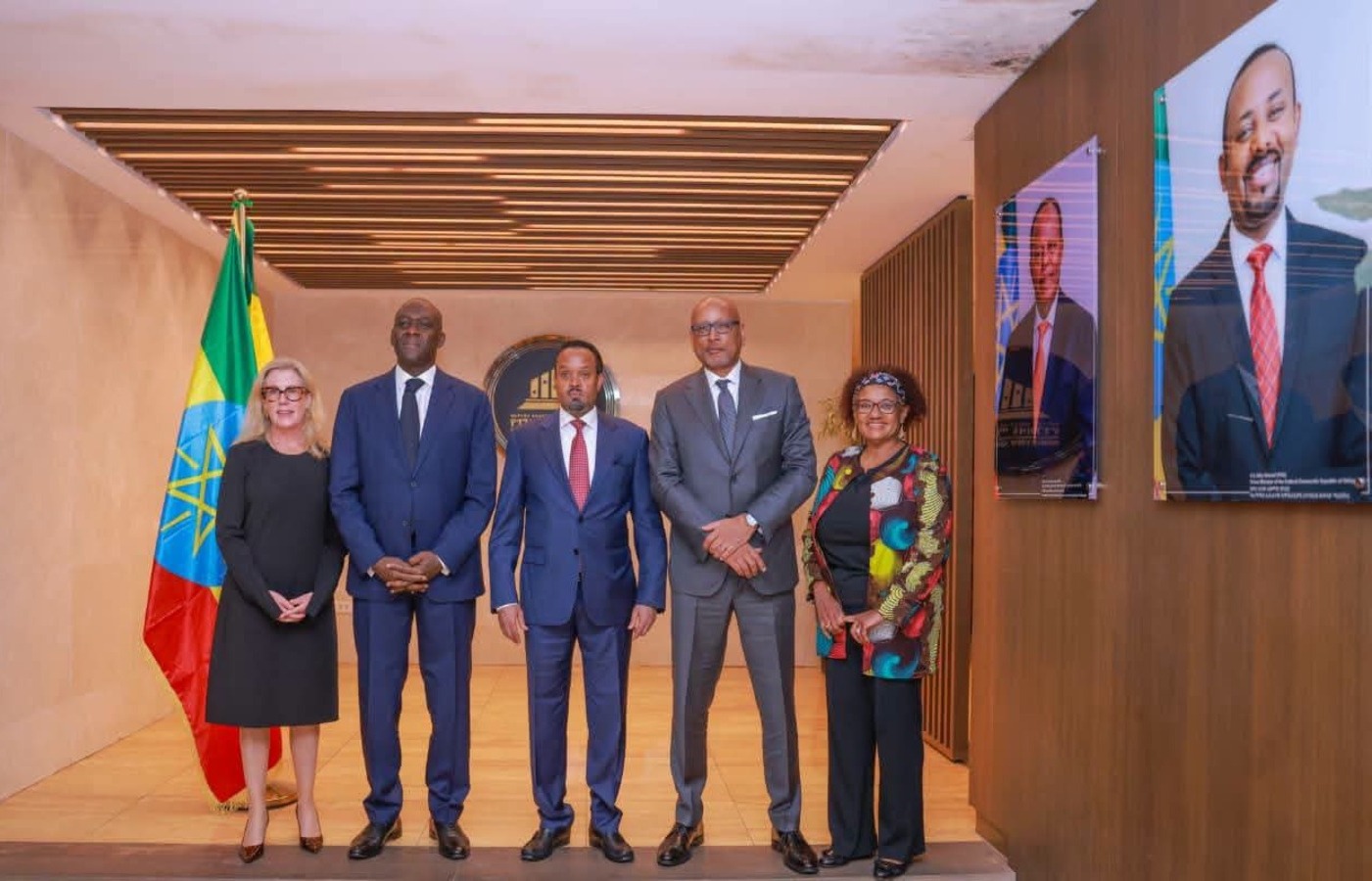
Ethiopia has asked the International Finance Corporation to expand its investment beyond its current 500 million US dollars portfolio, placing the planned Bishoftu International Airport and privately financed power projects at the centre of efforts to attract capital for infrastructure.
Finance Minister Ahmed Shide and IFC Managing Director Makhtar Diop discussed the proposed expansion in Addis Ababa on September 2, according to the Ministry of Finance.
The talks covered direct project investment, public-private partnerships and the mobilisation of private capital for transport, energy and housing. No new financing commitment, target or timetable was announced.
IFC’s portfolio in Ethiopia currently stands at about 500 million US dollars, spread across telecommunications, financial services, agribusiness, manufacturing, healthcare and tourism, the ministry said.
If calculated on a comparable basis, the figure represents a marked expansion from the 320 million US dollars active portfolio reported by the World Bank in July 2025—an increase of about 180 million US dollars, or 56 percent.
The discussions point to a potentially much larger investment pipeline. In July 2024, the World Bank Group said IFC was planning approximately 2.1 billion US dollars in investments in Ethiopia over the following three fiscal years, subject to project and board approvals. At the time, IFC’s portfolio stood at 320 million US dollars.
Among the projects discussed this week was the proposed Bishoftu International Airport, a greenfield aviation hub being developed by Ethiopian Airlines Group about 40 kilometres from Addis Ababa Bole International Airport.
The first phase is estimated to cost approximately 12.5 billion US dollars and is expected to accommodate as many as 60 million passengers annually. Capacity could eventually reach 110 million passengers, four times that of Bole International Airport, according to Ethiopian Airlines.
The scale of the project means Ethiopian Airlines and the government will need financing far beyond the carrier’s own resources. The proposed funding structure is expected to combine Ethiopian Airlines equity with debt from development finance institutions, export credit agencies and commercial lenders.
The African Development Bank has already been mandated to lead efforts to mobilise financing. IFC’s inclusion in the latest discussions suggests the World Bank Group’s private-sector arm could also play a role, either as a direct investor, lender, transaction adviser or mobiliser of third-party capital.
Ahmed also sought IFC support for a programme of independent power producers, or IPPs, as Ethiopia attempts to reduce the state’s dominance of electricity generation and bring private developers into the sector.
Although the country possesses significant hydropower, solar, wind and geothermal potential, private power investment has advanced slowly. Investor concerns have included foreign-exchange availability, payment guarantees, the financial position of state-owned electricity companies and uncertainty over contractual and regulatory arrangements.
The World Bank has been working with the government through its Power Sector Reform, Investment and Modernisation programme, which uses financing and guarantees to support power-sector reform and reduce risks facing private investors.
The proposed programme-based engagement with IFC could allow several power projects to be prepared and financed under a common framework instead of negotiating each development independently. Such an approach could help standardise power-purchase agreements, risk guarantees and competitive procurement procedures.
Ahmed told Diop that reforms introduced since July 2024 had improved Ethiopia’s investment environment and opened new opportunities for private companies.
The reform programme introduced a market-based foreign-exchange regime, eased restrictions on international transactions and established an interest-rate-based monetary policy framework. It has also included changes to taxation, customs, state-owned enterprises, banking regulation and public financial management.
The World Bank said in 2025 that the reforms had narrowed exchange-rate distortions, strengthened exports, improved domestic revenue mobilisation and moderated inflation. However, foreign investors continue to face constraints including regulatory uncertainty, limited access to long-term local-currency finance, infrastructure deficiencies and the cost of imported inputs.
The World Bank Group’s latest country strategy, covering the 2026–2031 fiscal years, puts private-sector-led job creation at the centre of its engagement with Ethiopia. The shift reflects the government’s need to supplement public investment as debt pressures and fiscal constraints limit its ability to finance large projects directly.
IFC’s largest publicly disclosed Ethiopian investment has been its backing of Safaricom Ethiopia. In 2023, it announced a 157.4 million US dollars equity investment in the company’s holding structure and a 100 million US dollars loan to the telecommunications operator.
The transaction was accompanied by one billion US dollars in political-risk guarantees from the World Bank Group’s Multilateral Investment Guarantee Agency. IFC estimated that the wider Safaricom project could generate as much as 8 billion US dollars in investment over a decade.
Diop welcomed the government’s reforms and reaffirmed IFC’s commitment to supporting Ethiopia’s development priorities, according to the ministry.




