

The Ethiopian economy is suffering from a dearth of debt. Despite rapid growth, there is not enough credit to smooth over the business cycle and for firms to access cheap and long term loans. While there is too little debt within the country, its external debt is small and distressed. Growing a domestic savings base within the country is necessary to ease credit shortages. But where can that come from?
Ethiopian Investment Holdings, by its own estimates, is the largest sovereign fund in Africa. The needs of the Ethiopian economy, and the portfolio of the Fund, should be considered as the primary pool to counter the country’s capital shortage. The purpose and function of the Fund, unlike most sovereign wealth fund Ethiopia, is not dependent on oil-exports.
The Ethiopian government needs the revenue from its state-owned companies to address gaps in its budget. But this reliance is already decreasing, as tax reforms are successfully deepening the revenue base. The Fund, in the long run, will need to build up its savings pool to supply the internal debt market.
Unlike most sovereign wealth funds, nearly all of EIH’s assets are held domestically. Ethiopian Investment Holdings approaches its portfolio allocation sectorally rather than asset wise because it manages investments across the transportation, telecommunications, hospitality and others, while the financial instruments are largely similar. Its main pillar is equity in state owned companies and, the loans EIH makes are mostly to its own subsidiaries, such as the Commercial Bank of Ethiopia.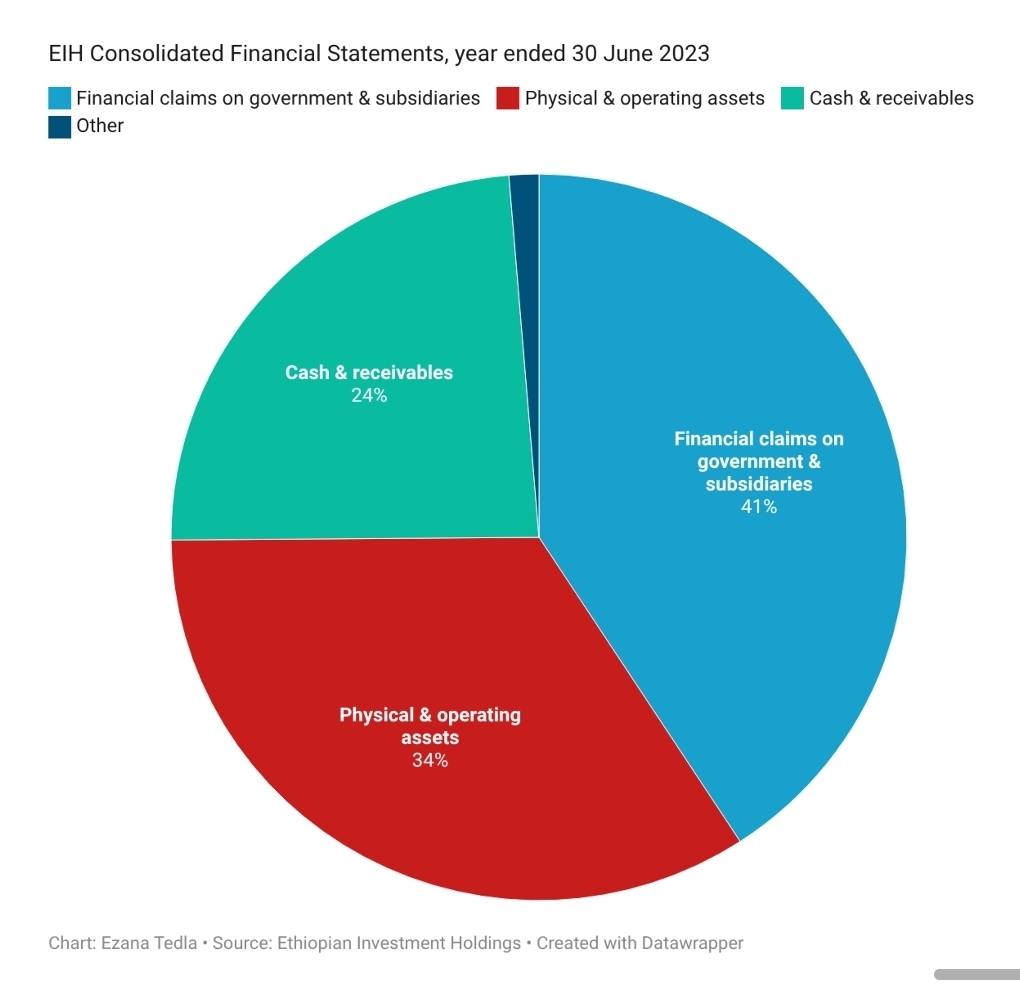
Ethiopian Investment Holdings moves procyclically with the country’s economies because of its asset concentration within the country. This is a result of how the Fund was assembled, it was created by conglomerating dozens of state-owned enterprises under one umbrella, rather than as a result of an export surplus. Tying performance to the Ethiopian economy is benefiting the sovereign fund, as the country approaches double-digit growth year over year. It has contributed to that growth by also being able to use its long-term horizon to spur development, like in industrial production. State-owned enterprises handover their profits to the government as a quasi-dividend. Contributions are carried out differently; some transfer through EIH, while the Commercial Bank of Ethiopia transfers dividends directly to the Ministry of Finance.
As all of these state-owned companies are owned by, and represent most of the asset value of, Ethiopian Investment Holdings, it faces that requirement across its portfolio. But the contribution is uneven. While there are over two dozen state owned enterprises it owns, two companies, Ethiopian Airlines and Ethio Telecom generate the majority of the total Fund’s profits; they also contribute the majority of foreign currency earnings. It is also one of the few firms in the country that possess financial protections. Its subsidiaries, the national airline and shipping company, have hedges against fuel-prices. The Fund’s access to international earnings and balance sheet give it the necessary size to engage in more sophisticated financial engineering ,such as hedging against commodities and foreign exchange that the rest of the country's institutions do not have access to.
The Fund’s largest role is arguably in buttressing the country’s monetary policy. Ethiopian Investment Holdings owns the Commercial Bank of Ethiopia. The bank's largest asset class is government debt securities, much of it bonds the government issued to retire non-performing, previously government-guaranteed loans to state-owned enterprises. Profits from Ethiopia Investment Holdings pays down a portion of the debt.
Financial loops across different ministries and enterprises are typical, and a tighter connection is often necessary in frontier and emerging economies. The connection demonstrates the Fund’s systemic importance in Ethiopia’s financial system, even though it is often excluded from international assessments of Ethiopia’s fiscal strain. It is harder to assess the links because of the different publishing schedules across the Fund, its subsidiaries, and ministries.
If the Fund was not as profitable, its shortfall would undercut the government’s debt management. It is the indirect owner of a large portion of the government’s debt through the Commercial Bank of Ethiopia. It also indirectly pays off the debt by remitting its profits to the Ministry of Finance.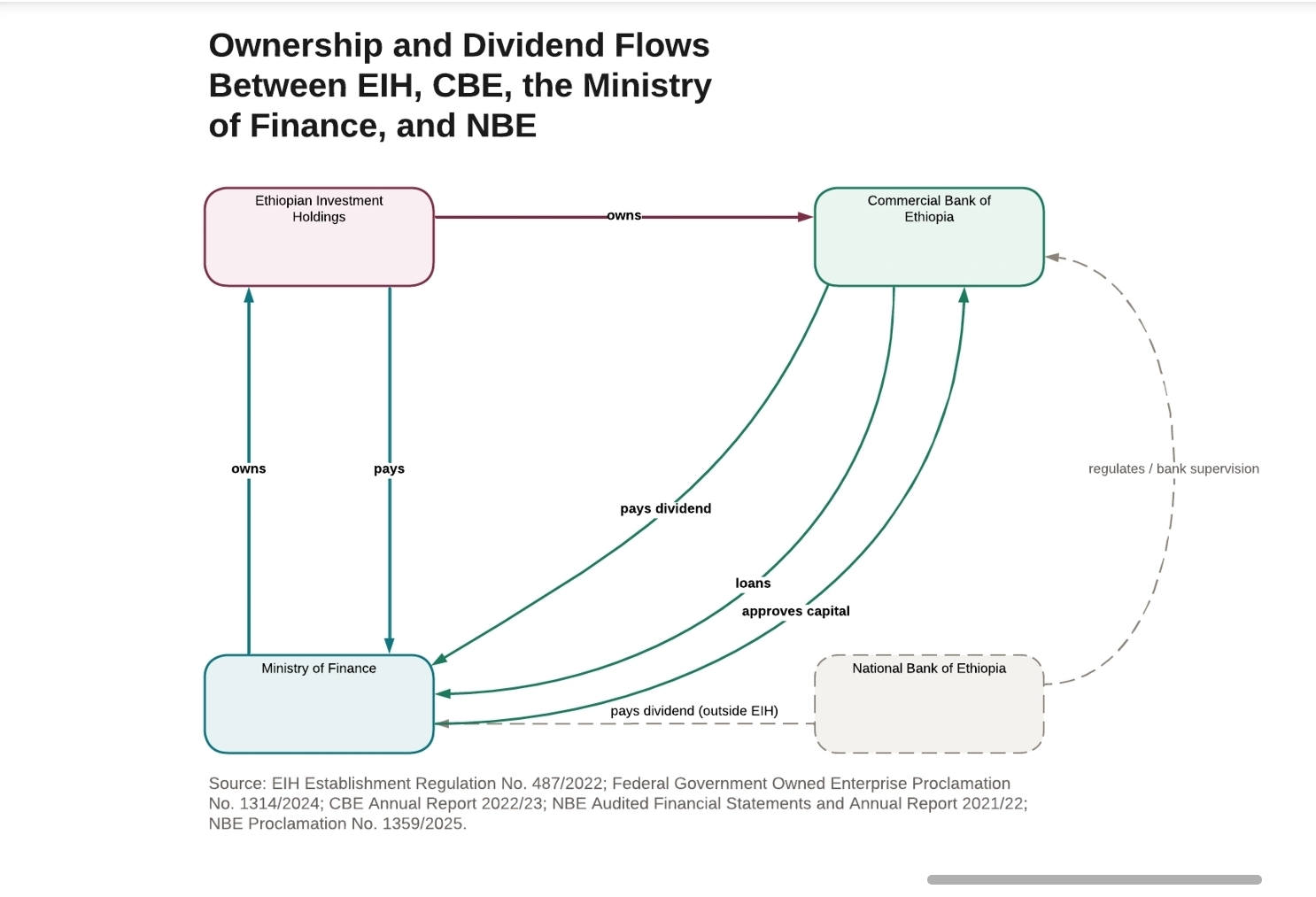
The National Bank of Ethiopia’s contributions to the Ministry of Finance has stopped because of the financial reforms. Other than the sovereign fund, the National Bank of Ethiopia is the other key source of non-tax revenues. Closing the foreign exchange spread between black and official rates has required the central bank to expend significant reserves. The Fund is likely to play a larger role over the next few years, but an excessive burden would undermine its ability to grow its savings pool.
State owned enterprises have been used to channel savings elsewhere. China has successfully grown its state enterprises into a large pools savings base. However, unlike Ethiopia, there is no unified balance sheet across the hundreds of state-owned companies in China. The dividends are also lower allowing the companies to more quickly grow. Continued industrialization in Ethiopia will likely follow this path of state-enterprises leading development because of their size.
The largest difference between Ethiopian and Chinese state owned companies are the trade balances of their respective countries. Because of a persistent trade and fiscal deficit, the relationship between government and sovereign fund is inverted. Ethiopia’s government must take profits from the Fund to pay debt obligations, rather than allocate surpluses to them. The lack of domestic debt forces widescale external borrowing, especially for foreign currency dependent imports. It is not feasible for the Ethiopian government to stop these transfers in the short-term. Fostering savings growth, however, is key or long-term debt stability.
The successful execution of the financial reform is necessary to lessen the transfer burden. Sealing foreign exchange leakages, alleviating balance of payments issues gives both the government and its sovereign wealth fund the necessary breathing space for it to build its savings stock. A deeper savings pool within Ethiopia will help repeating the cycle of sovereign debt distress.
Ezana Tedla is an analyst at the Bourse & Bazaar Foundation. He has a focus on macrofinance and trade across the Middle East and the Horn of Africa. He has degrees in Economics and History from Yale University.




