

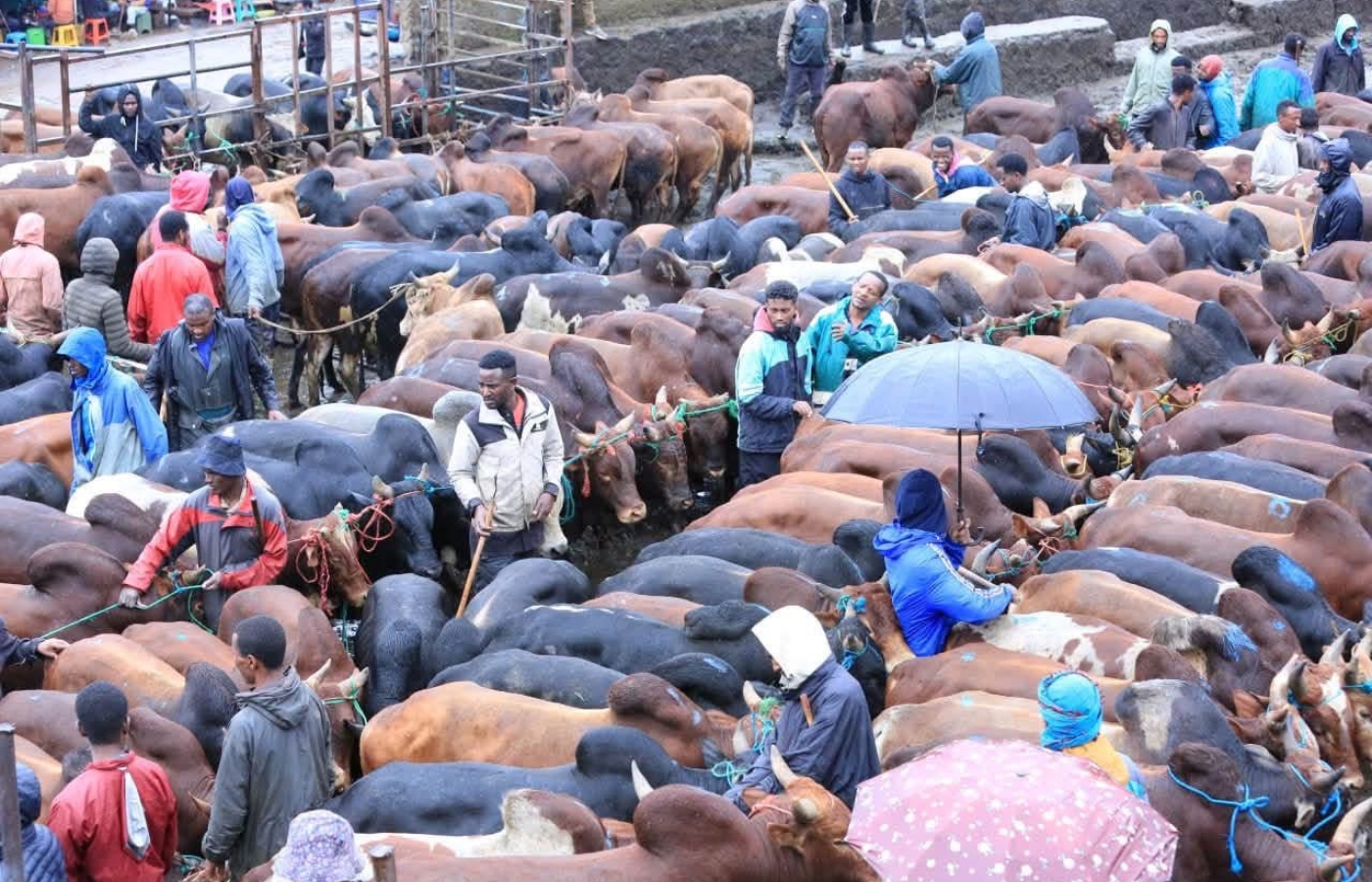
On the eve of Ethiopia’s New Year, the livestock markets are full, the chickens are waiting and the spices needed for the holiday feast remain available. What is increasingly absent is the purchasing power that turns supply into celebration.
For Wossen Desta, a father of three, the arrival of 2019 in the Ethiopian calendar will be marked by what his family must go without.
In previous years, he bought new clothes for his children and a sheep for the family’s New Year meal. This year, the children will not receive new clothes. There will be no sheep, either. Wossen has decided to buy a smaller quantity of meat instead.
“These days, there is hardly any holiday spirit,” he said. “This is not how we used to welcome the New Year.”
His children still associate the holiday with the traditions they have grown up expecting. But Wossen’s salary can no longer stretch far enough to preserve them all.
“There are things my family has come to expect, and I haven’t been able to provide them,” he said. “I used to buy them clothes for the New Year, but now I can’t. Every New Year, we used to buy a sheep, but the price of sheep has soared.”
His predicament captures the defining contradiction of this year’s holiday market: livestock and essential food items are available, but increasingly beyond the reach of the people looking to buy them.
“My salary and the shrinking value of the birr have taken a toll,” Wossen said. “I don’t know what to do. I can’t afford a sheep now, so I have decided to buy meat and serve that to my family instead.”
The same tension is visible among traders. Asefa Belay, a sheep trader, said the market cannot be understood simply by counting the animals brought for sale. The deeper question is how many customers can still afford them.
“When you look at the market as a whole, it has a complicated dynamic,” he said. “Yes, there is supply. But the real problem is price. Prices have risen beyond what consumers can afford. That imbalance has stalled trade.”
Compared with last year, Asefa said, sheep prices have increased sharply. Customers are bargaining longer, searching for smaller animals and scaling back their expectations. Some inspect several sheep before leaving without buying any.
“The weakening purchasing power of money and related pressures point to an economy that is faltering,” he said. “Even so, people are buying as much as their means allow.”
That phrase—“as much as their means allow”—defines the Ethiopian New Year market of 2019. The holiday has not disappeared, but it is being resized around household income.
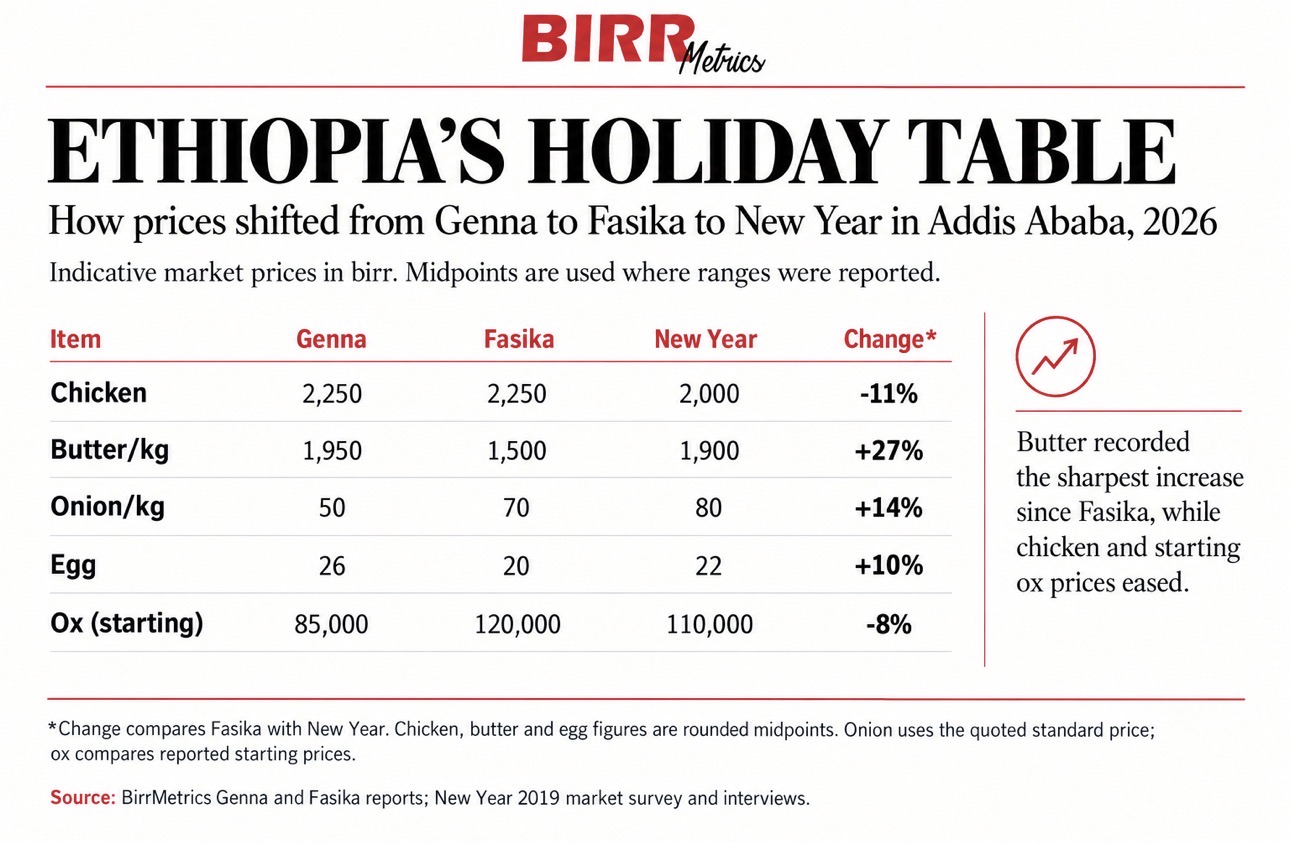
BirrMetrics’ previous holiday reporting documented the gradual emergence of the same coping mechanisms. Families bought smaller animals, increased the number of participants in shared-meat arrangements, substituted a few kilograms of meat for an entire sheep and reduced spending on clothing and other holiday items.
What once appeared to be temporary belt-tightening is increasingly becoming a new holiday routine.
The pressure is not confined to Addis Ababa.
In Shashemene, Yodit Alemu encountered a market in which most of the ingredients required for the New Year meal were available, with relatively limited increases in some staples since Easter. But the prices of animals and animal products still placed a heavy burden on household budgets.
Chickens were selling for between 1,500 and 3,000 birr, depending on their size. The largest birds had risen from around 2,000 birr during Easter to as much as 3,000 birr ahead of the New Year, according to Yodit.
Sheep ranged from about 10,000 to 20,000 birr. A good sheep that sold for no more than approximately 15,000 birr during the previous holiday period could now cost closer to 20,000 birr—an increase significant enough to force some households to reconsider whether to buy one.
“Sheep, chicken and oxen have become like fire,” Yodit said, using a common expression for prices that have become painfully high. “But, praise be, they can still be found according to one’s means.”
Cattle prices in Shashemene varied widely. Cows were selling for between 50,000 and 70,000 birr, while fattened bulls ranged from approximately 100,000 to 200,000 birr.
Yodit recalled that a cow purchased for a shared-meat arrangement during Easter had cost about 40,000 birr. Current prices suggest that even kurt—the practice of several households jointly purchasing and dividing an animal—is becoming more expensive.
Elsewhere, cattle traders reported an even broader price range. Small cattle known as wefen could be found from around 80,000 birr, although animals generally considered suitable oxen started closer to 110,000 birr. The largest could command between 350,000 and 360,000 birr.
Oxen brought from Harar and Gondar were priced according to size and condition, with the generally larger Gondar cattle averaging between 260,000 and 270,000 birr.
Unlike sheep, however, cattle prices in some markets had declined compared with Easter. Traders attributed the difference largely to the seasonal character of demand. The tradition of slaughtering oxen and dividing the meat among several households is generally stronger during Easter and Christmas. For the New Year, demand tends to shift towards sheep and goats.
Transport costs were also reported to have been manageable this year, while traders said they had experienced no major supply disruptions. Those conditions helped keep cattle prices below their Easter peaks.
But lower cattle prices relative to Easter do not necessarily indicate stronger household purchasing power. Even at the bottom of the quoted range, buying an ox remains impossible for most individual families and increasingly difficult for groups sharing the cost.
The Shashemene food market presented a more mixed picture.
Onions were selling for between 110 and 120 birr a kilogram, about 10 birr more than during Easter. Berbere, the spice mixture central to many holiday dishes, was priced at between 950 and 1,000 birr a kilogram. Cottage cheese was around 500 birr a kilogram, while eggs remained stable at about 25 birr each.
Teff prices were also described as broadly stable, with only limited movement since Easter.
Butter, however, stood out. Yodit found it selling for around 1,800 birr a kilogram, with a quarter kilogram costing approximately 500 birr. Although she could not provide a reliable comparison with the previous holiday, the current price surprised her and illustrated how quickly an essential ingredient can strain a family’s budget.
“No, I haven’t even bought butter myself,” she said after being asked which item had registered the most alarming increase.
Taken individually, a 10-birr increase in onions or a stable egg price may appear manageable. But households do not buy holiday goods individually. They must assemble an entire meal, often while also paying for clothing, transport, beverages and family gatherings.
A family purchasing even a lower-priced sheep in Shashemene could spend 10,000 birr before buying a single onion, egg or measure of spice. Add butter, chicken and the other ingredients required for several holiday dishes, and the cost quickly exceeds what many salaried workers can absorb from one month’s income.
Kassahun Gizachew, a father of two whom BirrMetrics interviewed during Christmas last Ethiopian year, is among the households that have managed to preserve the tradition of buying a sheep.
This year, he paid 18,000 birr for one.
Kassahun said his other holiday expenses remained within the range he had anticipated. He did not encounter the exaggerated additional costs he had feared and described the overall market as broadly consistent with his expectations.
His experience provides a counterpoint to Wossen’s. Not every household has been priced out of the livestock market. Some saved in advance, adjusted the size of the animal they planned to buy or reduced expenditure elsewhere.
Yet an 18,000-birr sheep can hardly be considered a modest purchase for a family dependent on a fixed salary. For many households, the ability to buy one now depends on sacrifices made in other parts of the family budget.
The divide between Kassahun, who could still buy a sheep, and Wossen, who chose a few kilograms of meat, illustrates how inflation is reshaping the meaning of an ordinary holiday.
The market’s weakness is also painful for sellers. High prices do not necessarily translate into large profits. Traders must pay more to acquire animals, transport them, feed them and keep them in urban markets until they are sold.
If customers cannot absorb those costs, traders become trapped. They cannot cut prices deeply without losing money, but they cannot make sales if they hold firm. Buyers and sellers can spend hours negotiating across a gap neither side created and neither can close.
This is why a holiday market can appear crowded while trade remains slow. Foot traffic is not the same as effective demand. A customer may inspect 10 animals, bargain over several of them and still leave empty-handed.
The livestock may be abundant, but affordable livestock is scarce.
Across Addis Ababa and Shashemene, the evidence points to a market divided into two realities. Supply conditions are relatively stable, transport has not caused serious disruption and most goods can be found. At the household level, however, the erosion of purchasing power has made that apparent stability feel almost meaningless.
Consumers are responding through substitution. A sheep becomes several kilograms of meat. An ox is divided among more families. A whole chicken becomes an optional purchase. New clothes are postponed. Butter is bought by the quarter kilogram. The number of holiday dishes is reduced.
These decisions rarely appear in official economic statistics. But together they reveal how rising prices change daily life long before a family stops celebrating altogether.
Wossen’s family will still welcome the New Year. There will be a meal, and the family will be together. But some of the traditions his children once regarded as automatic will be missing.
“When all is said and done,” he said, “the most important thing is peace.”
It is a statement of resilience, but also of resignation. Ethiopians will welcome 2019 as they have welcomed every year—with hope, faith and a determination to celebrate.
For a growing number of families, however, keeping the spirit of the holiday now depends on accepting how much of its substance they can no longer afford.
For continuous coverage of Ethiopian commodity markets, consumer inflation metrics, and macroeconomic policy, visit BirrMetrics and track official market data via the Ministry of Trade and Regional Integration.
Contributed by Amanuel Kindeya, Daniel Aweke and Yared Seyoum




