

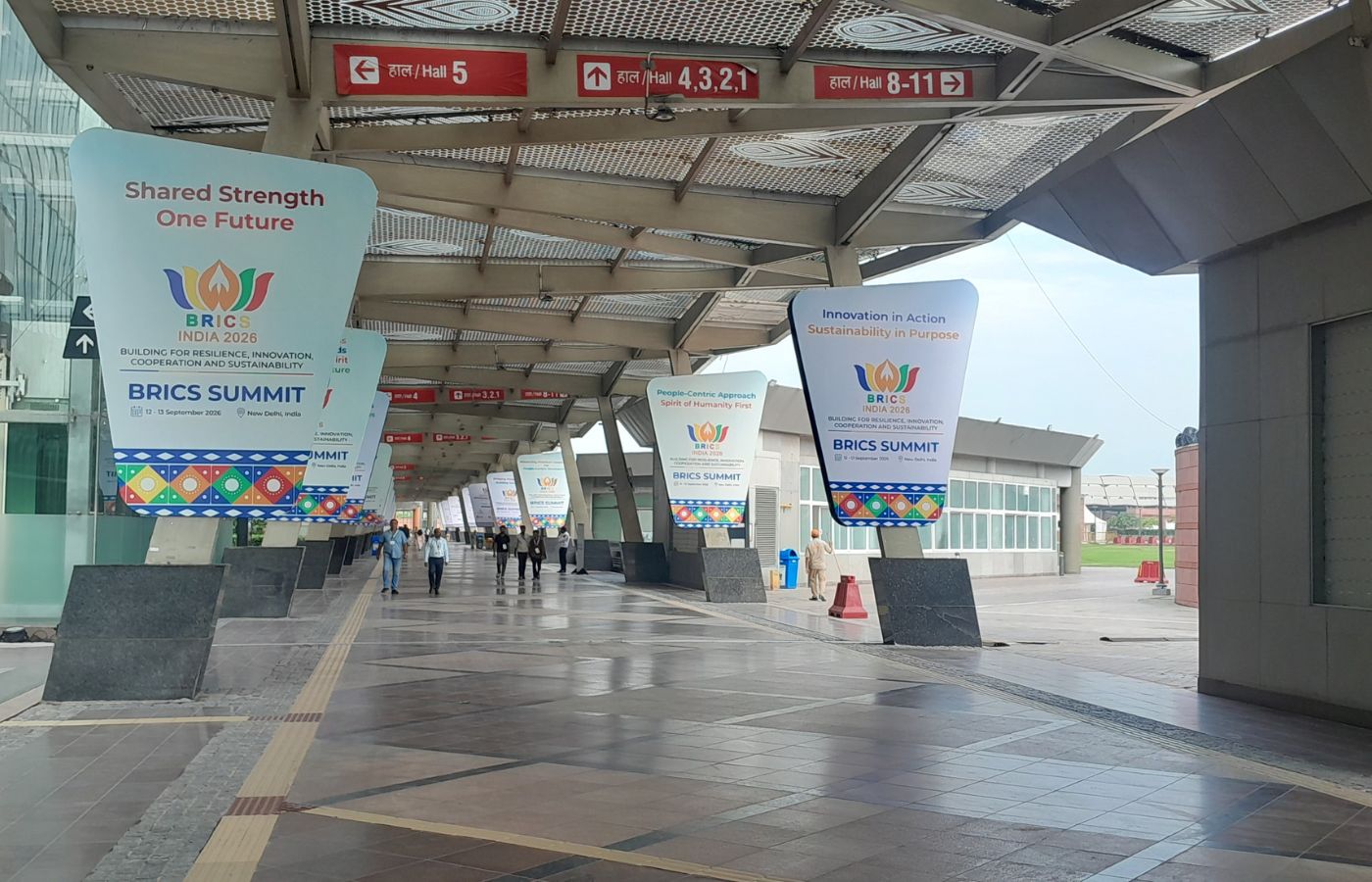
BRICS leaders gathered in New Delhi on Saturday as the grouping marked two decades since its launch in 2006, with its members facing the difficult task of finding common ground on trade, finance and a turbulent geopolitical landscape.
The heads of state and government arrived at Bharat Mandapam as rain cooled Delhi after several days of hot weather, offering a subdued setting for a summit confronting a long list of contentious issues.
The summit, closed to private media, began on Saturday afternoon, with Chinese President Xi Jinping’s arrival in New Delhi drawing particular attention. It was Xi’s first visit to India in seven years, and he held talks with Prime Minister Narendra Modi on the sidelines of the summit, where the two leaders discussed improving bilateral ties, expanding business and trade links and maintaining peace along their disputed border.
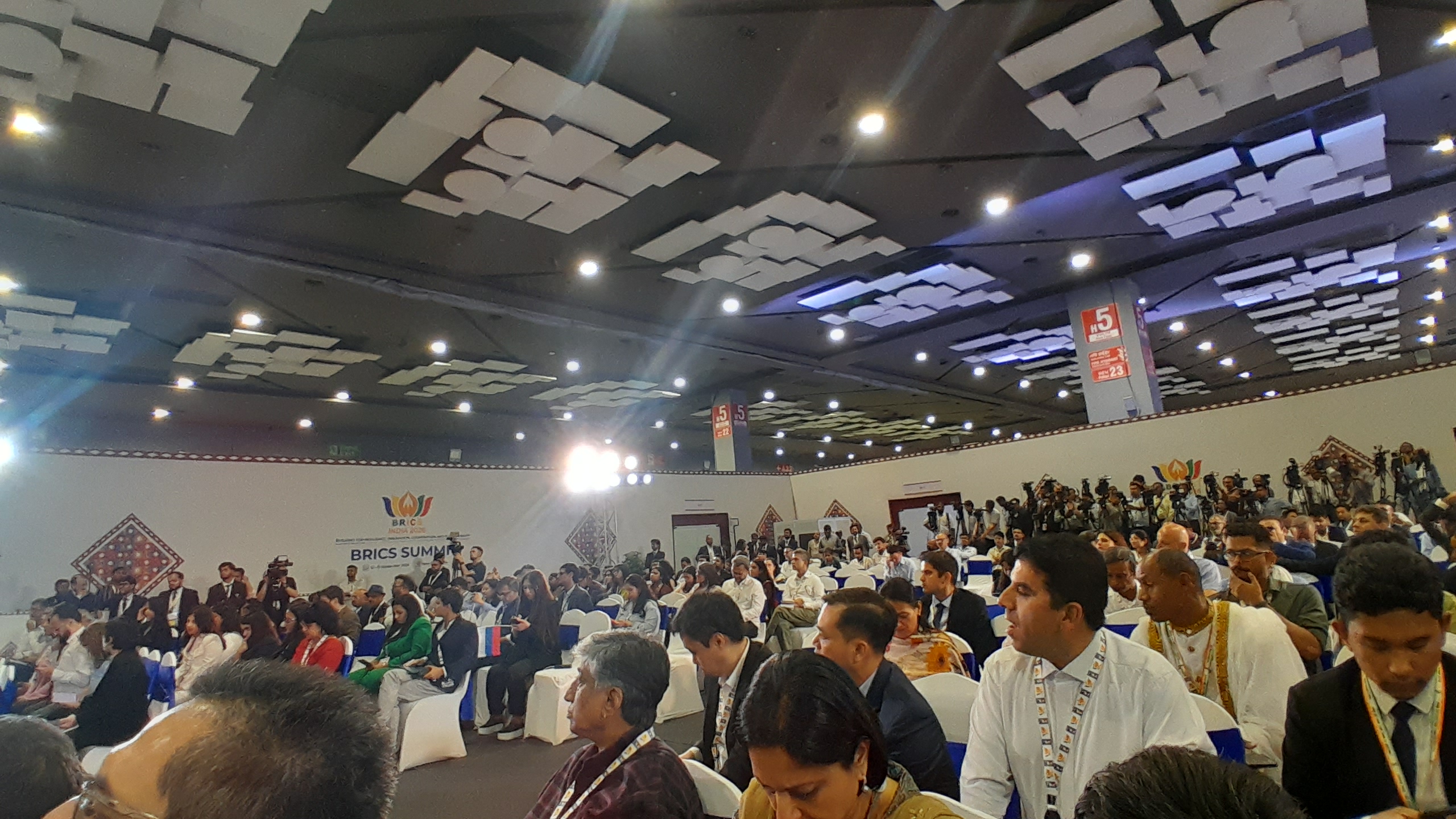
For private-media journalists who had travelled to New Delhi to cover the summit, access to the main proceedings was limited. Much of the day passed without direct access to the leaders’ discussions, with journalists relying on official briefings and statements for details of what was taking place inside. What was clear from those statements, however, was the scale of the agenda confronting a grouping that has changed considerably since its creation.
What began in 2006 as a four-country grouping of Brazil, Russia, India and China has since expanded to include South Africa and, more recently, Egypt, Ethiopia, Iran, the United Arab Emirates and Indonesia. Its growth has given BRICS greater economic and demographic weight, while also bringing together countries with sharply different interests and alliances.
That expansion has also widened the range of issues the grouping is seeking to influence, from global trade and financial governance to geopolitics. One of the more concrete positions to emerge from Saturday’s declaration concerned the future of the World Trade Organization’s dispute-settlement system.
BRICS leaders called for new members to be appointed to the WTO’s Appellate Body, seeking to revive the appeals stage of a dispute-settlement system that has been unable to function fully for years.
In the New Delhi Declaration adopted on Saturday, the leaders called for the "immediate restoration" of an accessible, effective and fully functioning two-tier binding WTO dispute-settlement mechanism and urged the appointment of new Appellate Body members without further delay. The 45-page declaration contains 140 points covering trade, finance, development, global governance, security and other areas.
The Appellate Body is not a new institution that BRICS is proposing to create. Established in 1995 under the WTO’s Dispute Settlement Understanding, it is a standing body that was designed to hear appeals against rulings issued by WTO dispute panels. It normally consists of seven members, with three sitting on each appeal, and can uphold, modify or reverse a panel’s legal findings. Appeals are limited to questions of law and legal interpretation rather than a re-examination of the facts of a case.
That system has effectively been frozen at the appellate level. The terms of successive members expired without replacements being appointed, and the term of the last sitting member expired on November 30, 2020. With no members currently serving, the Appellate Body cannot review appeals.
The distinction matters because the WTO’s dispute-settlement system itself has not disappeared. Panels can still examine disputes and issue rulings, but the appeal stage is unavailable. Under the WTO rules, either party to a dispute can appeal a panel ruling on legal grounds, meaning the absence of an operational Appellate Body leaves an important part of the system unfinished.
BRICS’ demand therefore goes beyond a general call for WTO reform. It seeks to restore a mechanism intended to give members a final, rules-based avenue for challenging the legal findings of trade panels.
The position comes as the grouping seeks to push for changes to institutions that shape global trade and economic governance. The declaration reaffirmed support for an open, transparent, equitable and rules-based multilateral trading system, with the WTO at its core.
The leaders also stressed the importance of preserving special and differential treatment for developing countries, particularly least-developed countries, as part of any WTO reform process.
The same argument for a greater role for developing economies runs through the declaration’s treatment of the global financial system. BRICS reaffirmed its call for reform of the International Monetary Fund’s quota and governance structure, arguing that voting power should better reflect countries’ positions in the global economy.
The leaders urged the implementation without further delay of quota increases agreed under the IMF’s 16th General Review of Quotas and called for meaningful quota realignment under the 17th review. They said any new quota formula should increase the shares of emerging markets and developing economies without reducing the shares of other developing countries, while protecting the quota positions of the poorest members.
BRICS also said voluntary financial contributions should not influence quota allocation, representation in the Fund’s governance or voting power.
“We also believe that any voluntary financial contributions should not influence quota allocation, governance representation and voting power,” the declaration reads. The bloc said it was ready to engage with other IMF members to secure meaningful quota and governance reforms under the 17th review.
The declaration extends the same demand for greater representation to the World Bank. BRICS described the institution’s 2025 Shareholding Review as an important opportunity to strengthen its legitimacy and called for a realignment of shareholding to correct what it described as the historic underrepresentation of developing countries.
For Ethiopia, the declaration carries a more direct significance. BRICS explicitly backed Ethiopia and Iran’s bids to join the WTO in its latest declaration, placing the two accession efforts within the bloc’s wider call for a stronger multilateral trading system.
The endorsement comes as Ethiopia’s long-running accession bid has entered a more active phase after years of limited progress. The country’s Working Party, established in 2003, held its seventh meeting in April, when WTO members reviewed reforms undertaken by Addis Ababa and further work on the draft accession report. The WTO said the negotiations had reached a "decisive juncture".
Ethiopia has also made progress on the bilateral side of the negotiations. At the April meeting, the government said it had concluded nine bilateral market-access agreements and made substantial progress with five other members. It had submitted more than 400 pieces of legislation to WTO members as part of the accession process.
One of those bilateral negotiations was concluded with India in May. The two countries signed a bilateral accession protocol in Geneva on May 22, covering mutually agreed market-access commitments in goods and services. The agreement formally concluded their bilateral negotiations within Ethiopia’s WTO accession process.
The progress has not yet completed Ethiopia’s accession. The WTO has called on Addis Ababa and members to intensify negotiations on outstanding bilateral market-access issues while work continues on the multilateral elements of the accession package.
The government has nevertheless maintained its ambition to complete the accession process in 2026. For Addis Ababa, WTO membership is part of a wider economic reform programme aimed at opening the economy, strengthening trade institutions and improving access to international markets.
The declaration also acknowledged China’s expansion of zero-tariff treatment to 53 African countries with which it has diplomatic relations, adding a trade dimension to BRICS’ wider push for stronger economic links between developing economies.
The pressure on the group is mounting. Wars in Ukraine and the Middle East, US-China rivalry, trade disputes and uncertainty over the future of the global trading and financial system are forcing its members to navigate conflicts that cut across their own interests.
India’s Prime Minister Narendra Modi used his opening address to frame those tensions as part of a wider problem with the international system, comparing global governance to a pyramid in which power and decision-making are concentrated at the top while countries affected by those decisions have limited influence over them.
He called for the pyramid to be replaced by what he described as a "platform of partnership" and proposed that BRICS develop 10 proposals for reforming global governance into a "BRICS Reform Roadmap" by the next summit.
For continuous coverage of global trade developments, BRICS economic policy, and emerging market analysis, visit BirrMetrics and track official updates through the World Trade Organization.




