

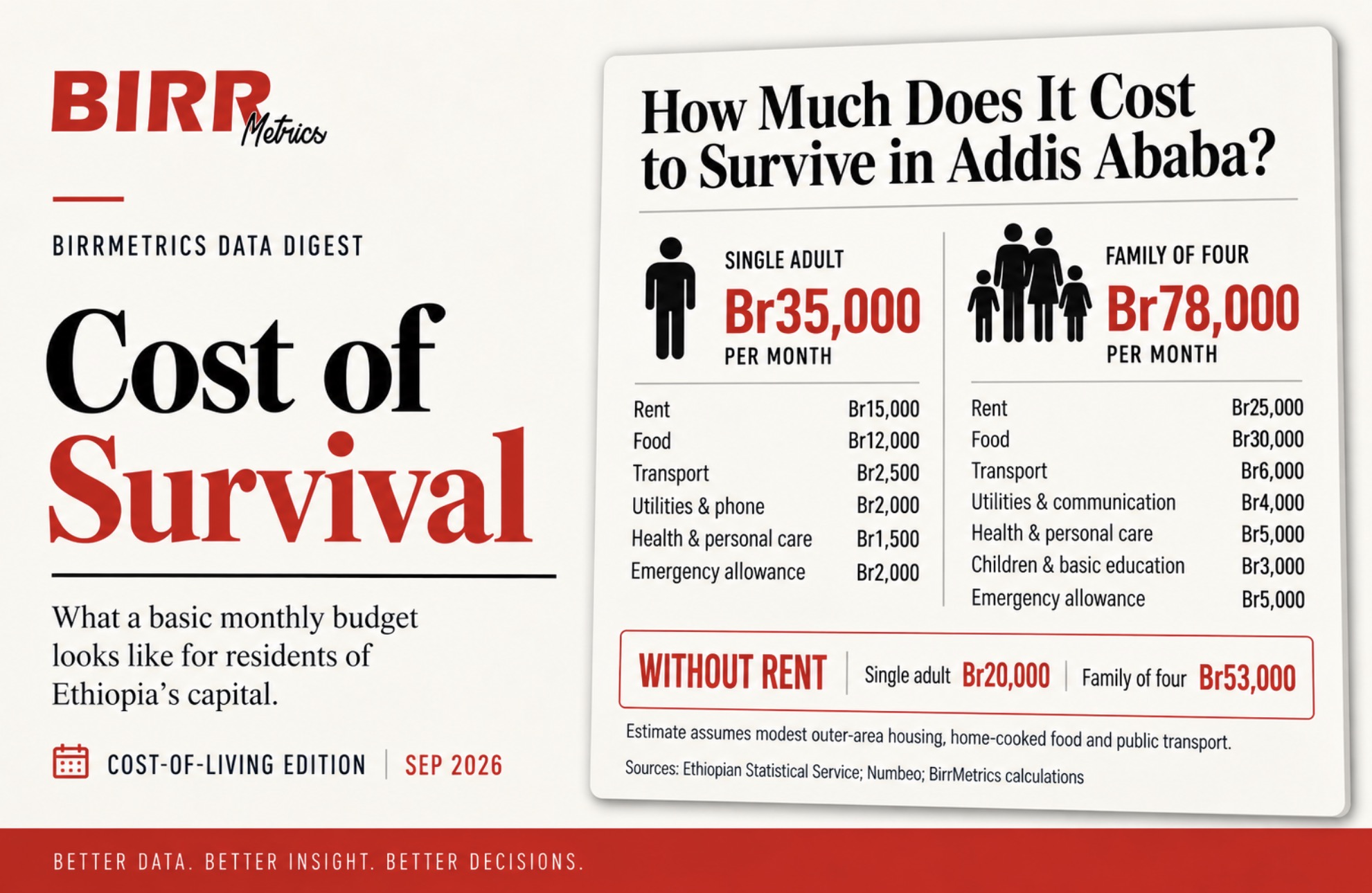
Addis Ababa has never been an easy city in which to be poor. It is now becoming increasingly difficult merely to remain afloat. A BirrMetrics estimate suggests that a single adult renting modest accommodation needs at least Br35,000 a month to cover essential expenses. A family of four requires approximately Br 78,000. a
These are not comfortable-living budgets. They do not include a private vehicle, regular restaurant meals, domestic help, expensive entertainment or private-school tuition. They assume accommodation outside the city’s most expensive neighbourhoods, food prepared mainly at home and reliance on public transport. In other words, Br35,000 buys survival—not prosperity.
Housing consumes the largest share of the single adult’s budget. Even a modest room or small residence is estimated to cost around Br15,000 a month. Food absorbs another Br12,000. Transport, utilities, communication, healthcare, personal necessities and a minimal emergency allowance consume the remaining Br8,000.
There is little room for error. One medical bill, rent increase, family obligation or unexpected journey can destroy the monthly calculation. The Br2,000 emergency allowance is less a financial cushion than an acknowledgement that emergencies happen. It would be insufficient to cover most serious medical, household or employment-related shocks.
The family budget is more punishing. Housing is estimated at Br25,000 and food at Br30,000, meaning those two necessities alone consume Br55,000. Transport, utilities, healthcare, children’s expenses and a small contingency allocation lift the minimum to Br78,000.
Even this figure understates the cost faced by families paying private-school fees, servicing loans, caring for relatives or travelling regularly across the city. It also assumes that household members remain healthy and that rent does not change unexpectedly.
The calculation exposes the growing distance between earnings and the cost of urban life. Numbeo’s July 2026 data put the average monthly net salary in Addis Ababa at about 203.50 US dollars. Converted at an exchange rate of roughly Br161 per dollar, that equals approximately Br32,800—already below BirrMetrics’ estimated minimum for a single renter.
For a family of four, even two adults each earning that reported average would bring home around Br65,600. They would still face a monthly shortfall of more than Br12,000 against the estimated survival budget. That gap would have to be closed through additional work, borrowing, support from relatives, reduced food consumption or the postponement of healthcare and education expenses.
Home ownership dramatically changes the equation. A single adult who does not pay rent could meet the estimated essentials with approximately Br20,000 a month. For a family of four, the figure falls from Br78,000 to about Br53,000.
This means housing tenure increasingly determines economic security. Two households earning the same income may experience entirely different standards of living simply because one owns a home while the other rents. A homeowner may struggle with food and transport costs; a renter must confront those pressures after surrendering a large portion of income to a landlord.
The divide also helps explain why older condominium allocations, inherited family homes and informal housing arrangements have become important forms of social protection. In the absence of affordable rental housing, property ownership does more than accumulate wealth: it protects households from the monthly arithmetic of survival.
Inflation continues to make that arithmetic harsher. The Ethiopian Statistical Service reported annual inflation of 15.1 percent in August 2026. Food prices were 14.9 percent higher than a year earlier, while housing and utility costs increased by 13.7 percent. Transport prices rose by 15.6 percent.
The headline rate also conceals much sharper increases in essential categories. Meat prices rose by 22.6 percent, milk, cheese and eggs by 18.7 percent, and oils and fats by 18.8 percent. Education costs increased by 25.3 percent. These are not luxury items that poorer households can easily eliminate. They are central components of nutrition, mobility and human development.
Inflation therefore forces households to adjust the quality, not merely the quantity, of what they consume. Meat disappears from meals. Milk and eggs become less frequent. Medical appointments are postponed. Children are moved to cheaper schools or pulled from supplementary activities. Workers walk part of their journey or spend longer waiting for less expensive transport.
Such adaptations can make official household expenditure appear stable even while living standards deteriorate. A family may continue spending Br30,000 on food, for example, but receive fewer calories, less protein or lower-quality products in return. Survival budgets must consequently be updated regularly; today’s Br78,000 basket may not purchase the same goods several months from now.
The estimate also illustrates the limitations of measuring economic wellbeing through salary increases alone. A nominal wage can rise while its purchasing power falls. An employee receiving a 10 percent salary adjustment during a period of 15 percent inflation has effectively suffered a real-income reduction.
Employers, policymakers and financial institutions therefore need to pay closer attention to the cost of a basic urban consumption basket. Salary reviews disconnected from rent, food and transport prices risk becoming cosmetic. Credit cannot permanently solve the problem either. Borrowing may smooth a temporary shock, but using loans to purchase food or pay rent merely transfers today’s shortfall into tomorrow’s obligations.
BirrMetrics’ estimate is not an official poverty line or living-wage determination. Spending varies substantially by neighbourhood, family structure, housing arrangement and lifestyle. The figures should be understood as a conservative snapshot of what it takes to maintain a basic but dignified existence in September 2026.
Yet the broader message is difficult to escape. In Addis Ababa, having a job no longer necessarily guarantees that a person can independently afford housing, food and transport. A salary of Br35,000 may once have represented a respectable urban income. For a renter today, it increasingly represents the minimum price of getting by.




