

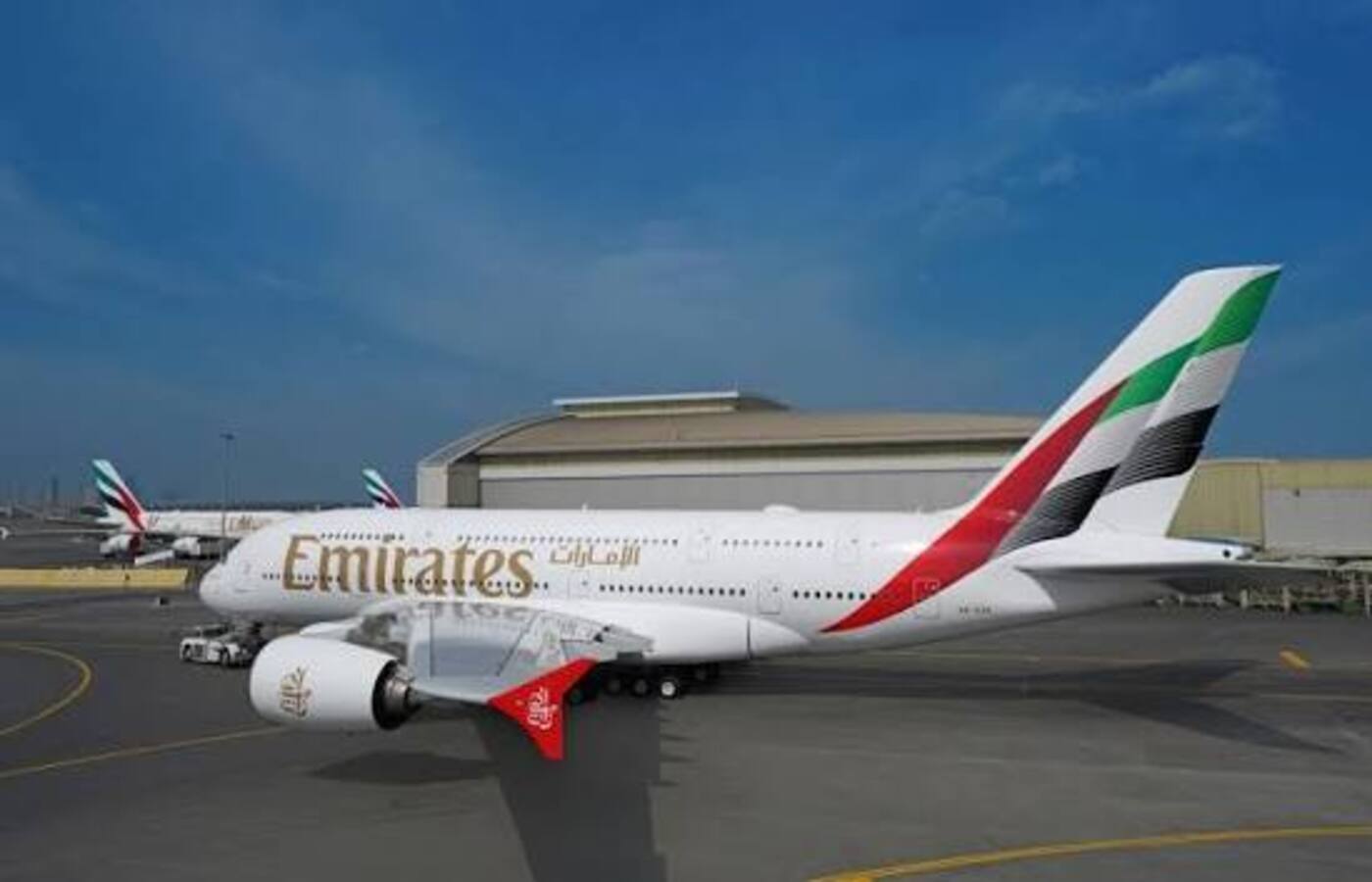
Emirates carried more than 8.6 million passengers in July and August, the Dubai-based airline said on Monday, as demand strengthened across its network ahead of the winter travel season.
Passengers arriving in Dubai on Emirates flights in the second half of August rose 7% from a year earlier to more than 500,000, the airline said.
Emirates is operating at about 93% of its pre-disruption capacity, with bookings for the winter season, which begins in late October, tracking ahead of last year in several markets.
South Africa, Brazil, India, Portugal, Egypt, Ghana, Colombia, Saudi Arabia and Pakistan are among the markets where demand is currently higher than a year earlier, while demand from Nepal has also increased through Emirates' partnership with flydubai.
The airline said demand for premium travel continued to grow, with Premium Economy demand strongest in the Americas.
Emirates has received 18 aircraft since January, including 11 Airbus A350s and seven Boeing 777 freighters. Six more A350s are scheduled to be delivered before the end of December.
The airline has completed retrofits on 104 aircraft, comprising 53 Boeing 777s and 51 Airbus A380s. The programme has increased the number of aircraft offering Premium Economy and other updated cabin products to 137.
That figure is expected to reach 155 aircraft by the end of December.
Premium Economy is currently available on services to 90 destinations, with six more destinations due to receive the cabin before the end of the year, including Paris, Delhi and Stockholm.
Almost 50 Emirates aircraft have also been equipped with Starlink, with installations continuing alongside the retrofit programme.
The airline introduced a new U-dream headrest on its A350 Economy Class seats this year, as well as privacy dividers for Premium Economy and new-generation lounges. New lounges have opened in Munich, Frankfurt and Manchester.
Emirates will add Helsinki to its network on Oct. 1, with the route initially served by an A350.
The A350 currently operates to 30 destinations from Dubai, a number Emirates expects to increase to 36 by the end of the year.
The airline will add second daily flights to Accra, Tokyo Narita, Ho Chi Minh City and Hanoi. One of its daily Delhi services will also be upgraded to an A380.
From late October, Emirates plans to deploy A350 aircraft to Larnaca, Malta, Nairobi and Hamburg, followed by Mauritius in November.
Retrofitted Boeing 777s will begin operating to Stockholm in October and Frankfurt in November.
Emirates said its 168 codeshare, interline and intermodal partnerships provide access to an additional 1,750 cities. More than 13,000 Emirates passengers connect to destinations on partner airlines on an average day, it said.
The carrier's partnership with flydubai provides access to more than 214 destinations in more than 100 countries, with more than 4,600 connection opportunities through Dubai.
The two airlines have carried more than 28 million passengers across their combined network since the partnership began in 2017.
Emirates has also expanded travel flexibility for customers, including one free date change across its network and unlimited free date changes for journeys to Dubai. It has also introduced comprehensive travel cover that includes medical protection related to conflict and airspace disruption, as well as accommodation, ground support and rebooking.




