

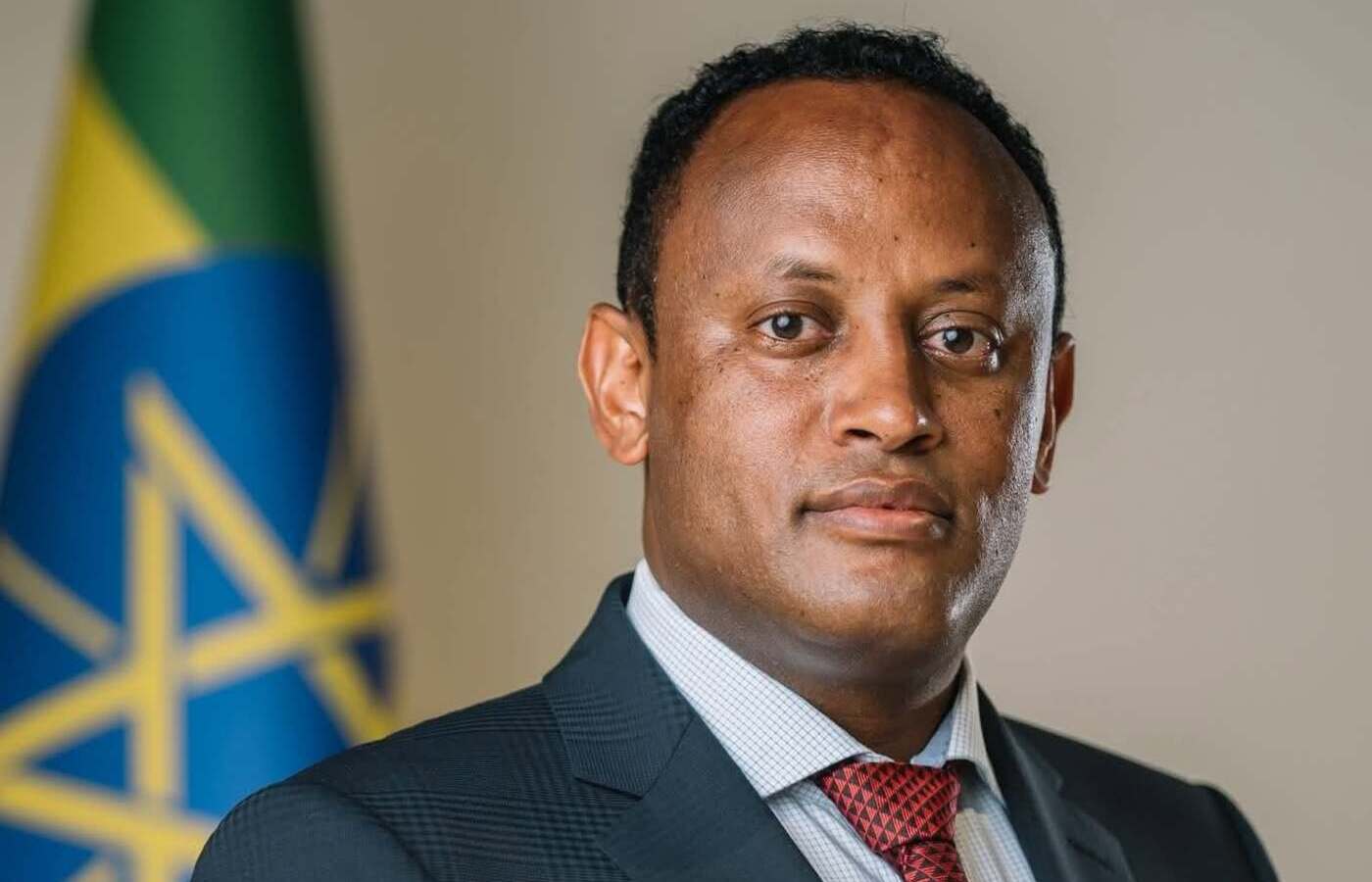
Prime Minister Abiy Ahmed has appointed Abraham Belay (PhD) as Commissioner of the Ethiopian Nuclear Energy Commission, placing the former Ethiopian Electric Power chief and ex-defence minister in charge of the institution leading the country’s emerging nuclear energy programme.
The appointment took effect on September 24, 2026, according to the Office of the Prime Minister.
Abraham succeeds Sandokan Debebe, who had been serving as commissioner of the newly established institution. The leadership transition comes as Ethiopia moves beyond policy declarations and bilateral agreements towards the more technically and financially demanding stages of developing a nuclear power programme.
The Ethiopian Nuclear Energy Commission was established in 2025 under Council of Ministers Regulation No. 575/2025 and serves as the federal institution responsible for coordinating the peaceful development and use of nuclear science and technology.
Its mandate covers nuclear electricity generation as well as applications in healthcare, agriculture, industry, research and environmental protection.
The Commission also serves as Ethiopia’s Nuclear Energy Programme Implementing Organization, the body responsible for coordinating the range of institutions involved in preparing a country to introduce nuclear power.
Abraham takes over as Ethiopia works on feasibility studies and institutional preparations for what would be the country’s first commercial nuclear power plant.
The programme has gained momentum through Ethiopia’s expanding nuclear cooperation with Russia.
Ethiopia and Russia have in recent years deepened discussions on the development of nuclear energy infrastructure, culminating in an action plan aimed at advancing work towards a nuclear power plant.
The framework has included plans for technical studies, development of a project roadmap, establishment of specialised working arrangements and negotiations on the legal and institutional framework required for implementation.
Russia’s state-owned nuclear corporation Rosatom has been the principal international partner in the discussions.
While the political commitment has strengthened, Ethiopia has yet to announce several of the most consequential elements of the proposed project, including its final generating capacity, location, financing structure, reactor configuration, construction cost and timetable.
That leaves the new commissioner with the harder part of the nuclear programme still ahead.
Developing a nuclear power plant requires substantially more than selecting a technology provider. Ethiopia would need to put in place an extensive nuclear safety and security architecture, specialised legislation and regulation, emergency preparedness systems, radioactive waste management arrangements and a trained technical workforce.
It would also need to ensure that the national electricity network can absorb electricity generated by a large nuclear facility.
That grid question is particularly important.
Nuclear plants typically operate as large, continuous sources of electricity. Introducing such capacity into Ethiopia’s power system would require significant transmission infrastructure, system stability planning and adequate domestic and regional electricity demand.
Abraham’s previous experience at Ethiopian Electric Power could prove directly relevant.
He previously headed the state-owned electricity company responsible for major power generation and transmission infrastructure. His appointment marks a return to the energy sector after holding several senior positions in government.
Abraham has also served as Minister of Innovation and Technology, Minister of Defence and Minister of Irrigation and Lowlands. He previously headed the federally appointed interim administration established in Tigray during the northern Ethiopia conflict.
His experience across the power, technology and government sectors places him at the intersection of many of the institutions that would need to work together if Ethiopia proceeds with a nuclear plant.
The nuclear push forms part of a broader effort to diversify Ethiopia’s electricity supply as demand from households, manufacturing, mining, transport and other industries grows.
Hydropower currently dominates Ethiopia’s electricity generation system and is expected to remain its principal source following the development of major projects, particularly the Grand Ethiopian Renaissance Dam.
The government has nevertheless been seeking a broader generation mix encompassing geothermal, wind, solar and, increasingly, nuclear power.
Nuclear generation could provide large volumes of electricity continuously and reduce the electricity system’s dependence on hydrological conditions.
But it would also introduce a very different financial challenge.
Large nuclear plants are among the most capital-intensive infrastructure projects in the energy sector. They generally require billions of US dollars in upfront investment and long periods of preparation and construction before generating revenue.
Ethiopia has a longer history of working with nuclear technologies in areas such as medicine, agriculture and scientific research and has been a member of the International Atomic Energy Agency since 1957.
The transition into commercial nuclear power, however, represents a substantially larger undertaking.
Countries pursuing nuclear power are expected to progress through a series of infrastructure milestones covering areas ranging from government policy and financing to nuclear safety, environmental protection, safeguards, radioactive waste management, procurement and grid readiness.
That process can take several years before a government is in a position to make a final investment decision.
For deeper analysis of energy infrastructure, industrial power policy, and macroeconomic trends in the Horn of Africa, read full coverage on Abraham Belay Appointed Ethiopia Nuclear Energy Commission, or monitor official energy updates on the Ministry of Innovation and Technology and Ministry of Water and Energy portals.




