

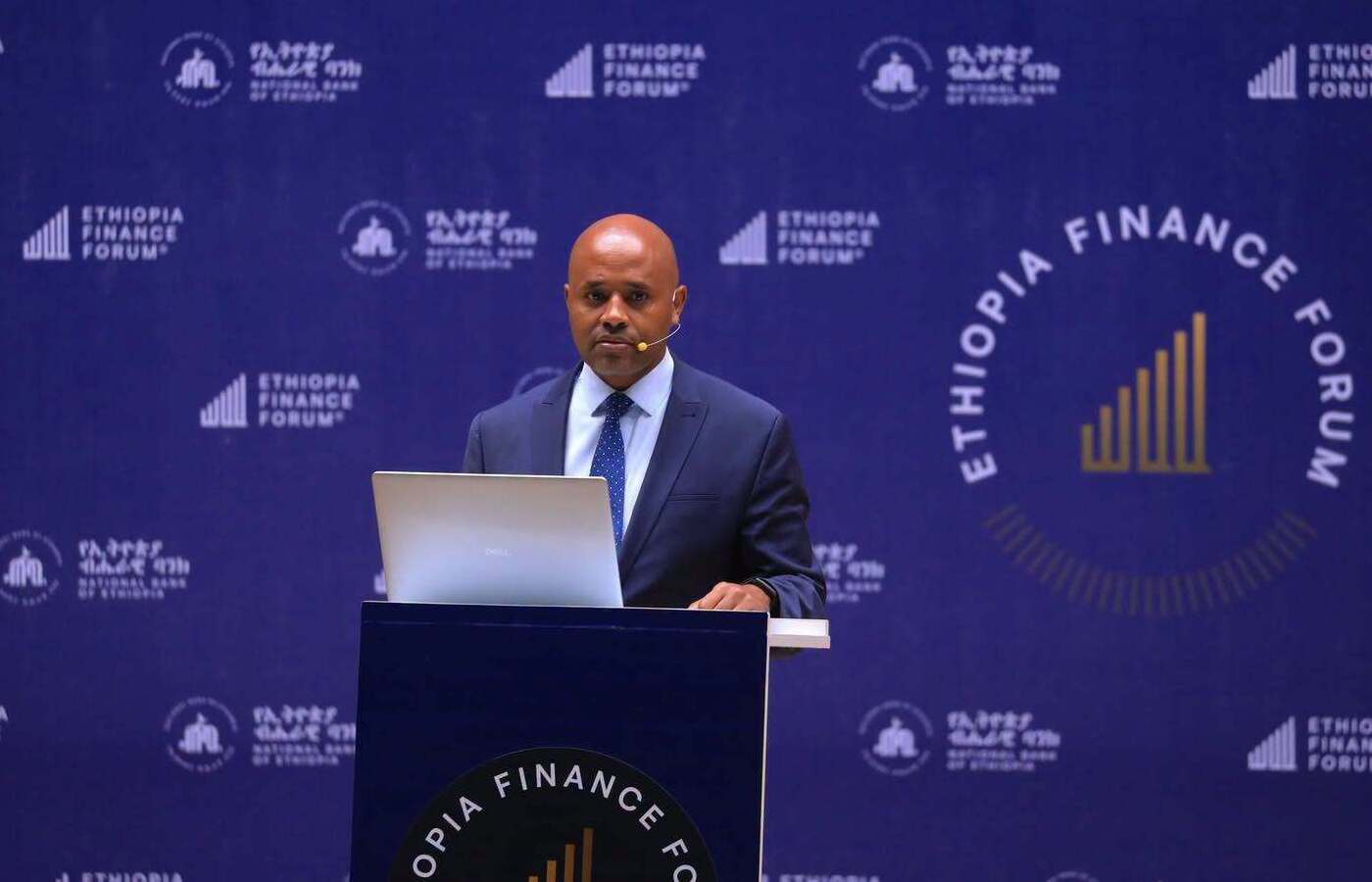
The National Bank of Ethiopia is moving further away from direct administrative controls in monetary and foreign-exchange policy, with Governor Eyob Tekalign (PhD) signalling further easing of export surrender requirements as the central bank deepens its shift toward market-based instruments.
Speaking at the Ethiopia Finance Forum 2026 on Tuesday, Eyob said the central bank intends to gradually eliminate mandatory foreign-exchange surrender requirements once the interbank foreign-exchange market becomes sufficiently deep and liquid.
The move would extend a series of policy changes introduced over the past two years as the National Bank seeks to replace quantitative restrictions with interest-rate, liquidity and market-based instruments.
Surrender requirements have already been removed for service exporters, allowing them to retain all of their foreign-currency earnings. Requirements on goods exports were reduced in July from 50 percent to 30 percent.
Eyob said the remaining requirement would be removed gradually rather than immediately, with the timing dependent on the development of the foreign-exchange market.
The policy forms part of a wider transformation in the way the National Bank manages monetary conditions.
In July, the central bank removed the credit growth cap that had limited the expansion of commercial bank lending, nearly three years after the measure was introduced as part of efforts to contain inflation.
The National Bank said at the time that the ceiling had achieved its transitional objective and could be replaced by indirect monetary-policy instruments.
The regulator simultaneously raised the National Bank Rate by one percentage point and said it would continue maintaining a tight monetary-policy stance through interest rates, reserve requirements and other market-based tools.
Eyob told the forum that the shift represents a change in the instruments used by the central bank rather than a relaxation of its underlying policy stance.
The National Bank has been working since July 2024 to develop an interest-rate-based monetary-policy framework in which the policy rate becomes the main signal for influencing credit and liquidity conditions.
When the new framework was introduced, the National Bank Rate was initially set at 15 percent, accompanied by open-market operations, standing lending and deposit facilities and an electronic interbank money market.
The removal of the credit cap marked another step in that transition.
The ceiling was originally introduced in 2023 to restrain rapid credit expansion at a time when inflation was running at elevated levels.
The central bank later maintained and adjusted the cap while developing alternative instruments capable of influencing monetary conditions.
As recently as late 2025, the policy rate had not yet developed a sufficiently strong transmission mechanism to act alone as the main monetary anchor, prompting authorities to retain a 24 percent annual credit-growth ceiling.
By July 2026, the central bank said conditions had improved enough for the restriction to be removed.
A similar transition is taking place in the foreign-exchange market.
Ethiopia moved to a market-determined exchange-rate system in July 2024 as part of the government’s broader economic reform programme.
Since then, authorities have progressively relaxed restrictions governing foreign-currency transactions while developing an interbank market intended to shift more foreign-exchange trading between commercial banks.
An automated interbank foreign-exchange trading platform was launched at the Ethiopian Securities Exchange in January 2026, while amendments introduced the following month removed surrender requirements for service exports and gave banks wider authority over forward transactions, external borrowing approvals and several retail foreign-exchange services.
The National Bank has also increased its oversight of banks’ foreign-currency positions.
Eyob said banks are being required to comply with stricter net open position rules, with action taken against institutions holding foreign currency beyond permitted limits rather than supplying it to the market.
Net open position requirements are designed to limit the difference between a bank’s foreign-currency assets and liabilities and reduce excessive exposure to movements in exchange rates.
The National Bank has also been selling foreign exchange through competitive auctions, while restricting its direct market intervention outside published auction mechanisms.
Authorities have said the pace of further liberalisation will depend on market conditions.
Among the factors being monitored are the persistence of the parallel-market premium, trading volumes between banks, unmet demand for foreign currency and the ability of institutions to manage their foreign-exchange positions.
The reforms follow years in which Ethiopia’s foreign-exchange system was characterised by administrative allocation, extensive surrender requirements and a large difference between official and parallel-market exchange rates.
The July 2024 reform allowed banks to determine foreign-exchange rates through market transactions while the central bank shifted toward regulation and periodic auction-based intervention.
The authorities say the next stage will depend increasingly on whether the interbank market is capable of providing sufficient liquidity and price discovery without the same level of direct administrative intervention.
Eyob said the broader reform programme is now moving from policy changes toward implementation and tangible economic results.
At the forum, he also highlighted the expansion of digital financial services, with digital transactions exceeding 19 trillion birr, and said banking-sector indicators remained within regulatory thresholds.
Non-performing loans stand at around 3.3 percent, below the National Bank’s five percent prudential threshold, according to figures presented by the Governor.
The central bank’s current policy direction places interest rates, interbank markets and prudential regulation at the centre of monetary and foreign-exchange management.
The remaining FX surrender requirement is one of the administrative measures still in place.
Its eventual removal would mark another step in Ethiopia’s transition from a system built largely around direct controls toward one in which banks, interest rates and market liquidity play a greater role in determining credit and foreign-exchange conditions.




