

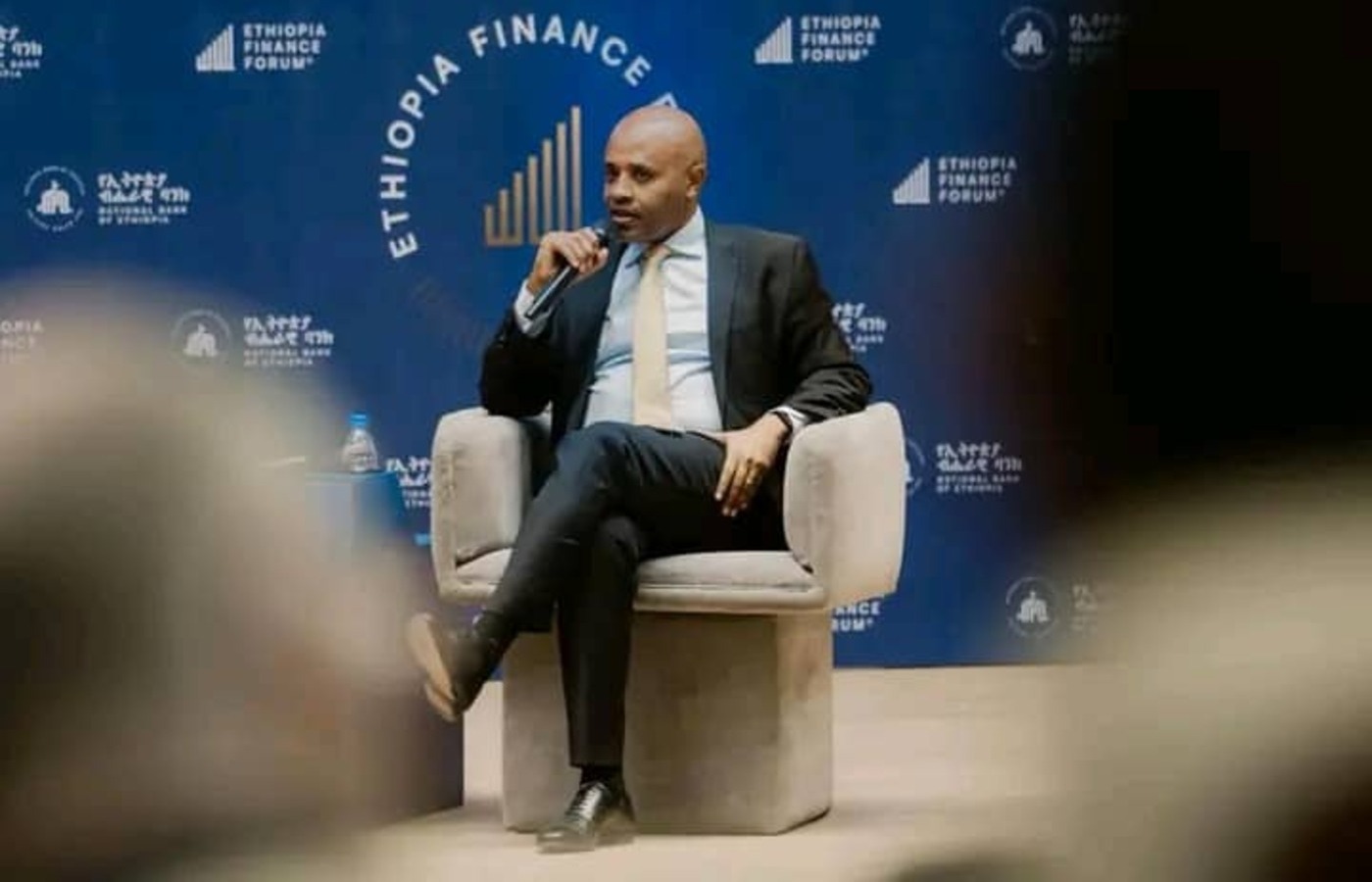
Ethiopia’s foreign reserves have climbed from about 2 billion US dollars in 2023 to roughly 5.6 billion US dollars in 2025 as the government’s market-based foreign-exchange overhaul begins to rebuild the country’s external buffers, National Bank of Ethiopia Governor Eyob Tekalign (PhD) said.
The reserve build-up marks one of the clearest shifts in Ethiopia’s external position since the government dismantled a decades-old foreign-exchange regime in July 2024 and allowed the exchange rate to be increasingly determined by market forces.
Speaking at the conclusion of the Ethiopia Finance Forum 2026 in Addis Ababa, Eyob said the numbers showed that the reform programme was moving in the intended direction, but cautioned against interpreting the gains as a completed economic turnaround.
“The task is not yet complete, and I do not wish to declare victory prematurely,” Eyob said. “The trajectory is very promising, but we must collectively sustain the effort.”
The reserve recovery has come alongside an even sharper adjustment in Ethiopia’s current account.
The deficit narrowed to 289.3 million US dollars in the fiscal year ending June 2025, from 6.2 billion US dollars a year earlier — a decline of more than 95 percent.
The National Bank’s Financial Stability Report similarly shows the current-account balance improving from a deficit equivalent to around 3 percent of GDP in 2024 to just 0.2 percent in 2025. The central bank attributed the shift partly to a 119.2 percent surge in exports and a 13 percent rise in private remittance inflows during the 2024/25 fiscal year.
For an economy that spent years struggling with chronic foreign-currency shortages, import backlogs and a widening gap between official and parallel exchange rates, the improvement represents a significant change in the country’s external financing position.
Eyob described the July 2024 foreign-exchange reform as a historic break with roughly five decades of policy.
The government, he said, had abandoned the assumption that Ethiopia could build a competitive economy while maintaining a heavily distorted foreign-exchange market.
The reform shifted Ethiopia toward a market-determined exchange-rate system, liberalised a wide range of foreign-exchange transactions and progressively eased restrictions on access to foreign currency.
Further changes followed in 2026. An automated interbank foreign-exchange trading platform was launched at the Ethiopian Securities Exchange in January, while the National Bank subsequently amended its foreign-exchange directive to remove additional restrictions, including surrender requirements for service exporters and some controls on foreign-currency transactions.
The IMF said in July that exports, reserves and government revenues had performed above expectations through the end of 2025, although it cautioned that preserving the gains would require continued policy discipline and further structural reforms.
The foreign-exchange shortage had for years been one of the most persistent constraints on Ethiopian businesses.
Companies routinely waited months for banks to allocate foreign currency for imports, while the large premium in the parallel market encouraged transactions to move outside formal financial channels.
The reform sought to change those incentives by bringing the official exchange rate closer to market conditions and redirecting foreign-currency flows through the banking system.

According to the National Bank, the gap between official and parallel-market rates has since narrowed substantially, while commercial banks’ foreign-currency reserves reached about 2.8 billion US dollars during the 2024/25 fiscal year.
Eyob said capital flight had fallen significantly and that resources were now flowing into the economy at a level equivalent to about 8 percent of GDP for the first time in three decades.
But the adjustment has not come without costs.
The depreciation of the birr has raised the domestic cost of imported goods ranging from fertiliser and pharmaceuticals to fuel and industrial inputs. Businesses carrying foreign-currency liabilities have also faced sharply higher debt-servicing costs when measured in birr.
Eyob acknowledged those pressures, describing them as substantial short-term costs attached to an adjustment intended to correct deeper structural distortions.
The government has responded with targeted interventions, including temporary subsidies on fertiliser and public-transport fuel and an expansion of social-protection programmes.
According to Eyob, the Productive Safety Net Programme has expanded from around six million to 10 million beneficiaries, while temporary subsidies have amounted to roughly 1.5 percent of GDP.
He pointed to the telecommunications sector as an example of how companies heavily exposed to foreign-currency debt have had to adjust.
Foreign-exchange exposure increased sharply after the currency adjustment, he said, but debt restructuring has helped affected companies balance repayment obligations against the need to continue investing.
Inflation Falls, Then Comes Under Pressure
The foreign-exchange reform forms part of a broader monetary overhaul under which the National Bank has moved toward an interest-rate-based policy framework and ended routine central-bank financing of the government.
The IMF has described the changes as a fundamental transformation of Ethiopia’s monetary and exchange-rate regimes, encompassing a more flexible exchange rate, interest-rate-based monetary policy and greater institutional independence for the central bank.
Eyob said headline inflation had fallen from close to 30 percent in January 2024 to 9.7 percent by December 2025 before rising again to 13.4 percent in May 2026 amid fuel-supply disruptions associated with conflict in the Middle East.
The reversal illustrated what he described as the continuing vulnerability of Ethiopia’s economy to external shocks even as domestic imbalances are brought under greater control.
The IMF also warned in its latest review that preserving Ethiopia’s macroeconomic momentum would require careful responses to emerging pressures, alongside continued efforts to strengthen the foundations for private-sector-led growth.
Reform Moves Deeper Into Finance
Eyob said stabilisation alone would not determine whether the reform ultimately succeeds.
The next phase, he argued, must make Ethiopia’s financial system more competitive, inclusive and capable of financing investment at a much greater scale.
Banking and insurance must open further to competition, while financial services need to reach segments still poorly served by the formal system, including smallholder farmers, women entrepreneurs and households seeking long-term housing finance.
Insurance remains particularly underdeveloped, accounting for only about 1 percent of GDP, according to figures cited by the governor.
The opening of Ethiopia’s banking industry to foreign participation is also part of the wider restructuring of the sector. The National Bank has said stronger capitalisation, mergers and acquisitions, new sources of financing and foreign-bank entry are intended to increase the financial system’s capacity to support investment and economic growth.
Yet one of Ethiopia’s fastest transformations is occurring outside traditional banking branches.
Eyob said enrolment in the national digital identification programme has reached about 51 million people, while digital financial transactions climbed to approximately 33 trillion birr during the 2025/26 fiscal year.
The scale of that expansion, he warned, introduces a different kind of systemic risk.
“Rapid digitization does not automatically create a trusted system,” Eyob said.
He argued that greater financial access must be accompanied by cybersecurity, consumer protection and stronger institutional safeguards.
“One cannot be sacrificed for the other,” he said of speed and security. “As we expand our digital transformation, we must apply equal focus to security.”
Eyob compared digital identification to a door: it can be opened to bring millions of people into the financial system, but it must also be guarded against fraud and other risks.
“Open it for inclusion, but close it to risk.”
The National Bank has established a dedicated cybersecurity cluster and is requiring banks to strengthen and report on their cyber defences.
‘Do Not Declare Victory’
The message from the governor was ultimately one of cautious confidence.
Two years after the foreign-exchange overhaul began, Ethiopia has more foreign reserves, a dramatically smaller current-account deficit and a financial system undergoing its most extensive regulatory transformation in decades.
The government and the National Bank have repeatedly presented the improvement in reserves and foreign-exchange availability as evidence that the reforms are beginning to correct longstanding external imbalances. A January 2026 joint statement by the Finance Ministry and National Bank said foreign reserves were being steadily rebuilt while foreign-exchange reforms were improving access and supporting private-sector activity.
But Eyob resisted portraying the changes as irreversible.
For businesses and households, the benefits of stronger reserves and a healthier balance of payments exist alongside higher import costs, exchange-rate exposure and adjustment pressures.
For the government, the challenge is increasingly moving beyond stabilising headline economic indicators to demonstrating that those gains can produce investment, jobs, credit and improvements in living standards.
Eyob compared the process to teaching a teenager to drive: allowing greater independence brings risks, but permanently maintaining the old system carries its own costs.
“As a parent, you are naturally concerned when they first take the wheel,” he said. “But the alternative is to remain a lifelong chauffeur. The goal is independence.”
The sustainability of the reform, he said, must ultimately rest not on individual policymakers but on institutions capable of preserving stability when leadership changes.
“We have a proclamation that gives a powerful mandate to the central bank,” Eyob said.
For now, Ethiopia has rebuilt a reserve buffer that only three years ago stood at roughly 2 billion US dollars and has almost eliminated a current-account deficit that exceeded 6 billion US dollars a year earlier.
For Eyob, those figures are evidence of direction rather than destination.
“The trajectory is very promising,” he said. “But we must collectively sustain the effort.”
For additional regulatory updates, diplomatic insights, and market analysis, explore our article on ECMA Grants Security Registration Approval for Eight Million Existing Shares of Awash Insurance S.C., or check our coverage on Ethiopia Expels Egyptian Diplomat Ahmed Moharam Ahmed Soliman Amid Escalating Nile Tensions.




