

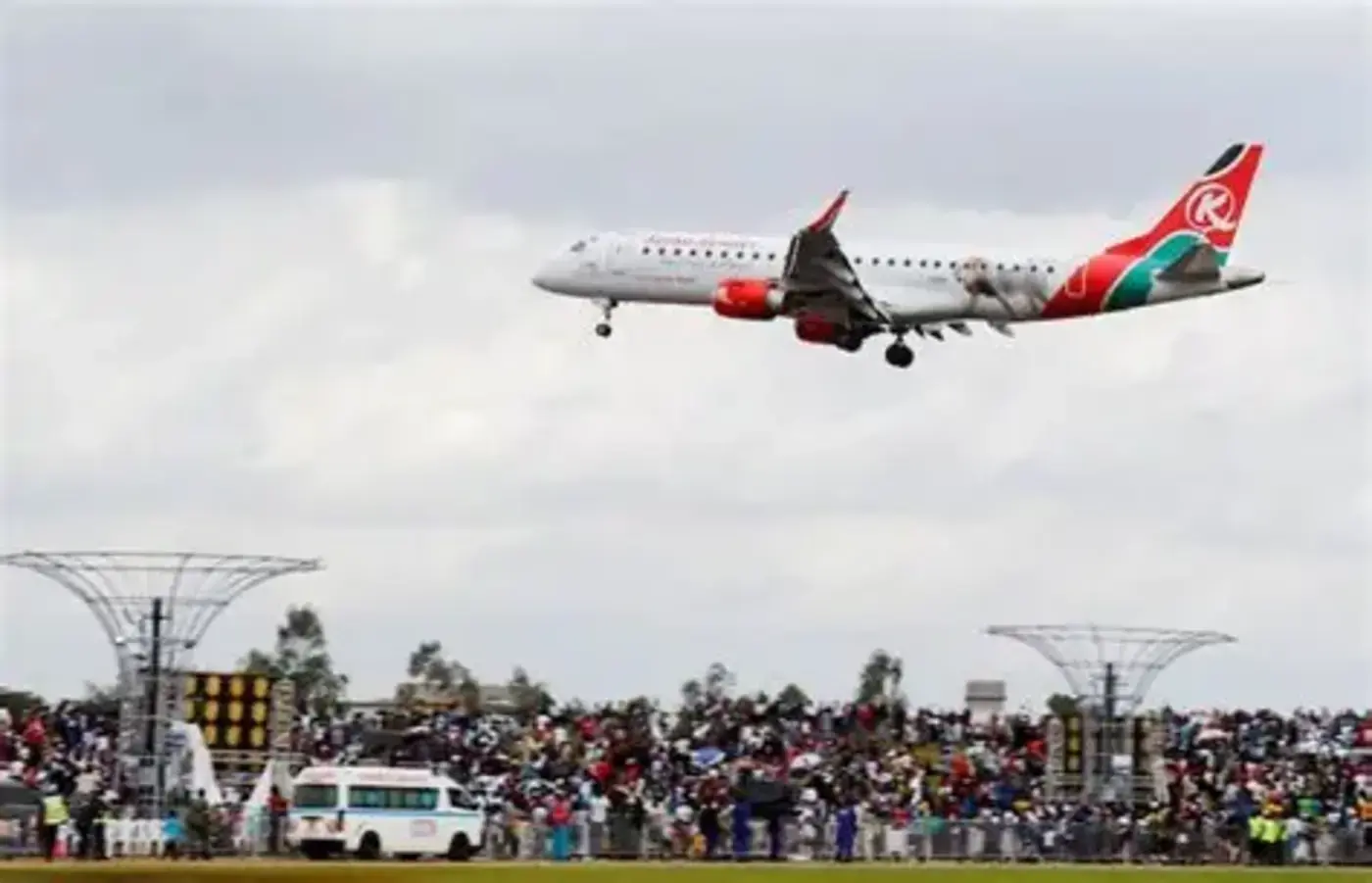
Kenya's government has approved 350 million US dollars in emergency financing for struggling national carrier Kenya Airways, alongside plans to restructure approximately 941 million US dollars in existing government debt, as the airline seeks to stabilise its operations, restore grounded aircraft and attract strategic investors amid mounting financial pressures.
The decision, announced on Friday, October 9, 2026, following a Cabinet meeting chaired by President William Ruto, represents one of the government's most significant recent interventions to support the loss-making airline, which continues to struggle with heavy debt obligations and operational constraints.
According to a statement from the president's office, the new financing will be provided through shareholder loans amounting to approximately 45.4 billion Kenyan shillings. The funds are intended to address urgent financial obligations, finance aircraft maintenance and return grounded planes to commercial service.
The financing will be released in instalments under the supervision of Kenya's National Treasury, with a repayment period of up to ten years. The arrangement also provides for the possibility of converting the loans into equity, subject to the necessary corporate, shareholder and regulatory approvals.
In a separate measure, the Cabinet endorsed a proposal to convert 122 billion Kenyan shillings in existing government loans, equivalent to approximately 941 million US dollars, into an equity-qualifying tradable financial instrument.
The proposed conversion is intended to reduce pressure on the airline's balance sheet and improve its ability to attract additional financing.
Unlike the newly approved 350 million US dollars, the proposed debt conversion does not represent fresh cash for the airline. Instead, it would restructure existing financial obligations into an instrument potentially linked to the company's equity, depending on the final terms and regulatory approvals.
Taken together, the measures address approximately 1.29 billion US dollars in new financing and existing government debt, although only 350 million US dollars represents newly approved funding.
The intervention comes as Kenya Airways continues to face financial difficulties despite years of restructuring efforts, government assistance and attempts to improve its operational performance.
The airline reported a pretax loss of approximately 15.92 billion Kenyan shillings during the first half of 2026, compared with a loss of 12.17 billion Kenyan shillings during the corresponding period of 2025.
The widening losses have reinforced concerns about the sustainability of its financial recovery, particularly as the carrier faces aircraft maintenance expenses, financing costs and challenges associated with keeping its fleet fully operational.
The government currently holds approximately 48.9 percent of Kenya Airways, making it the airline's largest shareholder and a central participant in its restructuring programme.
Kenya Airways has been seeking strategic investors capable of injecting fresh capital into the business while supporting efforts to modernise its operations and improve long-term profitability.
The company's restructuring strategy includes reducing its debt burden, strengthening its balance sheet and attracting investors who can provide both financial resources and operational expertise.
Government officials say the latest financing package is intended to create conditions for a more sustainable recovery while protecting the airline's contribution to Kenya's economy.
According to the Cabinet, Kenya Airways contributes more than 1.3 billion US dollars annually to the country's gross domestic product through tourism, international trade and regional connectivity.
The airline operates a network of destinations across Africa, Europe, Asia and the Middle East, using Nairobi's Jomo Kenyatta International Airport as its principal hub.
Its operations are considered strategically important for Kenya's tourism industry, export trade and ambitions to strengthen Nairobi's position as a regional aviation centre.
The financial intervention also has implications for competition in East Africa's aviation industry, where Kenya Airways and Ethiopian Airlines operate two of the region's most important international hubs.
Ethiopian Airlines, Africa's largest airline group by several operating measures, has expanded its international network, fleet and cargo operations over the past decade, strengthening Addis Ababa's position as a major connecting hub between Africa and international markets.
Kenya Airways, meanwhile, has faced repeated financial setbacks that have constrained its ability to expand capacity and compete effectively on some international routes.
Both carriers depend heavily on connecting passengers travelling between African destinations and markets in Europe, Asia, the Middle East and North America.
The ability to maintain reliable operations, expand aircraft availability and secure sufficient financing is therefore central to their competitive positioning.
For Kenya Airways, returning grounded aircraft to service could help improve operational capacity, reduce disruptions and support revenue generation. However, the extent of any competitive impact will depend on how quickly the financing is disbursed, the number of aircraft returned to service and the airline's ability to control operating costs.
The government's intervention comes at a time when African aviation markets face broader pressures from aircraft maintenance costs, access to financing, foreign exchange constraints and fluctuations in international fuel prices.
Airlines across the continent have also struggled with the high cost of aircraft leasing, maintenance facilities and spare parts, many of which are priced in foreign currencies.
These challenges are particularly significant for airlines operating in markets where local currency depreciation increases the domestic cost of dollar-denominated obligations.
Kenya Airways' financial difficulties have made government involvement a recurring feature of its turnaround efforts.
Over the years, the carrier has undergone several restructuring initiatives involving debt adjustments, government guarantees and changes to its operating strategy.
The latest proposal to convert existing government loans into an equity-qualifying instrument is intended to address some of these longstanding financial pressures while making the company more attractive to potential investors.
However, the effectiveness of the restructuring will depend on whether it delivers a sustainable improvement in profitability rather than merely postponing existing financial obligations.
The financing arrangement also raises questions about the potential fiscal implications for Kenya, where the government continues to face pressure to manage public debt and expenditure.
Although the 350 million US dollars has been approved as repayable shareholder financing, the possibility of converting it into equity means the government's ultimate financial exposure will depend on future decisions and the airline's performance.
Similarly, the proposed conversion of existing loans could change the form of the government's financial claims against the airline without necessarily recovering the amounts previously advanced.
The Cabinet said implementation of the financing and restructuring measures remains subject to the required approvals.
For related coverage on East African aviation, trade, and economic policies, read our report on Ethiopian Airlines to Resume Mekelle Flights After Three-Week Suspension or explore our analysis on Africa’s Imports Set to Outpace Exports as Global Trade Rebounds, WTO Warns.




