The sector’s share of national export earnings declined from 7.35 percent to 5.1 percent in a year, as Ethiopia seeks to expand domestic processing, diversify export markets and reduce its growing dependence on gold and coffee.
Ethiopia’s export earnings from pulses and oilseeds declined by approximately six percent during the 2025/26 fiscal year, despite an increase in shipment volumes and a 35 percent surge in the country’s overall export revenues.
The two commodities generated 572.9 million US dollars, down from more than 610 million US dollars the previous year, according to figures presented at successive international conferences on pulses and oilseeds.
The sector’s contribution to national export earnings consequently fell from 7.35 percent to 5.1 percent, even as Ethiopia recorded an unprecedented 11.2 billion US dollars in annual export revenues.
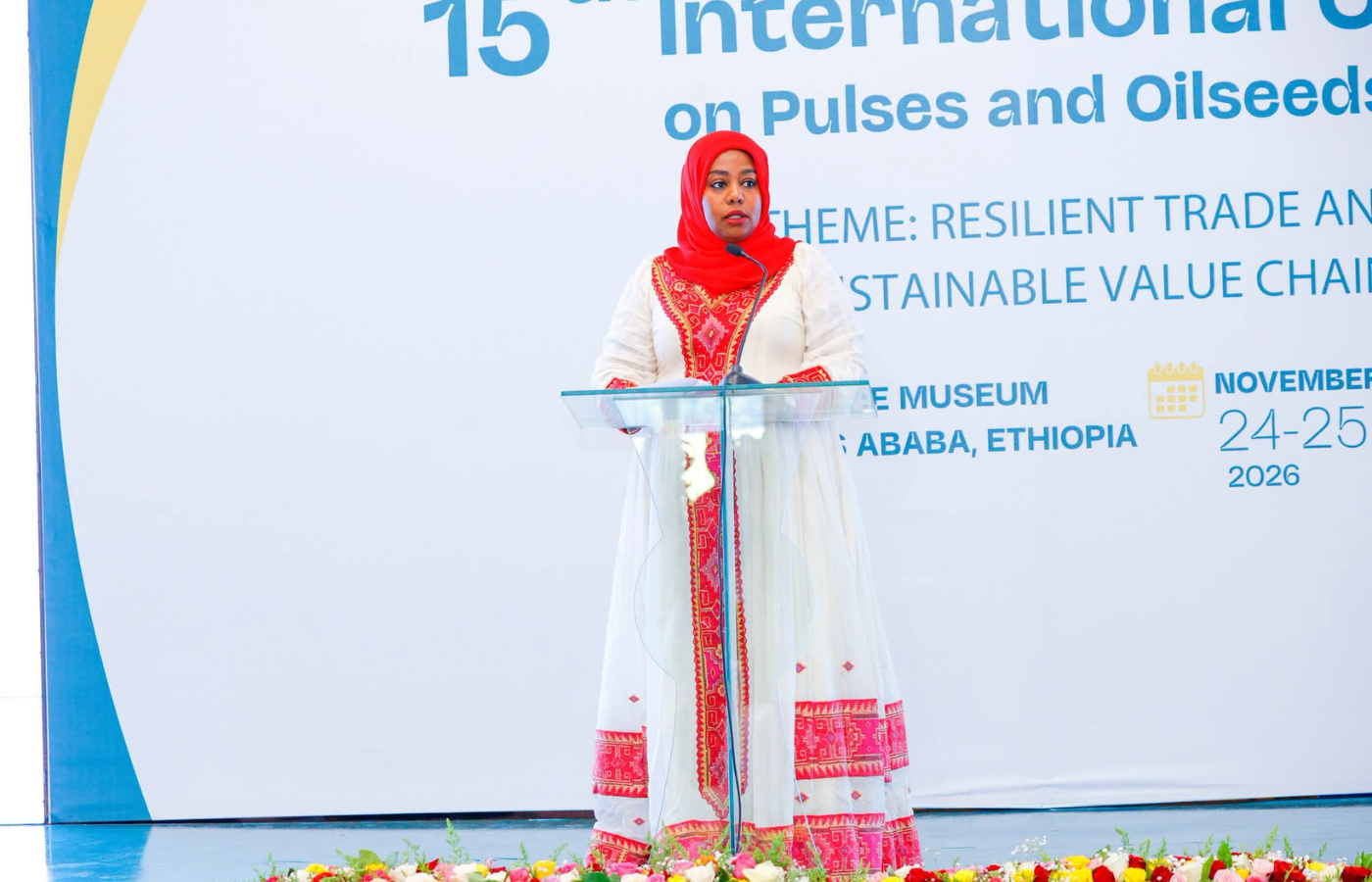
Yasmin Wuhabrebie, Minister of Trade and Regional Integration, disclosed the latest earnings figures at the opening of the 15th International Conference on Pulses and Oilseeds (ICOPOS 2026) in Addis Ababa on November 24, 2026.
The decline occurred despite Ethiopia exporting approximately 555,000 metric tonnes of pulses and oilseeds during the fiscal year, representing an increase of nearly five percent from the preceding year. Lower international commodity prices, particularly for sesame, contributed to the reduction in earnings.
The sector also fell short of the government’s combined annual export target of 743 million US dollars by approximately 170 million US dollars.
The performance contrasts with the rapid expansion of Ethiopia’s overall merchandise exports, largely driven by gold and coffee. Gold generated approximately 5.6 billion US dollars during the fiscal year, while coffee contributed 3.1 billion US dollars. Together, the two commodities accounted for nearly 78 percent of national export earnings.
The government is now seeking to expand the economic contribution of pulses and oilseeds through greater domestic processing, improved agricultural productivity, stronger quality standards and access to additional international markets.
Speaking at the conference, Yasmin identified investment opportunities in contract farming, agricultural aggregation, warehousing, edible oil manufacturing, food processing and packaging.
The proposed areas of investment extend beyond conventional exports of raw agricultural commodities, targeting activities that generate additional value domestically before products enter international markets.
The two-day conference, held under the theme “Resilient Trade and Sustainable Value Chains”, has brought together more than 600 producers, exporters, international buyers, financial institutions, government officials and diplomats from 17 countries.
Organisers are targeting commercial agreements worth up to 70 million US dollars during the conference, compared with 51 million US dollars in agreements signed during the previous edition.
However, structural constraints continue to affect the industry’s export performance.
The Ethiopian Pulses and Oilseeds Exporters Association, which represents more than 500 exporters, estimates that Ethiopia is utilising only about 30 percent of its potential in the sector. The association has also identified post-harvest losses, which it estimates could reach 25 percent of harvested crops, as a constraint on production and export earnings.
Cross-border smuggling remains another challenge. Although the association has called for stronger enforcement against illegal trade, neither the government nor the association has disclosed the estimated volume or monetary value of commodities leaving the country through informal channels.
Edeo Abdi, president of the association, said exporters needed to strengthen their capacity to anticipate international demand, understand market trends and establish commercial relationships with overseas buyers.
The industry’s performance comes more than two years after Ethiopia introduced a market-based foreign exchange regime in July 2024, partly aimed at improving export competitiveness, encouraging formal trade and increasing foreign currency inflows.
Subsequent reforms have opened selected trading activities to foreign investors, introduced foreign participation in the banking sector and sought to simplify trade administration through digitalisation and modernised licensing procedures.
Regional and international market integration also forms part of the government’s export development agenda.
According to Yasmin, Ethiopia began trading goods under the African Continental Free Trade Area (AfCFTA) framework in October 2025. Negotiations to join the World Trade Organisation have also reached their final stages, although membership remains subject to the completion of the accession process.
The government has set a national export earnings target of 13.4 billion US dollars for the 2026/27 fiscal year, representing an increase of nearly 20 percent over the previous year’s performance.
For the pulses and oilseeds industry, restoring its previous share of national export earnings would require annual earnings of approximately 985 million US dollars, assuming Ethiopia meets its national export target and the sector returns to its 2024/25 share of 7.35 percent.
That would require the industry to generate more than 412 million US dollars in additional annual export earnings, equivalent to an increase of approximately 72 percent from its latest performance.