Newly disclosed internal records trace Washington’s engagement with Ethiopian media, influencers and technology companies, while procurement data reveal the wider scale of its political-transition programme.
The official website of the United States Agency for International Development (USAID) is back online, nearly 22 months after it disappeared from the internet. But instead of offering information on aid programmes, the site now hosts a collection of internal documents from the former agency, including records that detail its activities in Ethiopia during the conflict in the north.
Released on November 24, 2026, the archive contains a reported 248 files, including internal memoranda, emails, presentations, spreadsheets and video recordings. The documents illuminate how a development agency addressed the information environment surrounding a conflict that also became a major US foreign policy concern.
Among the most striking disclosures is a February 17, 2022 memorandum prepared for then-USAID Administrator Samantha Power. It records training for 1,121 influencers, engagement with approximately 83 media outlets, support for around 83 radio programmes and fact-checking of more than 390 news items in Ethiopia.
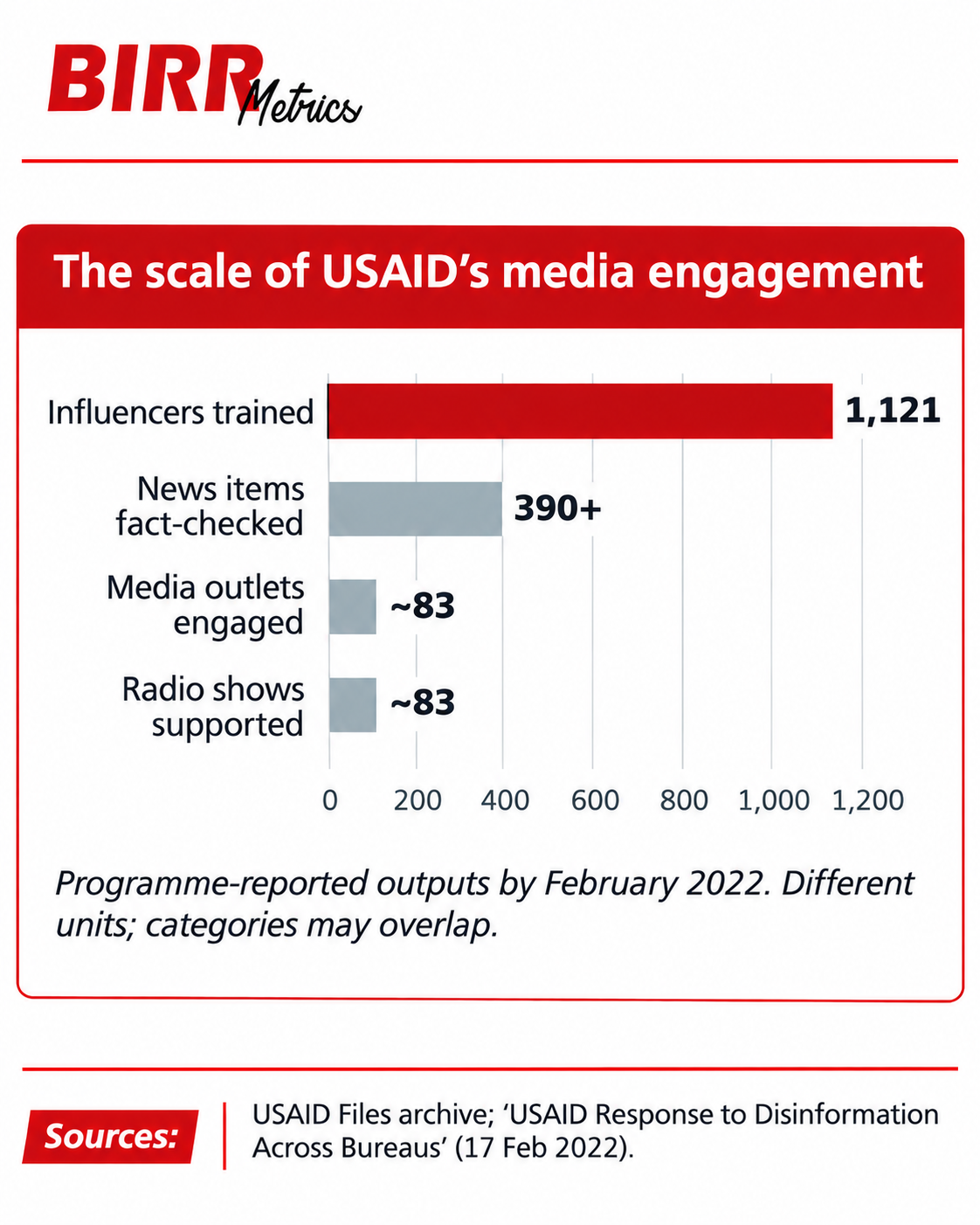
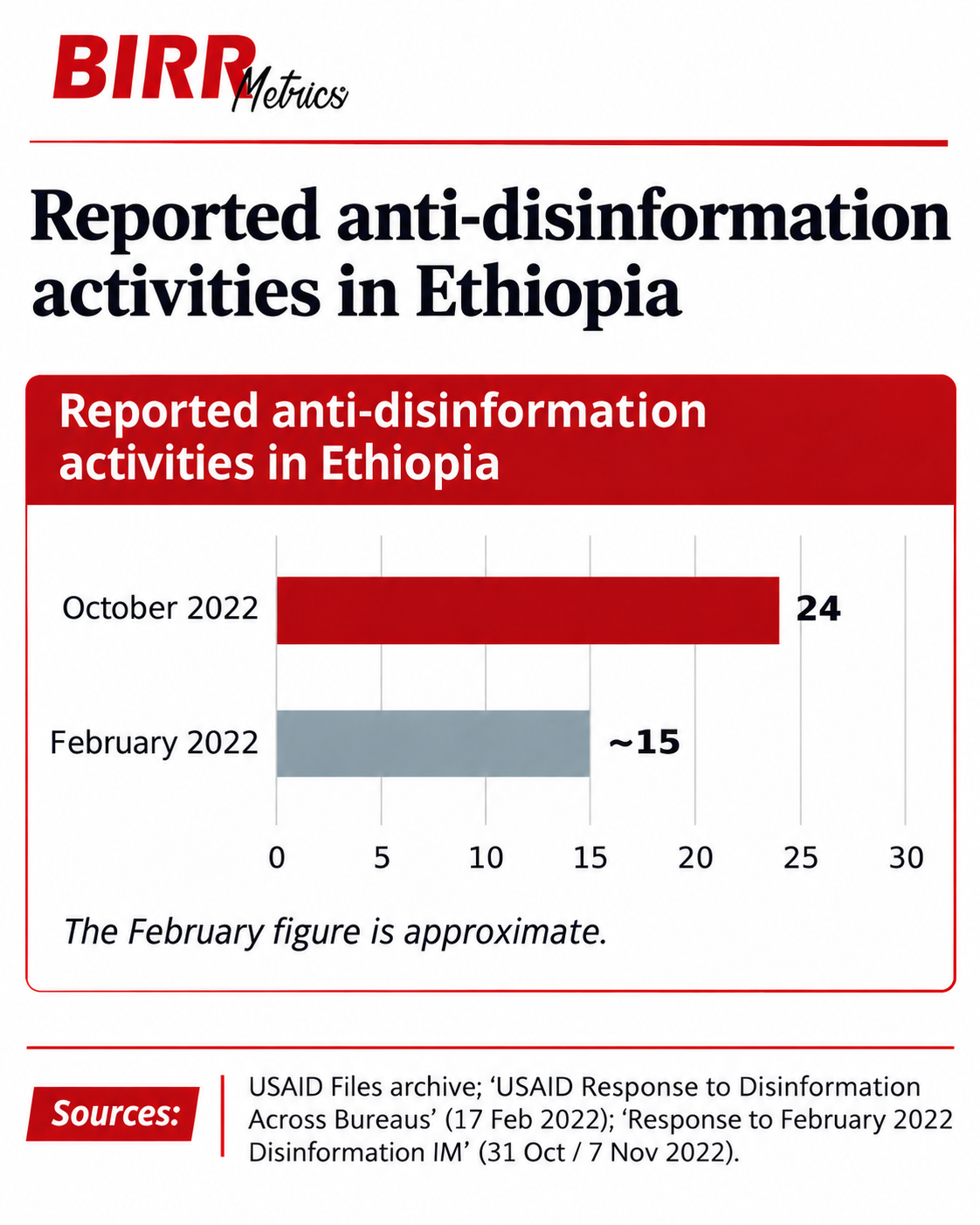
The February memorandum places the media activities within the work of USAID’s Office of Transition Initiatives (OTI), which was supporting approximately 15 interventions dealing with misinformation, disinformation and hate speech. It describes efforts to train journalists, improve conflict-sensitive reporting and encourage social cohesion.
By October 31, 2022, a separate memorandum responding to questions from Power put the number of such activities at 24. The rise of approximately 60 percent reflects an expansion in the reported activity count, although it does not establish a corresponding increase in funding, nor how many interventions were operating simultaneously.
The figures also raise questions about the relationship between foreign assistance and domestic media. The records identify broad categories of participants, including civil society groups, young people, community broadcasters and traditional leaders. They do not provide a complete beneficiary list or an accounting of the money spent on each activity. The February memorandum states that USAID did not direct its partners’ messaging.
From local monitoring to global platforms
One of the most consequential passages concerns a local organisation supported by OTI to produce fortnightly reports monitoring social media. According to the memorandum, the reports were shared with the US State Department’s Global Engagement Center, which was in the process of forwarding them to Twitter, Facebook and YouTube for content flagging.
That arrangement linked locally produced monitoring to a US diplomatic institution and potentially to the companies controlling the distribution of online information. The records do not name the local organisation in the cited passage or document which posts, if any, were removed as a result. Flagging content and deciding to take enforcement action are separate processes.
The internal records document how US officials assessed political narratives during the war. The February memorandum discusses the #NoMore movement, which mobilised Ethiopians and Eritreans, including members of the diaspora, against what they regarded as Western intervention. Its annexes reproduce public comments by Taye Dendea, Hermela Aregawi, Bronwyn Bruton and Al Mariam, among others.
The inclusion of public posts in an agency assessment does not establish that the individuals were paid, deliberately disseminated false information or had their accounts targeted for removal. What it does show is that criticism of US policy and humanitarian operations formed part of the agency’s assessment of the information environment.
The memorandum also traces the US government’s coordination on election-related hate speech and disinformation during Ethiopia’s 2021 general elections. The National Security Council sought an interagency response, and an August 2021 communications and outreach plan was prepared for its review. The discussions took account of Ethiopia’s 2020 hate speech and disinformation law.
When accurate information became a policy concern
A July 22, 2022 response to the National Security Council offers a more explicit account of the agency’s concerns. Commenting on a NATO information-risk framework, USAID proposed broadening its scope to address how even accurate information might be presented in ways that undermined the credibility of the United States.
“factually accurate information that could be misrepresented to discredit the US (such as discrediting our foreign policy in Ethiopia)”
The wording identifies a tension between identifying false claims and assessing reputational risks arising from the framing of true information. It is, however, a proposed change to a risk-assessment framework, not an instruction to censor truthful reporting. The file does not establish whether the recommendation was adopted.
A January 2023 planning presentation identifies Ethiopia, Moldova and Uzbekistan as missions that agreed to participate in a pilot for information-risk detection and assessment. The wider initiative envisaged data collection, automated risk assessment and early warning mechanisms to reduce risks to USAID personnel, programmes and partners. Its planning table identified the second quarter of US fiscal year 2024 as a target. The document does not demonstrate that the pilot was completed in Ethiopia.
The emails behind USAID’s Big Tech contacts
The release includes correspondence that shows how technology companies and USAID officials established contact over Ethiopia. On November 15, 2021, USAID official Madalina Cristoloveanu introduced a Twitter policy contact to Akemi Tinder, then acting deputy team leader for OTI Ethiopia in Washington. The company sought discussions concerning misinformation and hate speech, and Tinder welcomed the approach.
The exchange records a request for discussion rather than an agreement to take action. It does not reveal the outcome of any meeting or identify a specific moderation decision attributable to USAID.
Other emails, dated June 5–7, 2021, describe USAID’s efforts to obtain Facebook’s assistance with a potential Instagram engagement between Power and Ethiopian-Canadian musician Abel Tesfaye, better known as The Weeknd. The contemplated engagement sought to draw international attention to the humanitarian crisis in Tigray. Facebook staff routed the request to relevant policy colleagues.
This correspondence adds a behind-the-scenes account of how USAID sought to use social media platforms for public diplomacy. It is not evidence of a paid endorsement, nor does it establish that Facebook was asked to remove content in this exchange.
The archive also contains a USAID-funded study by DevTech Systems, approved on January 3, 2023, that assesses potential democratic openings in countries around the world. Ethiopia appears in the study’s quantitative country table, with an estimated 26.2 percent probability of a democratic opening during 2022–2023.
The study also recorded a 2021 liberal democracy index of 0.151 and a combined quantitative score of 0.199 for Ethiopia. These are different measures rather than probabilities. The assessment was intended to inform thinking about democracy-related investments; it was neither a prediction for 2026 nor evidence of a US plan to change Ethiopia’s government.
Together, the files trace several layers of activity: training and reporting through development partners, diplomatic coordination within the US government, direct communication with technology platforms and analysis intended to inform future programming. The documents do not establish that every proposal was implemented or that every activity was designed for the same purpose.
Following the money: a 54.4 million dollar programme
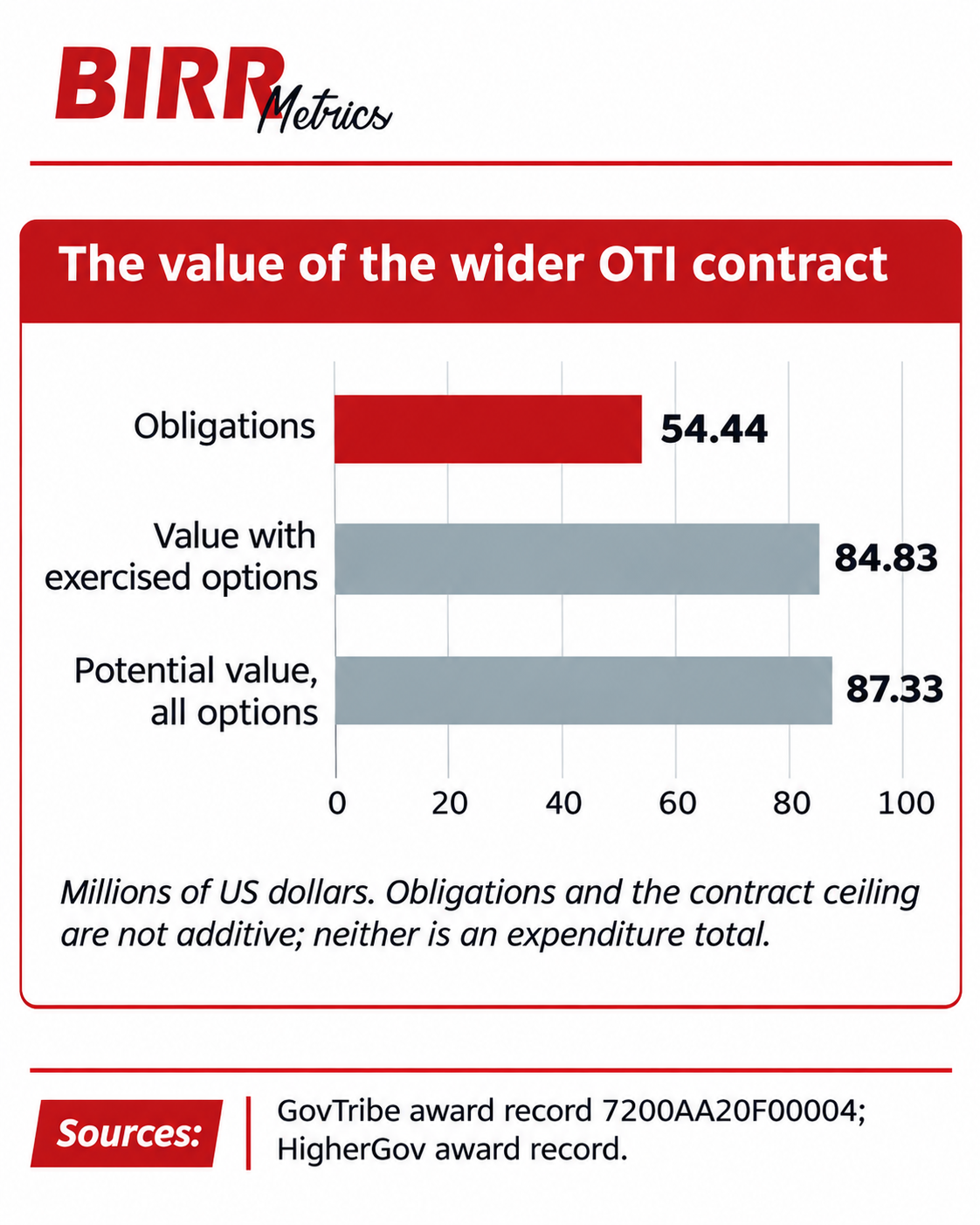
The newly published memoranda do not provide a comprehensive financial account of the Ethiopian media and monitoring activities. Existing procurement records offer a broader picture. A delivery order awarded to Dexis Interactive LLC on February 25, 2020, for the Ethiopia OTI programme records cumulative funding obligations of 54.44 million US dollars, against a contract ceiling of 87.33 million US dollars. The award was terminated for convenience on February 11, 2025.
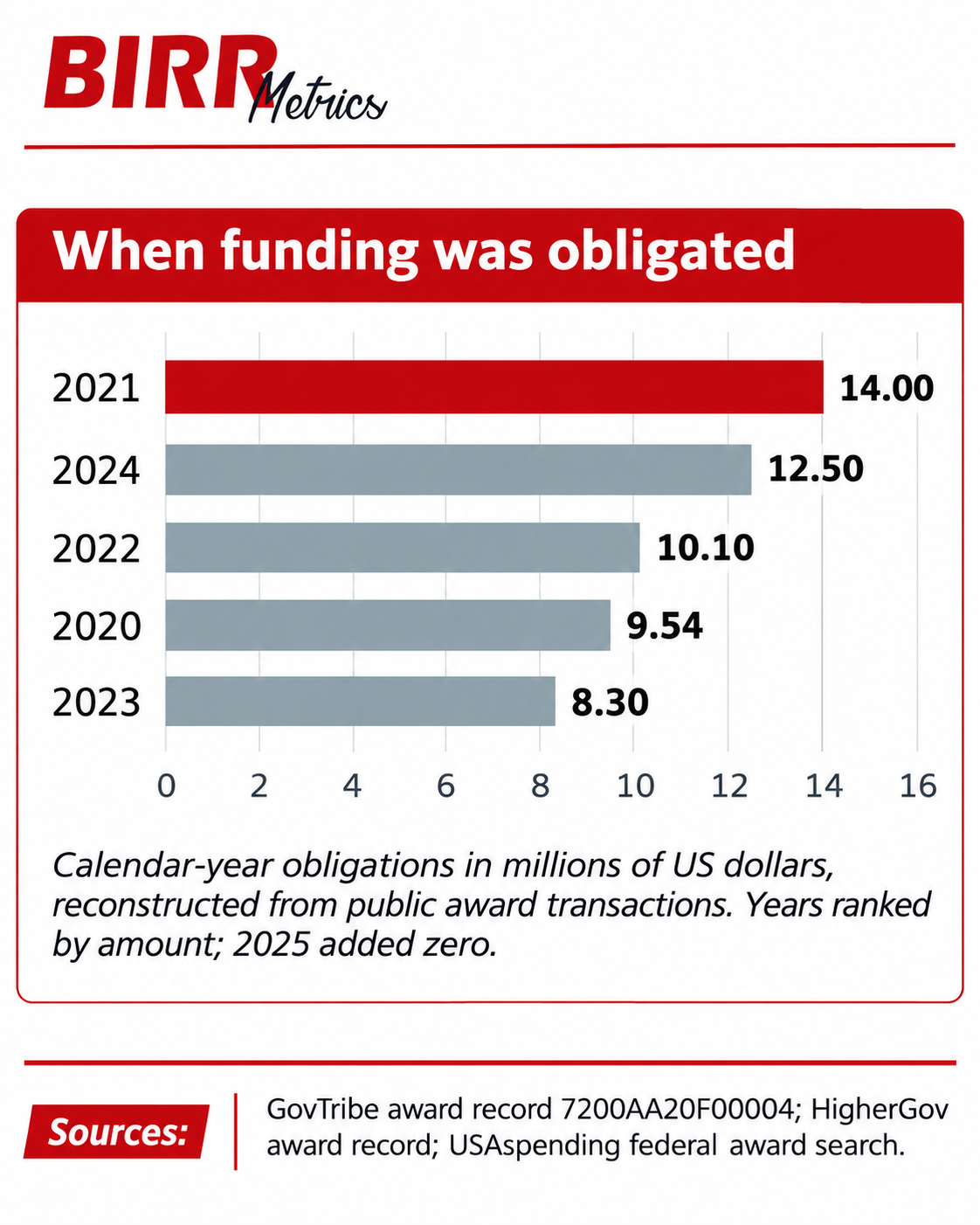
Calendar-year obligations in millions of US dollars, reconstructed from public award transactions. Years ranked by amount; 2025 added zero.
Annual commitments peaked at 14 million US dollars in 2021 and reached 12.5 million in 2024. The wider award supported political stability, peacebuilding, democracy and civil society, in addition to media-related activities. There is no basis in the available records for attributing all 54.44 million US dollars to influencer training, content monitoring or media grants.
A website returns, but the aid agency does not
The publication follows the agency’s shutdown as an administrator of foreign assistance. Its website went offline in February 2025, and the US Government Accountability Office reported that USAID ceased administering aid awards as of July 1, 2025. Ethiopia had been a major recipient: the agency’s inspector general recorded more than 3.3 billion US dollars in humanitarian assistance obligations during US fiscal years 2021–2023 alone.
The new website does not restore those operations. It presents a curated archive framed by the current administration as an accountability exercise. For Ethiopia, the documents provide a partial account of the intersection of foreign aid, media support and diplomatic strategy. The unanswered questions concern the identity of beneficiaries, the sums they actually received, the content of monitoring reports and the decisions, if any, made by technology platforms.