

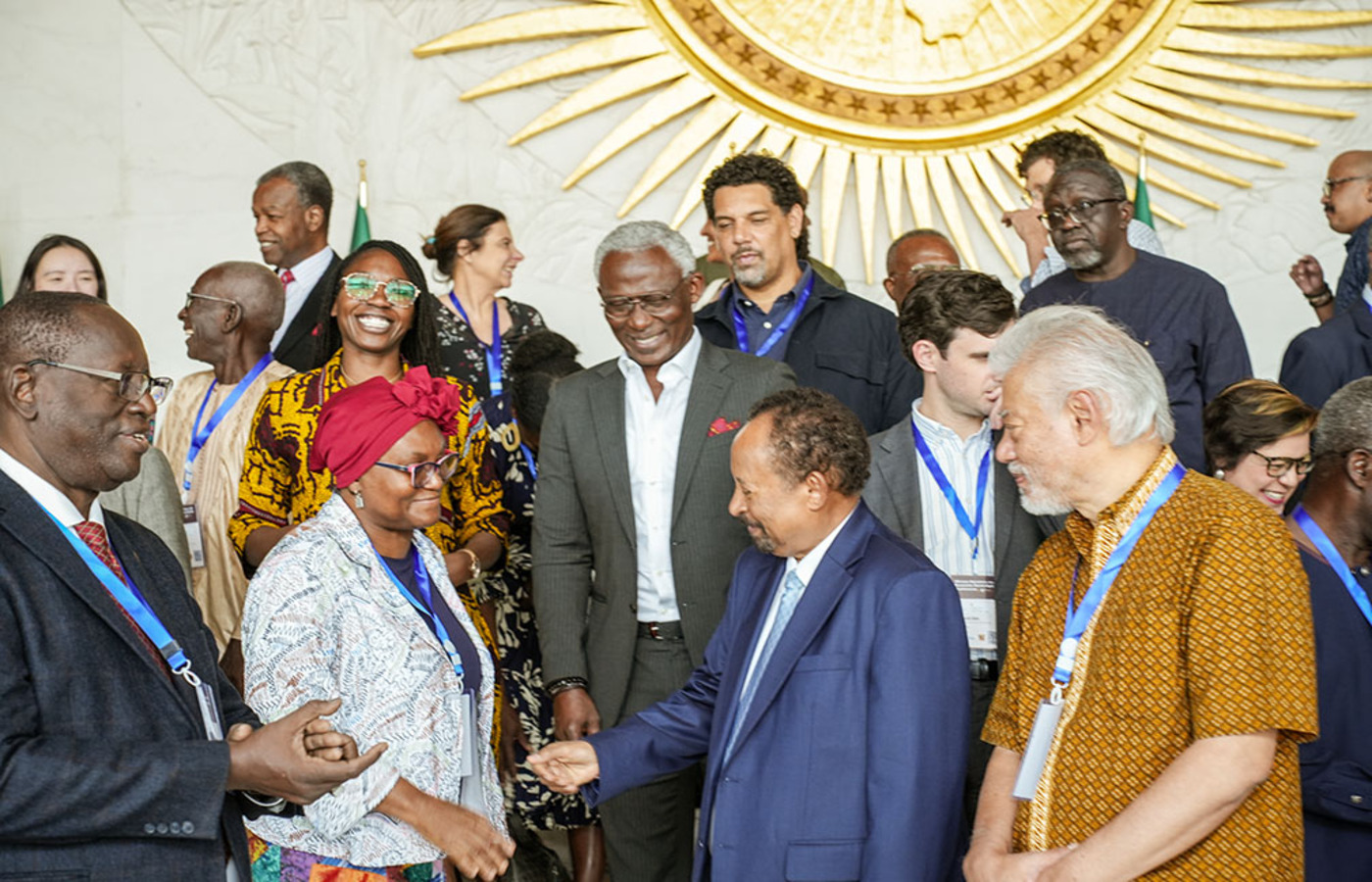
On October 09, 2024, the auditorium at the African Union headquarters was abuzz with activity as participants gathered for the Third African Monetary and Economic Sovereignty Conference. It had been two years since the last meeting in Dakar, where hopes were revived that Africa could take back control of its financial destiny through greater continental cooperation. Now leaders and thinkers had reconvened to review the progress made on those aspirations. As attendees found their seats, there was an air of cautious optimism as discussions around this critical topic had been ongoing for decades, but little concrete progress had been made. This conference aimed to shift those discussions into action.
Hippolyte Fofack (PhD), a research associate from Harvard University, stepped up to the podium to deliver the first presentation. He began by highlighting some concerning statistics about Africa's current economic situation. "Sixty percent of the world's poor are living in Africa despite the immense wealth and resources that exist across our lands. For too long, discussions around reforming the international financial system have failed to properly consider Africa's needs and priorities. Having a central bank and national currency is no longer enough to guarantee true monetary sovereignty in today's globalized world."
Fofack explained that Africa had surrendered more monetary sovereignty than any other region and remained marginalized in the global currency landscape. "More than 80 percent of African nations' debts are denominated in US dollars or euros, making them extremely vulnerable to monetary policy decisions by institutions like the US Federal Reserve and European Central Bank that they have no control over. For example, Germany can borrow at an interest rate of 2.2 percent for a 10-year bond while Nigeria pays over 20.5 percent." This undermined Africa's ability to direct public investment towards expanding human capital, especially in areas like education and healthcare, Fofack argued.
"The ratio of scientists per million inhabitants in sub-Saharan Africa is 95 compared to over 2,200 in Europe and East Asia. We cannot possibly develop and achieve our full potential under such constraints." Despite lower debt-to-GDP ratios than other regions on average, Africa suffered the most from being labeled as high risk for debt distress by institutions like the IMF. Fofack used the example of Ethiopia, one of Africa's fastest-growing economies that was still forced to enter an IMF program, to illustrate his point.
"Why would a country experiencing robust economic growth default on its debt if it truly had monetary sovereignty? The answer is the chronic deficit of control over monetary policies that disproportionately exposes even success stories like Ethiopia to the entrenched inequalities of the current system. Ethiopia's story represents Africa's story as a whole." In the absence of true monetary sovereignty, Fofack declared, economic sovereignty would remain elusive.
While African nations had central banks and currencies, none could claim to enjoy the full benefits and protections that sovereignty provides. They were at the mercy of international forces beyond their control. Fofack concluded by calling on African leaders to find new pathways towards gaining back sovereignty through continent-wide coordination and cooperation on monetary matters.
The journey towards African economic integration and sovereignty has been a long one spanning decades. In the aftermath of independence movements in the 1960s, many nations established their own central banks and currencies in an effort to assert control over monetary policy.
However, the legacy of colonialism left economies narrowly focused on raw material exports with little industrial capacity. This made newly independent states reliant on borrowing from Western financial institutions, which slowly eroded policy space. By the 1980s, spiraling debt levels forced governments to adopt damaging structural adjustment programs dictated by the IMF and World Bank. Currency devaluations disrupted trade within fragile regional blocs like ECOWAS while foreign debt ballooned.
As globalization accelerated in the 1990s, more African nations pegged their currencies to the dollar and euro for stability. But this came at the cost of true monetary independence as domestic conditions were overlooked. The lack of a unified continental strategy left each country vulnerable to external shocks and predatory lending practices.
The 1997 Asian financial crisis taught a harsh lesson about the need for autonomous decision-making capability. Early proposals for full African economic and monetary union were unveiled at the turn of the millennium as a means to pool sovereignty and defensive strengths. However, political will and technical preparedness fell short.
One of the presenters during the Third African Monetary and Economic Sovereignty Conference was Ndongo Samba Sylla, an economist from Senegal. He expressed skepticism about past proposals for monetary unification in Africa. "Lack of political will and the neoclassical economic ideology that has informed these agendas have made real unification difficult to achieve. I support greater integration in principle, but it can only happen alongside deeper political federalism."
Sylla reviewed three previous initiatives—establishing an African Central Bank, African Monetary Fund, and African Investment Bank—that were originally planned for 2023 but postponed until 2045. Regional bodies like the East African Community and ECOWAS had also pursued monetary cooperation with little success. "Monetary sovereignty is so important because it provides a limit against onerous international financial sanctions. We only need to look at what happened to Mali and Guinea recently to see this."
Both West African nations had faced sanctions from ECOWAS after military coups overthrew their governments. But where Guinea weathered the economic impacts because it has its own currency, Mali suffered significantly as it uses the CFA franc controlled by France. Financial coercion would not be possible against a country that had full control over its monetary policy space, according to Sylla. Fofack emphasized the need for Africa's major economies, like Nigeria, South Africa, and Egypt, to take leadership roles.
"I support greater integration in principle, but it can only happen alongside deeper political federalism," Sylla also issued a stark warning. Political federalism at the continental level must proceed incrementally and not be rushed based on artificial timelines set by others. Those claiming a monopoly on economic 'expertise' often pursue integration in a top-down manner, ignoring politics, which is why previous plans failed. For monetary union to have any chance, it must be a voluntary outcome of continental political synchronization, not prescribed from outside.
As the Third African Monetary and Economic Sovereignty Conference came to a close, there was a palpable sense of optimism in the air. While much work remained, the foundations had clearly been laid for Africans to work in solidarity and chart their own course. The initiatives spearheaded by early adopter nations provided living proof that alternative models respecting each country's unique circumstances could succeed where one-size-fits-all had failed.




