

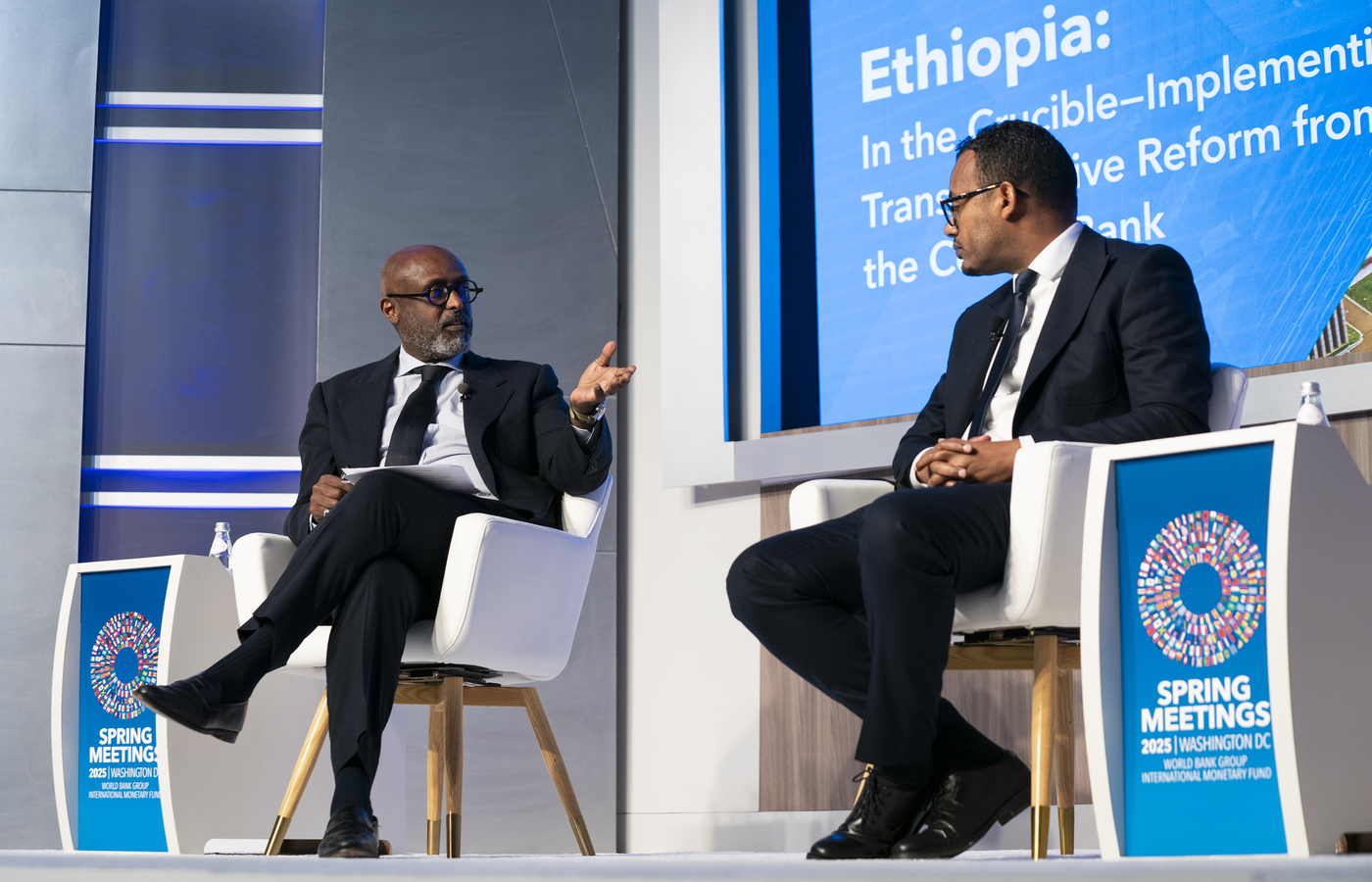
In a bold departure from decades of economic orthodoxy, Ethiopia’s central bank has pledged to halt all direct monetary financing of government deficits, marking a historic shift towards central bank independence and market-based discipline in one of Africa’s largest economies.
Governor Mamo Mihretu, speaking during the IMF’s Spring Meetings Governor’s Talk Series, said the National Bank of Ethiopia (NBE) would extend “zero credit to the treasury” in the current fiscal year — the first time in over a decade.
The move, he argued, signals Ethiopia’s commitment to fighting inflation and anchoring broader economic reforms aimed at liberalizing the financial sector and modernizing its monetary policy framework.
“For the first time in 12 years, we expect zero central bank credit to the treasury this fiscal year, reflecting prudent fiscal and monetary management,” Mamo told the audience, underscoring the gravity of the shift. “It is a significant moment for Ethiopia.”
The announcement comes as Ethiopia struggles to overcome the legacy of a development model heavily reliant on state-led investment, deficit financing, and foreign borrowing — a model that had delivered rapid growth but also left deep macroeconomic vulnerabilities exposed by recent shocks, including internal conflict, soaring inflation, and dwindling foreign reserves.
Overhauling a model embedded for half a century has proved no small task. Yet early results from Ethiopia’s monetary and financial reforms — launched under the Homegrown Economic Reform Program in 2019 and accelerated under Mamo’s leadership since January 2023 — are starting to emerge. Inflation, which had hovered around 30 percent for three consecutive years, has fallen to 13 percent as of March, with a target of 10 percent set for the next fiscal year, the lowest in a decade.
“Inflation is the core macroeconomic challenge we had to confront,” Mamo said. “Aligning Ethiopia’s monetary policy framework with peer countries required historic reforms.”
At the heart of the central bank’s strategy has been a comprehensive retooling of its operational framework. The NBE has introduced a policy rate, launched open market operations, established an interbank money market for banks to manage liquidity, and created a new Monetary Policy Committee to independently assess economic conditions and recommend interest rate moves.
Most importantly, the revised Central Bank Act now prioritizes price stability as the primary mandate — a landmark shift in Ethiopia’s monetary governance.
An End to Monetary Expansion
For years, the Ethiopian government had relied on the NBE’s balance sheet to finance budget shortfalls, a practice known as monetary financing. While politically convenient, the result was steady monetary expansion that fueled inflationary pressures and distorted economic incentives, leaving local currency assets unattractive and undermining private sector credit growth.
Ending this cycle, Mamo argued, was essential. “Previously, inflation had become entrenched. Financial repression meant savers were penalized, and the private sector was crowded out. Now, key interest rates, including the policy rate, interbank rate, and treasury bill rate, are positive in real terms.”
The effects are beginning to show. Today, 80 percent of new credit in Ethiopia supports the private sector, reversing a long-standing pattern where state-owned enterprises dominated bank lending. At the same time, treasury bills are increasingly priced at market rates, offering genuine returns to investors and tightening fiscal discipline on the government.
“This is a fundamental change,” Mamo emphasized. “It will foster a more dynamic, investment-driven economy.”
Currency Liberalization and FX Market Reform
Monetary tightening has been paired with a sweeping liberalization of Ethiopia’s foreign exchange regime — arguably the most politically sensitive component of the reform package.
For nearly 50 years, Ethiopia maintained a tightly controlled FX regime, leading to chronic shortages of hard currency, distorted incentives for exporters and importers alike, and a flourishing parallel market.
Under Mamo’s stewardship, the NBE has dismantled the old framework, moving towards a market-determined exchange rate and streamlining 87 outdated directives into a single, accessible regulation.
“This is not merely a devaluation,” Mamo said. “It is a comprehensive liberalization — the first of its kind in five decades.”
Banks are now allowed to retain foreign currency earnings, companies can access external credit more easily, and new operators — including FX bureaus and foreign portfolio investors — have entered the market. Surrender requirements, which once forced exporters to sell hard currency to the central bank at below-market rates, have been scrapped.
The early impacts have been significant: exports are projected to double this year, remittance inflows have risen by at least 25 percent, and foreign exchange reserves have tripled at the NBE and doubled across the banking system.
“Most importantly, the private sector now finds it easier to access foreign exchange,” Mamo said, adding that previously, manufacturers were among the sectors hardest hit by dollar shortages under the old regime.
Yet, challenges persist. Deepening the FX market and fostering genuine competition among banks remains a priority. The gap between the official exchange rate and the parallel market, while narrowing, continues to draw scrutiny.
“Transitioning to an efficient FX market takes time,” Mamo acknowledged. “We remain vigilant, monitoring dynamics and making targeted policy adjustments.”
Communication Strategy: Managing Expectations
Another critical component of the reform agenda, Mamo stressed, has been public communication. In a country where economic literacy varies widely and where the population has grown used to fixed prices and official interventions, explaining the complexity — and temporary pain — of market liberalization has required careful messaging.
“Effective communication is critical for building credibility,” he said. “At the NBE, we invest significant effort in transparent, professional, and integrity-driven messaging.”
The central bank’s strategy has emphasized patience and transparency: avoiding overreactions to short-term market fluctuations, and consistently delivering on promises to earn public trust.
“We tolerate some uncertainty,” Mamo said. “But we remain evidence-driven in our approach.”
He cited gold exports as an example where surging receipts allowed the NBE to intervene strategically to stabilize the market without derailing broader liberalization efforts.
Financial Sector Opening: A Parallel Revolution
Beyond monetary tightening and FX liberalization, Ethiopia is also embarking on a sweeping financial sector reform, aiming to modernize a banking system long dominated by state-owned institutions and closed to foreign competition.
Key changes include a new Banking Business Proclamation that opens Ethiopia’s banking sector to foreign entrants — a seismic shift in a market previously shielded from outside players. The Commercial Bank of Ethiopia, the country’s largest financial institution, has been recapitalized to ensure its financial stability amid rising competition.
Meanwhile, regulatory reforms seek to promote financial deepening, inclusion, and digitization — areas where Ethiopia has lagged behind its continental peers.
“These reforms align with our monetary and FX measures,” Mamo explained. “We are creating a coherent strategy to support sustainable, private sector-led growth.”
Still, analysts caution that Ethiopia’s banking sector remains fragile, with high levels of non-performing loans and a legacy of directed lending to politically favored sectors. Navigating the transition without triggering instability will require careful sequencing and regulatory vigilance.
Risks Ahead: Political and External Pressures
Despite the early wins, Ethiopia’s reformers are not without their critics — or their risks. The political environment remains volatile following years of civil conflict, and inflationary pressures could resurface if fiscal consolidation falters.
Moreover, while external financing needs have eased somewhat, Ethiopia still faces the complex task of restructuring its external debt under the G20 Common Framework — a process that has moved slowly, hampered by disagreements among creditors.
Governor Mamo, for his part, acknowledges the challenges. “Not everything goes as planned,” he said. “The need for adaptive skills — the mindset of learning, diagnosing, and recalibrating — is vital.”
Indeed, Mamo credits the doubling of exports as a positive surprise, but cautions against complacency. “Preparation matters. We invested significant time in internal analysis and inter-agency coordination to ensure a cohesive, government-wide approach,” he said. “Sequencing reforms — tightening monetary and fiscal policies before liberalizing the FX regime — has been critical.”
Looking Ahead: Building a New Economic Architecture
The next phase of Ethiopia’s agenda, Mamo said, will focus on deepening reforms: transitioning to a full-fledged inflation-targeting framework, enhancing the depth and competitiveness of the FX market, and addressing remaining macroeconomic vulnerabilities.
If successful, these steps could establish a durable foundation for Ethiopia’s ambitions to become a middle-income economy and a magnet for private investment in Africa.
“As Africa’s third-largest economy,” Mamo concluded, “a strong macroeconomic foundation will sustain productivity, attract private capital, and drive growth in the years ahead.”
Yet the stakes are high. Ethiopia’s economic transformation remains a work in progress — one that will test the resilience not only of its institutions, but of its political system and social contract.
The declaration of “zero credit to the treasury” may be the clearest signal yet that the old model is over. Whether the new one can withstand the inevitable shocks ahead will define Ethiopia’s future for decades to come.




