

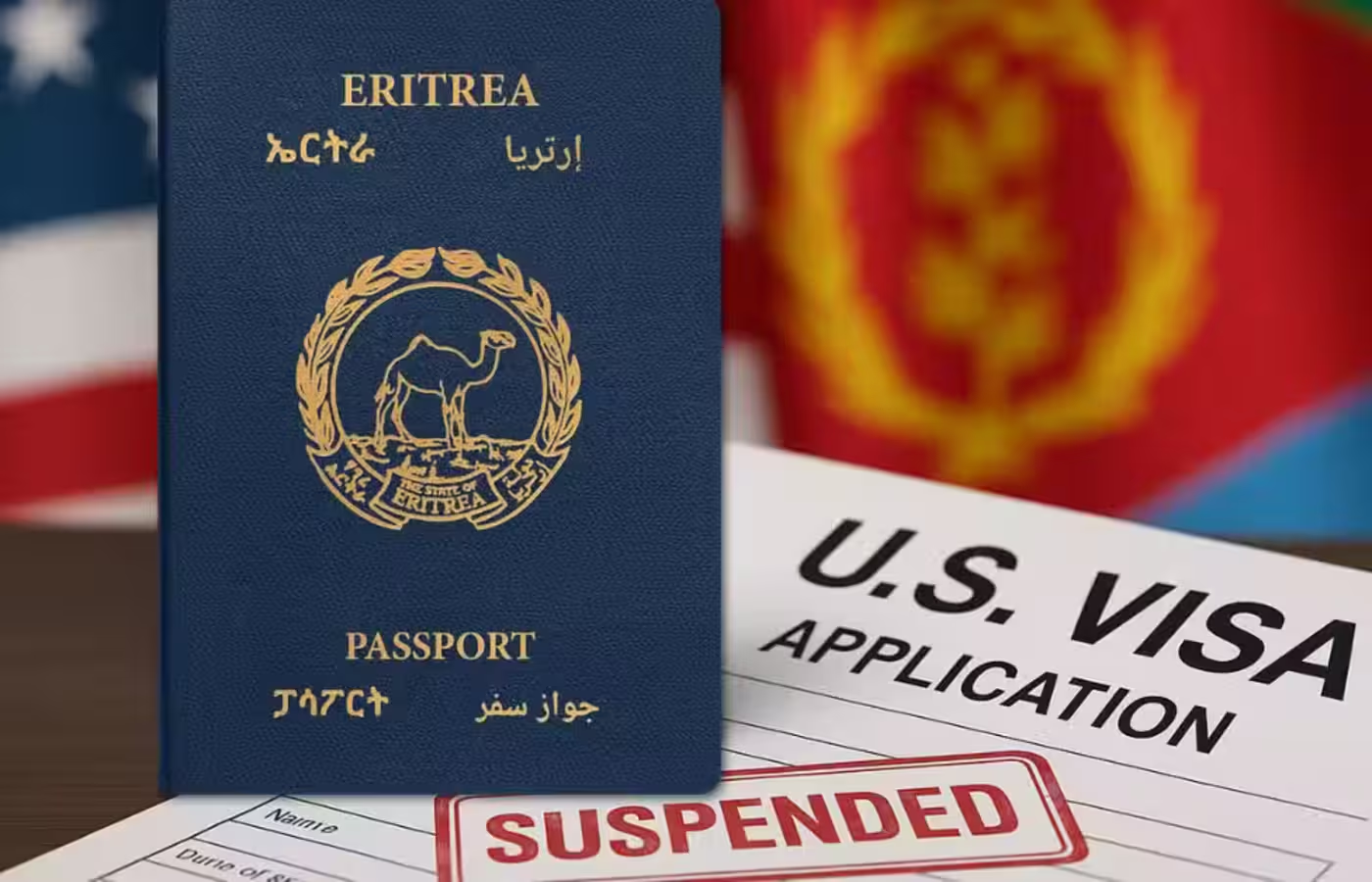
US President Donald Trump’s latest immigration crackdown took effect on Monday, barring citizens of 12 countries—including Eritrea—from entering the United States. The move, issued through a presidential proclamation, marks a significant expansion of the former president’s controversial travel restrictions and is already drawing diplomatic backlash across Africa and Latin America.
Under the new policy, nationals of Afghanistan, Myanmar, Chad, Congo-Brazzaville, Equatorial Guinea, Eritrea, Haiti, Iran, Libya, Somalia, Sudan, and Yemen are subject to a full entry ban. A further seven countries—including Cuba, Venezuela, and four other African states—face partial restrictions that limit access to student, work, and business visas.
The US administration cited “national security and immigration integrity” as the main drivers of the policy, saying these nations have either failed to adequately share security information or have visa overstay rates considered too high. President Trump said on his Truth Social platform: “We cannot have open migration from any country where we cannot safely and reliably vet and screen those who seek to enter the United States.”
For Eritrea, the decision represents a fresh diplomatic and economic blow. The Horn of Africa nation, already subject to limited international engagement and under unilateral sanctions by several Western countries, now faces new barriers that could disrupt vital remittance flows and deepen its economic isolation.
Eritrea’s government has not yet issued an official response, but political analysts in Asmara say the move will likely reinforce the regime’s long-standing belief that the international system is stacked against it.
“This ban will do more harm to ordinary Eritreans than to the state,” said a regional migration analyst. “Families depend on the diaspora, and the US has been a key destination for Eritrean refugees, students, and workers for over two decades.”
With an estimated one-third of Eritreans living abroad, primarily in the US, Europe, and the Gulf, remittances have become a critical source of foreign exchange—accounting for up to 30 percent of the country’s GDP, according to World Bank estimates.
The travel restrictions will likely curtail new migration, shrink the remittance base, and further complicate family reunification processes.
The reaction across Africa has been mixed. Chad’s President Mahamat Déby announced reciprocal measures, suspending visa issuance to US citizens, and stating that while Chad may lack financial muscle, “it has its dignity and pride.”
Somalia, also on the banned list, opted for a conciliatory approach, pledging to work with Washington to address its concerns. “Somalia values its longstanding relationship with the United States and stands ready to engage in dialogue,” said its ambassador in Washington, Dahir Hassan Abdi.
The African Union, which represents all 55 countries on the continent, expressed “deep concern” over the implications of the ban. In a carefully worded statement, the AU urged the US to engage in “constructive dialogue” and to ensure any national security measures remain “balanced, evidence-based, and reflective of the longstanding partnership” between Africa and the United States.
In Eritrea, where exit visas and government control over remittance channels already complicate mobility and financial flows, the ban is expected to accelerate reliance on irregular migration and informal transfer systems—networks that often expose vulnerable migrants to extortion, trafficking, and financial loss.
“The legal pathway to the US just got shut down for Eritreans, but the desire to leave hasn’t,” added the regional analyst. “What’s likely to follow is a spike in dangerous journeys via Sudan and Libya, despite the risks.”
Venezuela, one of the seven nations facing partial restrictions, responded in stark terms. Interior Minister Diosdado Cabello warned Venezuelans living in the US that their presence there posed “a big risk” and called the US “a fascist state run by supremacists.”
The policy, which Trump says will be reviewed every six months, leaves open the possibility that countries could be removed or added depending on improvements—or deteriorations—in security cooperation and immigration management.




