

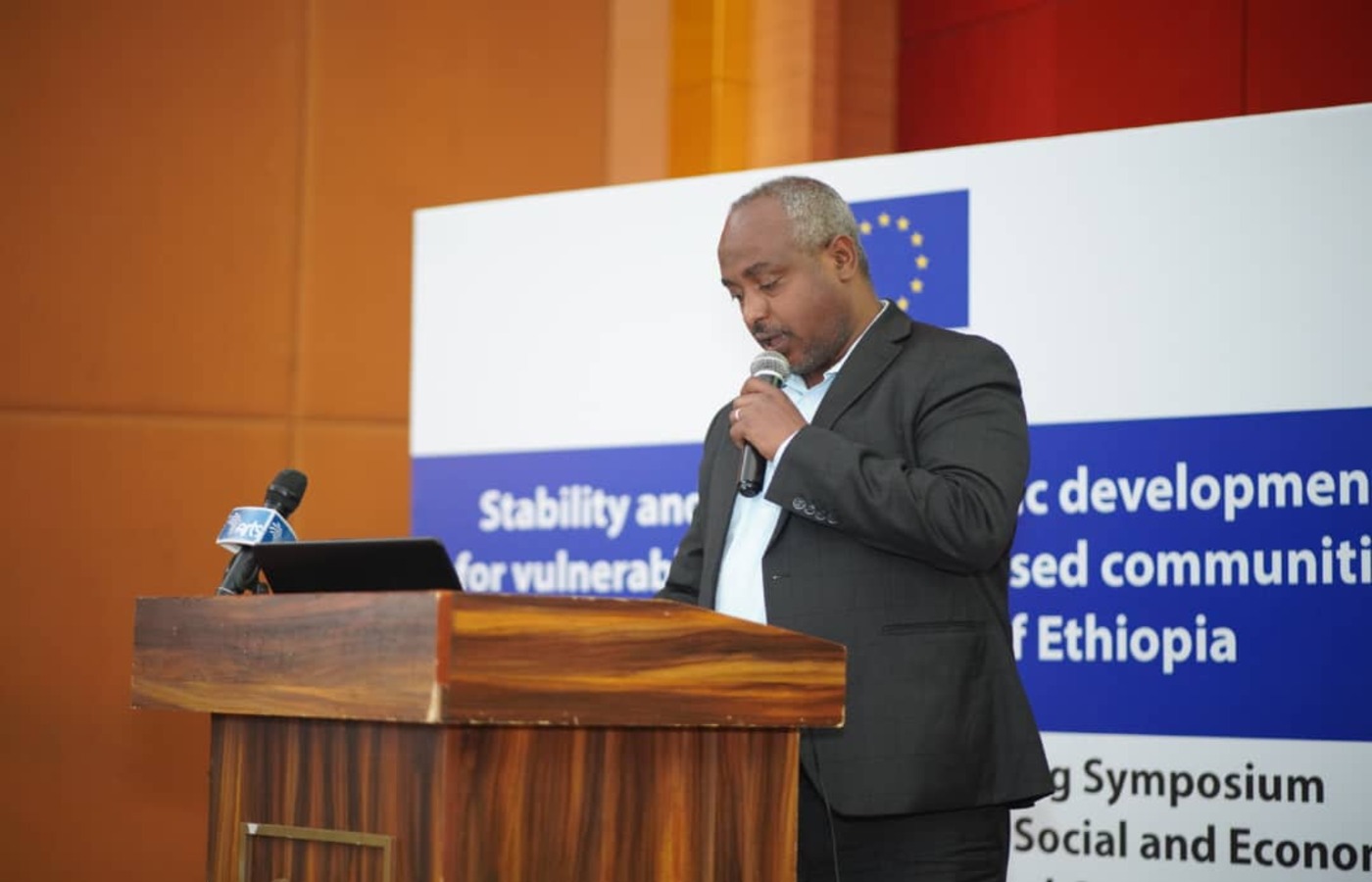
The European Union, in partnership with CST Ethiopia, held a learning symposium for a post-conflict recovery programme in Tigray, focusing on peacebuilding, socio-economic development, and community resilience.
The initiative, titled “Stability and Socio-Economic Development for Vulnerable and Marginalized Communities in the Tigray Region of Ethiopia,” was launched in 2021 and is funded through the EU Trust Fund (EUTF). It is implemented by a consortium including Adigrat University, Mekelle University, Catholic Relief Services, Fair & Sustainable Ethiopia, the Relief Society of Tigray, VIS, and the Ethiopian Catholic Church Social and Development Commission (Adigrat Branch). The programme operates across 11 woredas in central, eastern, and south-eastern Tigray, as well as the Mekelle City Administration.
Project manager Abraha Gebremariam said the programme aims to reach 270,000 people, with 50 percent comprising women, youth, and people with disabilities. He outlined the initiative’s main components: “Mental health post-war services for trauma healing to enable communities to return to socio-economic activities; legal aid including court representation; capacity-building training provided by universities; and humanitarian activities, with 54 percent of women engaged in agricultural work and about 4,000 households participating in small business activities supported by 30 million birr in loans.”
Since its launch, the initiative has reached more than 275,000 people. Activities include training 690 community peace agents and 100 religious leaders in conflict resolution and trauma healing, providing specialised mental health care to 420 individuals, running 1,104 group therapy sessions, offering legal aid services to 950 community members, establishing eight community-managed peace parks, and creating 30 school-based Green and Peace Clubs.
Speaking at the Learning Symposium held in Addis Ababa on October 14, 2025, CST Ethiopia Country Director Tamirat Belay described the organisation’s long-standing presence in Ethiopia and noted the project’s emphasis on partnership and localisation with local secular and faith-based organisations.
Editor’s Note: An earlier version of this article referred to the October 14 event as a “launching workshop.” It has been corrected to reflect that it was a learning symposium for a project that was launched in 2021.




