

By Bayu Samuel
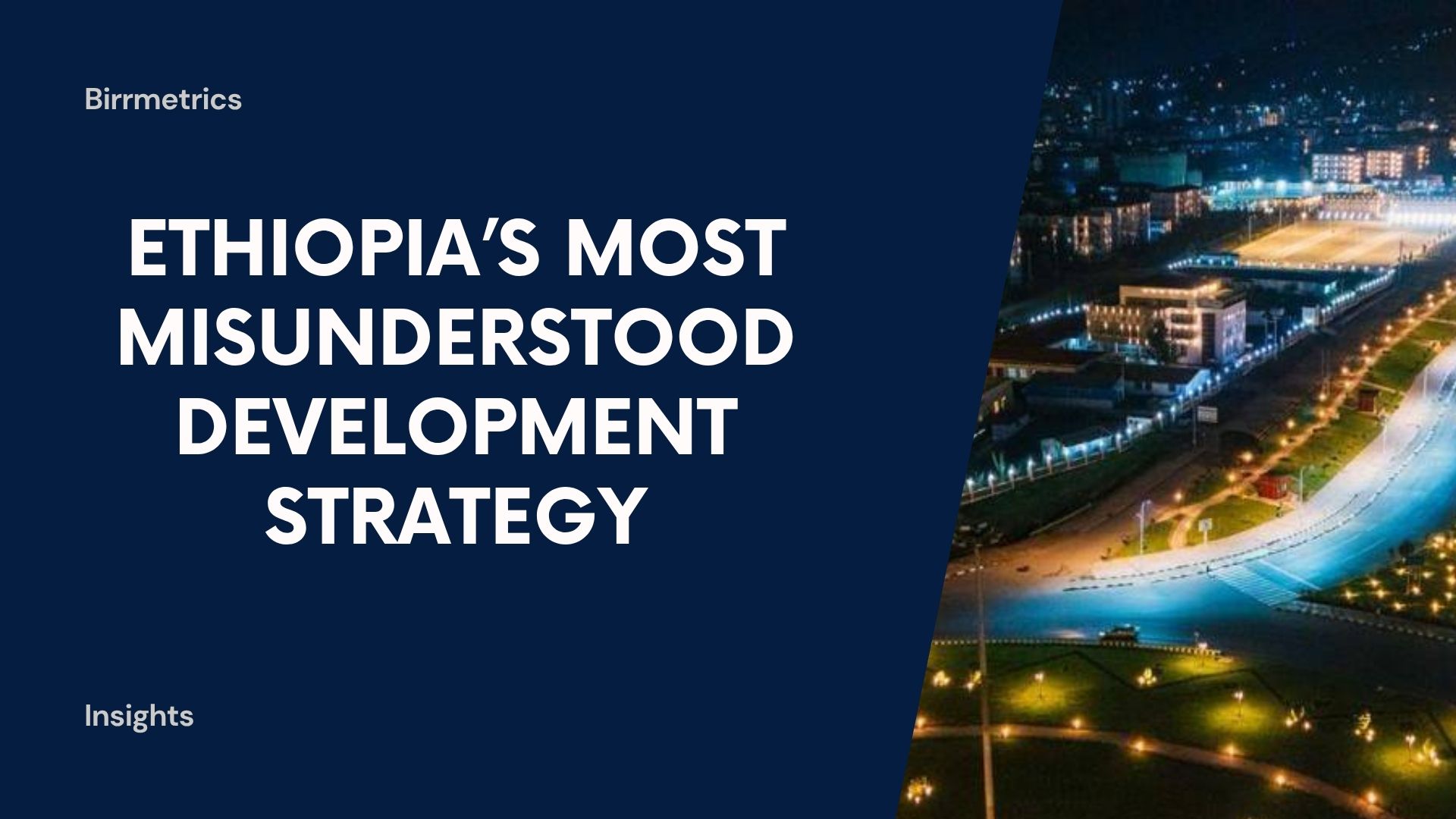
For much of the past decade, Ethiopia’s economic story has been told in binaries: growth or stagnation, reform or inertia, hope or insolvency. These simplistic narratives obscure the real challenges the country faces, and, in doing so, overlook one of its most quietly transformative initiatives: the Addis Ababa Corridor Development Program. Often dismissed as little more than an urban facelift, this strategy is, in fact, a pragmatic response to Ethiopia’s structural constraints, and one of the few tools capable of generating growth without deepening dependence on scarce foreign exchange.

Following the end of Ethiopia’s credit-fuelled investment boom of the 2010s, the country confronted a familiar development trap: depleted foreign-exchange reserves, constrained imports, and rising public debt. Industrialisation—long seen as the path to transformation—became increasingly difficult, given the foreign-currency requirements for machinery, spare parts, and technical expertise.
It was within this context that the corridor strategy emerged. Rather than seeking to impress with grandiose projects, it leverages what Ethiopia has in abundance—labor, land, and domestic materials—to generate activity that produces value almost immediately. Unlike mega-dams or industrial parks, which require years and billions of birr before yielding returns, corridors begin enhancing productivity within months of breaking ground.
The corridor program’s impact is already evident. It employs thousands of engineers, construction workers, and small suppliers, injecting income directly into urban communities. The World Bank–supported Urban Institutional and Infrastructure Development Program, a precursor to the Addis corridor effort, created over 1.1 million jobs across 117 cities in just six years.
But employment is only the first layer of impact. By improving traffic flow, reducing travel time, and expanding access to markets, corridors enhance productivity across entire urban systems. Informal traders gain safer, more permanent spaces, while businesses can operate more efficiently. Each kilometer of upgraded road multiplies economic returns—raising land values, tax receipts, and overall productivity. In a foreign-exchange-starved economy, this internally financed growth is invaluable.

Ethiopia’s informal economy, long overlooked, is central to this strategy. Millions of traders operate from sidewalks and street corners because that is where customers are. Corridor planning does not attempt to erase these livelihoods; it formalizes them. By integrating market stalls, pedestrian zones, and small-business clusters into urban design, the program gives informal workers a foothold in the formal economy. With an official address, traders gain access to credit, can pay taxes, and contribute to municipal revenues. This is urban renewal that stabilizes livelihoods rather than undermining them.
The corridor approach also draws lessons from global experience. Infrastructure-led stimulus is not new: during the Great Depression, New York’s bridges and parkways employed thousands and reshaped the city for decades. More recently, London’s Elizabeth Line and China’s Yangtze River corridors have generated jobs and connected previously isolated districts, boosting domestic trade. Ethiopia’s corridors follow the same logic: invest in connective tissue—roads, drains, transit hubs, and public spaces—to convert chaotic growth into coherent productivity. Here, infrastructure is economic policy, not decoration.
Critics rightly point to displacement and disruption as concerns. Yet every city that has successfully transformed—from Seoul to São Paulo—faced similar resistance. The crucial question is not whether development proceeds, but how it is executed. Transparent planning, fair compensation, and community engagement must be central. When done responsibly, corridor development improves opportunities for the poor, rather than imposing static hardship through inaction.
Finally, the corridors are symbolic. At a time when many Ethiopians question the state’s capacity to deliver complex projects, visible progress restores confidence in institutions. Roads are being paved, markets rebuilt, and districts connected. Credibility, once established, is itself a form of economic capital, attracting investment and fostering trust between citizens and government.
Corridor development alone will not resolve Ethiopia’s macroeconomic challenges. It cannot replenish foreign reserves or erase debt overnight. But it makes the economy more functional, cities more efficient, and people more employable. In a context defined by scarcity and constraint, it represents a rare form of pragmatic innovation. Rather than a distraction, it is the work that matters—a blueprint for adaptation demonstrating that even under tight constraints, intelligent design can unlock prosperity.
Before dismissing the next stretch of concrete poured along Addis Ababa’s avenues, it is worth remembering: the road itself may be Ethiopia’s most viable path out of the economic gridlock it has faced for nearly a decade.
Bayu Samuel is a Strategy & Investment Analyst with experience across Ethiopia’s public and private sectors. He holds a BSc from Addis Ababa University and applies expertise in securities, financial modeling, and game theory to guide investment decisions. He is currently an Associate at ACE Investment and Impact Advisors and previously served as a Senior Analyst at the FDRE Land Bank and Development Corporation.




