


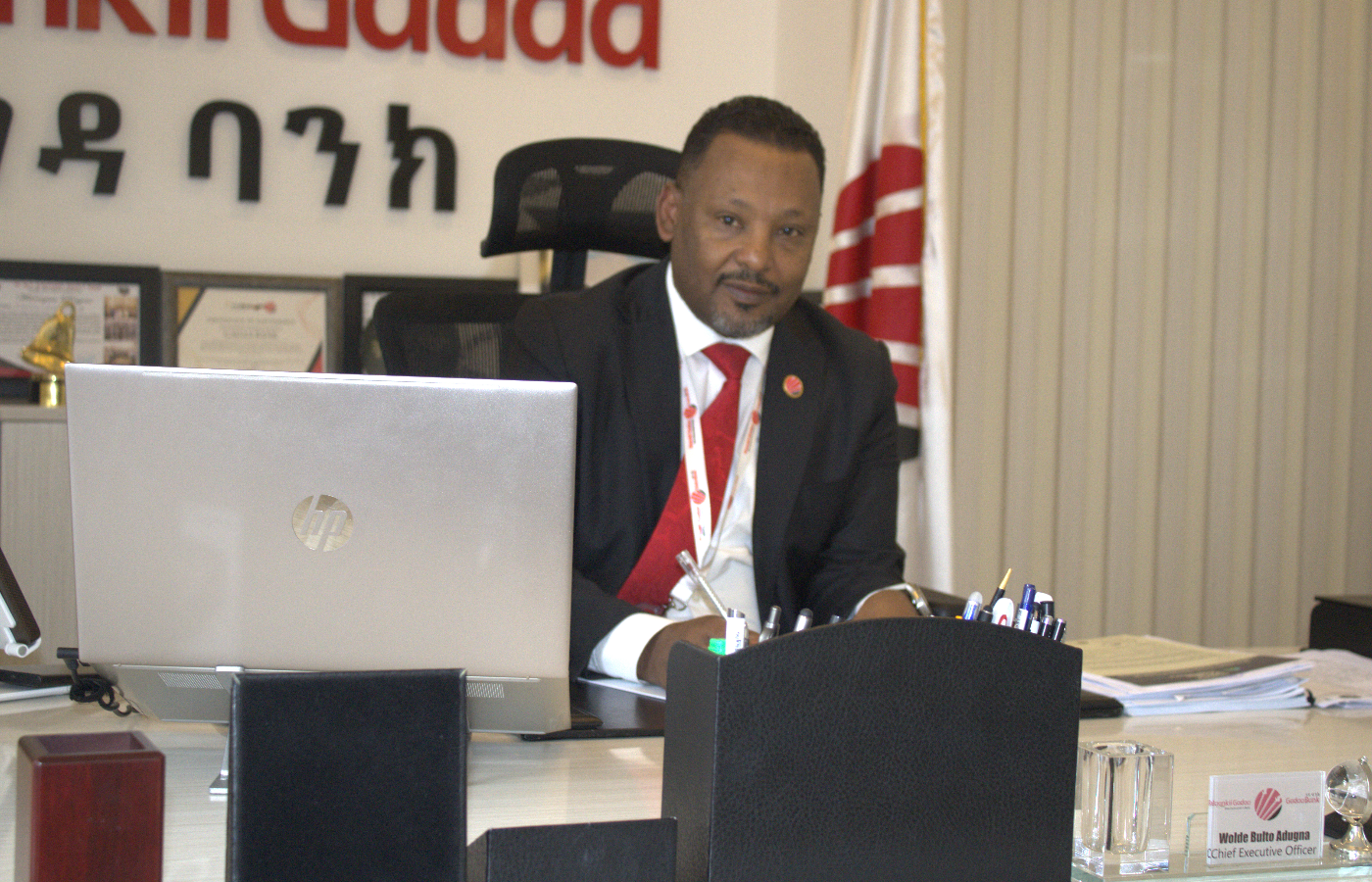
Gadaa Bank is still new to Ethiopia’s banking sector, but in less than three years it has navigated significant challenges while pursuing growth. Chief Executive Wolde Bulto spoke with Birrmetrics’ Amanuel Kindeya about the pressures facing new banks, including regulatory shifts, non-performing loans, and the potential impact of forced mergers. He also highlighted the bank’s focus on strategic partnerships and exploring opportunities as it works to secure a stable foothold in the industry.
Q: When Gadaa Bank entered the industry, what new practices did it bring? Let’s start with the challenges and opportunities you encountered as a new bank.
A: Gadaa Bank entered the market just under three years ago, at a time of significant turbulence. The banking sector was grappling with COVID-19, the conflict in the northern regions, and a widespread foreign currency shortage. Starting operations under these conditions was costly and complex.
At the same time, the National Bank of Ethiopia (NBE) issued a directive requiring banks to raise their minimum paid-up capital from 500 million to 5 billion birr. With the commitment of our founders, we navigated these challenges, aligning our short- and long-term strategies with the prevailing circumstances. At that moment, the bank’s paid-up capital stood at 551 million Birr, with a pledged capital of 1.2 billion Birr.
A key challenge was anticipating shareholder concerns. Market volatility and inflation had eroded the real value of their investment, so we had to craft a strategy that reassured founders while safeguarding the bank’s growth potential.
Another hurdle was a new National Bank directive requiring all new banks to be fully supported by Information Technology systems. Unlike older banks operating with conventional, low-cost processes, this mandate demanded imported technology and foreign currency, constraining our operations and limiting our ability to plan for the future.
Despite these pressures, these challenges shaped Gadaa Bank’s approach. They forced us to innovate, think strategically, and build resilience from day one. In many ways, no other new bank in the sector has faced such a rigorous test.
Q: There is criticism that Ethiopia’s banking landscape is not favorable for new entrants. Considering the challenges you just mentioned, how do you assess this?
A: The challenge is broader than banking. In Ethiopia, newly established organizations often face an uphill reception, and banks are no exception. From our perspective at Gadaaa Bank, the environment is far from favourable. Frequent changes in directives, particularly those from the central bank concerning Information Technology, demand substantial foreign currency, something not easily accessible to new banks.
At the same time, rising prices for goods and essential banking inputs added pressure. In some cases, we even negotiated to pay in birr for technological equipment, which was unusual and challenging. To navigate these conditions, we adopted a focused cost-saving strategy: reducing branch numbers, lowering rent expenses, and optimising leased spaces.
Even amid these obstacles, we remained confident in the bank’s profitability. That said, the industry’s initial reception of Gadaa Bank was discouraging and, frankly, morale-challenging. Overall, I believe the work culture in Ethiopia is particularly tough on new startups, and the banking sector exemplifies that reality.
Q: The Central Bank has issued a directive requiring banks to increase their capital from 500 million to 5 billion Birr. Do you believe Geda Bank is on track to meet this within the set timeframe?
A: The conditions are undoubtedly challenging. However, the action plan we submitted to the NBE has been assessed positively by its officials, who indicated that it shows strong potential for effectiveness. The directive allows five years for existing banks and seven years for new entrants. For Gadaa Bank, this sets the target year at 2029 in the Ethiopian calendar, and based on our current assessment, we are confident we can meet the minimum capital requirement.
It is important to consider how banks approached capital growth before this directive. Many relied on annual profit distributions to increase capital. Given the structural changes in the banking industry and the challenges we discussed earlier, meeting these requirements is more difficult for newer banks like ours. Still, with careful planning and a focused strategy, we believe the goal is achievable.
Q: Some suggest that bank growth in Ethiopia is not proportional to overall national economic growth. How should a bank’s growth performance be measured?
A: This is a fundamental question. Banks operate under multiple risks, including operational, credit, liquidity, and funding risks. To mitigate these, they often pursue strategies such as increasing capital, a practice supported by international banking standards and research.
However, in a national economy with limited resources and structural constraints, measuring bank growth against the broader economy can be misleading. In Ethiopia, directives often precede a full study of the business environment, creating a potential misalignment between regulatory expectations and practical realities.
While it is true that bank growth and economic activity are not always proportional, focusing solely on capital growth as a measure of a bank’s contribution to the economy is a misunderstanding. A bank’s growth should be assessed not just by capital or profits, but also by its ability to manage risks, support economic activity, and sustain operations under challenging conditions. From this perspective, the current debate about banks’ contribution to national growth requires a more nuanced view.
Q: Another concern is bank consolidation, which some say could challenge new entrants like Gadaa Bank. As the CEO, how do you view this?
A: Bank consolidation is a sensitive topic. At Gadaa Bank, our growth strategy focuses on collaboration and strategic partnerships. This could include alliances with other domestic banks, mergers, or even partnerships with foreign institutions. For a growth-oriented bank like ours, such strategic alliances can be healthy and constructive.
However, the idea that a bank should be forced to merge solely because it fails to meet a capital requirement is problematic. That approach relies on legal pressure rather than aligning with a bank’s growth strategy. Gadaa Bank, for instance, became profitable in its seventh month of operation, and we believe that continuing our current approach will enable us to meet both regulatory and market expectations.
Forced consolidation, without considering business strategy, philosophy, and model, could discourage investment in the sector. I believe it should be approached with caution and clear guidelines, ensuring that it supports, rather than undermines, the growth of emerging banks.
Q: Do non-performing loans pose a negative impact on startup banks?
Wolde Bulto: Absolutely. Startup banks often lack the established capital base and long-term clients needed to absorb such risks. Banks operate primarily by lending from the deposits they collect, so a heavy non-performing loan burden can strain their operations.
In Ethiopia, the situation in recent years has been particularly challenging and, at times, unpredictable. Directives were sometimes issued before fully assessing the realities of banking operations, adding to the difficulty. Nevertheless, the strategies and procedures we have implemented at Gadaa Bank provide the resilience and capacity to manage these pressures effectively.
Q: What are Gadaa Bank’s business expansion plans, and how is the bank moving forward with them?
A: Although Gadaa Bank is a recent entrant to the sector, we are keen to leverage emerging opportunities in the economy. One of the key openings we identified was in the capital markets, and we see this as a strong avenue for growth. Banks that actively participate in these new markets are generally better positioned, and Geda Bank is moving strategically to take advantage of these opportunities.




