

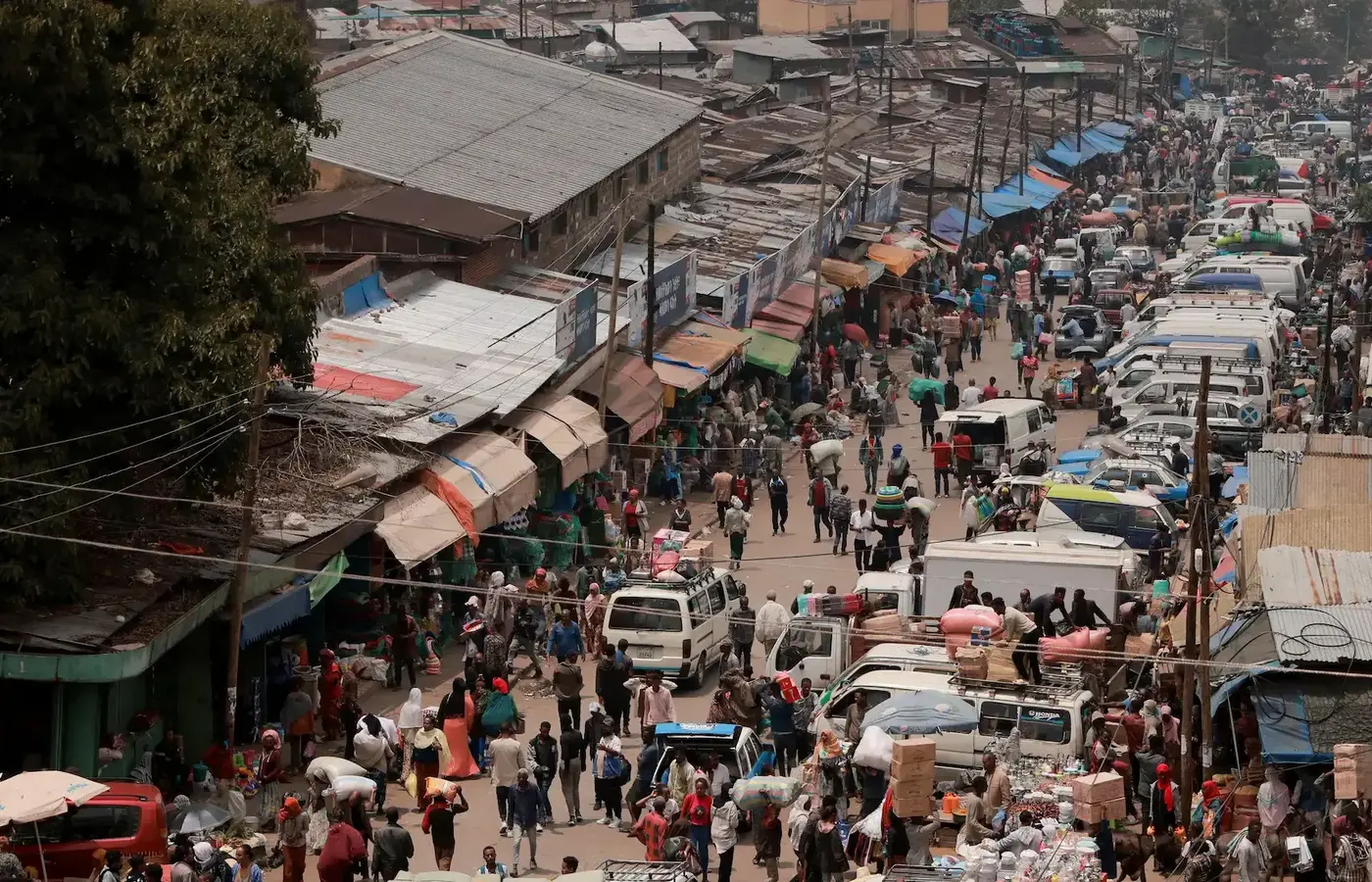
Ethiopia’s economy hums with small enterprises. In the dusty alleys of Addis Ababa’s markets, in the workshops of shoe-makers and carpenters, and on the fringes of urban agriculture, micro, small, and medium enterprises (MSMEs) provide livelihoods for millions. Yet for decades, these businesses—vital to employment, innovation, and GDP growth—have struggled to access the financial lifeblood they need. Banks prefer large firms, financiers prize bricks over ideas, and collateral requirements often resemble a medieval relic.
At a recent Learning Symposium on Unlocking Finance for MSMEs, policymakers, financiers, technologists, and development actors convened in Addis Ababa to confront these challenges. Hosted by the LIWAY Programme, supported by Sweden’s Embassy and the Netherlands, and implemented by SNV and Mercy Corps, the event was a rare attempt to map Ethiopia’s fragmented finance ecosystem and chart a path toward inclusion.
As Nicola Eriksson, Sweden’s second secretary for private-sector development, explained, “MSMEs drive innovation, create jobs, and contribute significantly to Ethiopia’s GDP. Yet access to finance remains a persistent challenge. High interest rates, collateral requirements, and limited financial literacy often hinder the potential of these businesses—particularly those led by women and youth.”
Financial exclusion in Ethiopia is both systemic and structural. Banks operate under a risk-averse paradigm shaped by regulation, limited competition, and a history of state dominance. MSMEs, which often rely on informal records, minimal assets, and flexible operations, are deemed risky, costly, and opaque.
According to the International Finance Corporation (IFC), more than 40 percent of Ethiopian businesses cite access to finance as a primary barrier to growth. Among MSMEs, the proportion rises to roughly 60 percent. Female and youth entrepreneurs face additional hurdles, often due to prevailing gender norms and lack of collateral.
Yewbdar Hailu, LIWAY project leader, outlined the twin obstacles: “From the financial institutions’ side, challenges include reliance on physical collateral, high operational costs, lack of tailored products, and gendered lending biases. From the MSEs’ perspective, barriers include insufficient collateral, complex loan procedures, limited financial records, and restricted access to appropriate financial products.”
In practice, this leaves Ethiopia’s smallest businesses in a catch-22: banks are unwilling to lend without assets or data, while MSMEs remain informal and undercapitalized, unable to build the credibility banks require.
Collateral in Ethiopia is not merely a risk-management tool—it is a cultural obsession. Banks prefer immovable assets: land, buildings, machinery. For most MSMEs, however, assets are movable: inventory, livestock, tools, or receivables.
“Only about 22 percent of MSMEs’ assets are fixed assets that banks accept,” said Bisrat Mulugeta, an IFC specialist. “The rest are movable assets. That mismatch keeps many businesses locked out of finance.”
Recognizing this constraint, Ethiopia has undertaken a quiet legal revolution. A Movable Property Security Rights Proclamation has formalized the ability to use movable assets as collateral, backed by a national collateral registry. Enforcement mechanisms and digital registration now allow farmers and traders to leverage grain, livestock, equipment, or warehouse receipts to secure loans.
The impact is significant: over 105,000 loans worth 4.9 trillion birr have been registered against movable assets, with nearly 10,000 MSMEs accessing 356 billion birr. In some cases, cows, sheep, or stacked sacks of grain serve as guarantees.
“Cows and sheep can now unlock finance,” said Mr Mulugeta. “That’s a big deal.”
Agricultural SMEs face uniquely volatile conditions: unpredictable rainfall, price swings, and limited liquidity. The new movable asset framework has enabled warehouse-receipt financing, allowing farmers to store produce in certified facilities and use receipts as collateral. Products include wheat, teff, maize, and barley, unlocking loans for both trading and farm operations.
The system has disbursed 2.7 billion birr to date, with early-stage livestock lending pilots contributing another 20 million birr. These innovations are slowly integrating Ethiopia’s rural economy into the broader financial system, though challenges persist, including slow adoption of regulatory reforms and limited secondary markets.
Cash, for small business owners, is a double-edged sword. It can be diverted to urgent personal needs, undermining business growth and repayment discipline. Rays Microfinance Institution has pioneered an alternative: item-based digital lending.
Instead of cash, entrepreneurs receive inventory—electronics, groceries, or raw materials—delivered directly to their shops. Payments are handled via Rays’ Sahay Pay digital wallet platform.
“If I give cash, it might go to school fees or bills,” explained Abdi Kemal, CTO at Rays. “If I give milk, bread, and water, the business opens tomorrow. The loan is used as intended.”
Digital tools allow Rays to track borrowers’ transactional behaviour: cash-ins, cash-outs, bill payments, and merchant activity feed into hybrid AI credit models. These models suggest loan limits, but human officers verify decisions, creating a hybrid digital-human system.
“We trust data,” Kemal said. “Data shows how you behave, not how you look. Banks offer you an umbrella when it’s sunny—we must prepare for the rain.”
The results are promising: over 161 million birr has been disbursed to 4,000 women and youth, with high repayment rates and reduced operational costs. Early assessments by Agar Consulting confirm that such hybrid models are effective in transitional markets, where trust, technology, and human judgment must coexist.
Ethiopia’s challenges are compounded in regions affected by conflict. Here, MSMEs often lack assets, credit histories, or even formal business registration. Adeday Microfinance, through its Economic Recovery for Conflict-Affected People (ER-CAP) Project, has piloted approaches to bridge this gap.
Loans are small—50,000 to 120,000 birr—and often secured only by business licences or group guarantees. Interest waivers, loan restructuring, and capacity-building complement financing, allowing entrepreneurs to restart operations after displacement or disruption.
“Seventy percent of our clients are women and youth,” said Yohannes G/Silassie, ER-CAP coordinator. “Only two percent are in default. That is tolerable.”
More than 600 informal businesses have received loans and financial literacy training, and many have formalized their operations within a year. The approach demonstrates that even in fragile contexts, tailored finance can catalyze recovery and inclusion.
While fintech and microfinance grab headlines, Ethiopia’s SACCOS (savings and credit cooperatives) remain a pillar of inclusive finance. Awacch SACCO, founded 19 years ago with 41 members and 15,600 birr, now serves 170,000 members, holding 17.5 billion birr in assets, with a loan portfolio exceeding 26 billion birr.
“We don’t have shareholders,” said founder Zerihun Sheleme. “Our members are our owners. Finance is for service, not profit.”
Awacch offers multiple saving and credit products, prioritizes women and youth, maintains non-performing loans below 2 percent, and provides dividends to members. Thousands of vehicles, including ride-hailing cars, have been financed through the cooperative, with social responsibility embedded via a foundation that supports civil institutions.
For entrepreneurs like Woynishet Kostre, finance is transformational. A small shoe-maker, Woynishet struggled to scale due to limited capital. A microfinance loan allowed her to invest in equipment, hire staff, and purchase bulk materials.
“My production increased, my sales rose, and my family’s life improved,” she said. “It empowered me as a woman in business.”
Her story illustrates the broader impact: inclusive finance not only grows firms, it strengthens households, communities, and the local economy.
Ethiopia’s MSME finance revolution is still nascent. Documentation remains complex, credit information fragmented, and liquidity limited. Yet the trajectory is encouraging.
Hybrid lending models, movable asset frameworks, digital wallets, and item-based financing are proving that even undercapitalized, informal, and vulnerable entrepreneurs can access credit if systems are designed thoughtfully.
As Eriksson urged symposium participants, “Let us be more catalytic—scaling up investments, reducing risks, and empowering entrepreneurs to build a more prosperous Ethiopia.”
The old banking model—cash-heavy, collateral-obsessed, urban-centric—is yielding to something more flexible, data-driven, and inclusive. It may not yet be elegant. But for Ethiopia’s small businesses, it is finally beginning to work.




