

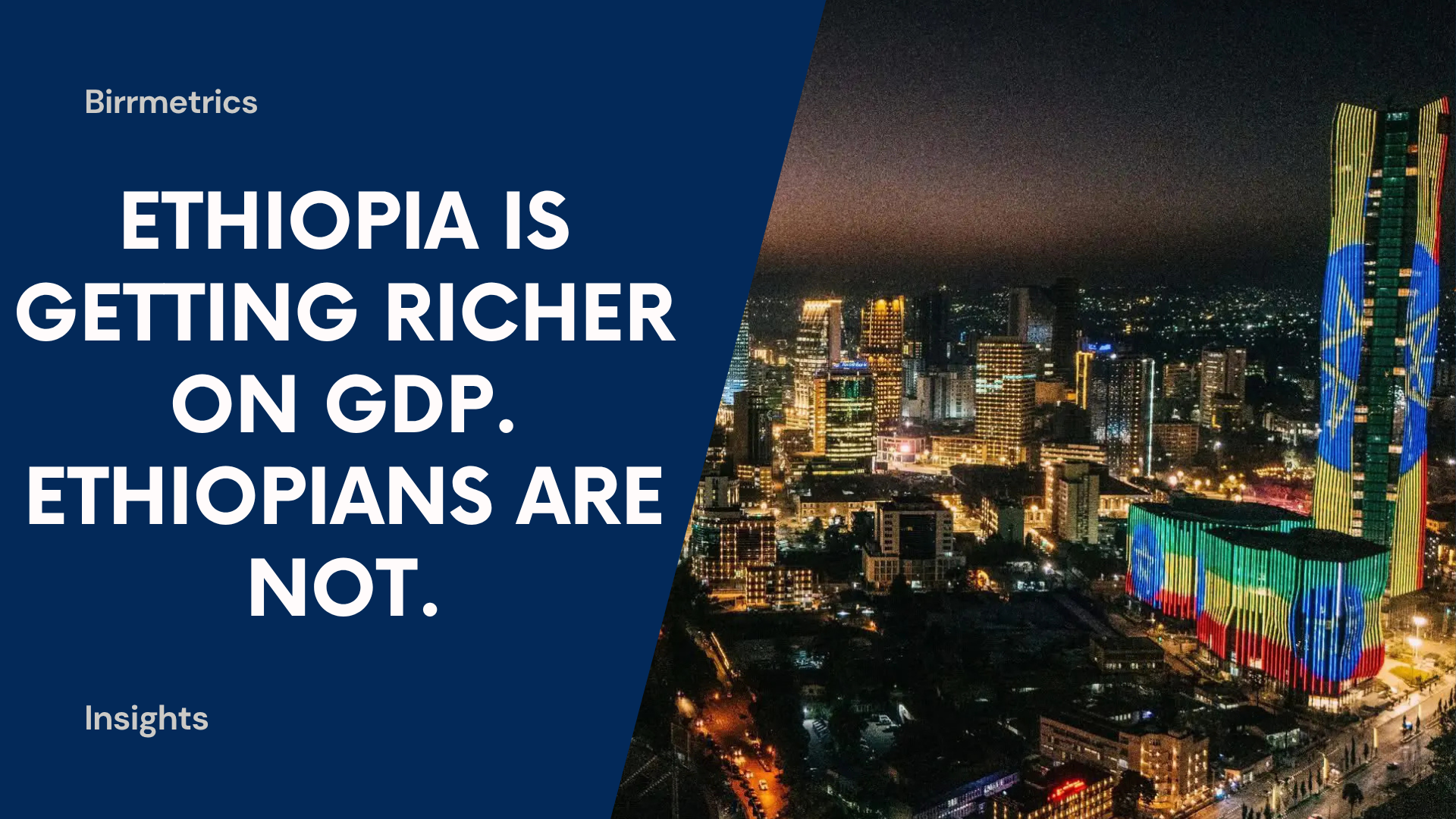
An economy expanding by around nine percent while roughly four in ten people remain below a 3 US dollars-a-day poverty line does not have a growth problem. It has a transmission problem — and possibly a development-model problem.
There is a number Ethiopia likes to talk about: nine percent.
And there is another number it should be far more uncomfortable talking about: roughly 40 percent.
The first is economic growth. The second is poverty.
The coexistence of these two numbers should provoke a much more difficult national conversation than the one Ethiopia is currently having.
Ethiopia’s economy expanded by about 9.2 percent in 2024/25. Industry grew rapidly. Agriculture also expanded. Exports strengthened. Foreign-exchange reserves recovered. Inflation fell sharply from its previous highs. On a macroeconomic dashboard, this looks impressive.
Now walk away from the dashboard.
Recent estimates put roughly 41.8 percent of Ethiopians below the $3-a-day international poverty line in 2024/25, with the share expected to decline gradually thereafter. Even under that more optimistic trajectory, close to four out of every ten Ethiopians remain beneath an extraordinarily modest poverty threshold.
That is not a minor social-policy problem sitting beside an otherwise successful economic story.
That is the economic story.
And it should force Ethiopia to confront an uncomfortable proposition: What exactly is the purpose of nine-percent economic growth if such a large share of the population remains desperately poor?
GDP is not welfare. Economists know this.
A country can produce more goods and services without the median household becoming proportionately better off. GDP can accelerate because mining expands, construction booms, commodity exports rise or capital-intensive industries grow. None of those developments guarantees that enough income reaches poor households.
What matters for poverty reduction is not merely whether national output grows. It is who participates in that growth, who gets paid from it, how many jobs it creates, what happens to real wages, what happens to household consumption and what happens to the prices of the goods poor people actually buy.
On those measures, Ethiopia’s record is much less flattering.
The deterioration did not begin yesterday. Poverty had already risen sharply by 2021 compared with the middle of the previous decade, reversing part of Ethiopia’s earlier progress. Conflict, drought, COVID-19, slower growth and severe inflation all contributed. Subsequent estimates suggest poverty worsened further before beginning to decline from an extremely elevated level.
So it would be analytically wrong to claim that poverty is still accelerating today. The reality is arguably more disturbing: Ethiopia went through years of substantial economic expansion while poverty first rose dramatically and has only recently begun to retreat.
That is a serious breakdown in the relationship between growth and welfare.
Ethiopia’s central economic challenge is therefore not simply how to generate growth. The country has demonstrated that it can produce periods of very rapid aggregate expansion. The challenge is whether that growth is strong enough, broad enough and labour-intensive enough to raise household consumption and pull people out of poverty at scale.
The country knows how to generate growth. It has not yet demonstrated that it knows how to distribute the opportunities created by growth widely enough.
Consider the labour market.
Employment indicators have not improved in line with headline GDP growth. That should concern any policymaker in a country where roughly 1.8 million new job seekers enter the labour market every year. Weak labour absorption is not merely an economic inconvenience. It is a demographic threat.
A mine can generate enormous value with relatively few workers. A construction boom can inflate GDP without creating durable employment. A surge in coffee or gold prices can improve export earnings without transforming the productivity of millions of households. Government investment can expand measured output without creating a competitive private economy capable of absorbing the next generation of workers.
That is why the composition of growth matters at least as much as its rate.
Ethiopia learned this once before. The country’s earlier success in reducing poverty was closely connected to improvements in agriculture, because agriculture was where the poor actually worked. The lesson remains brutally relevant today.
A large majority of Ethiopia’s workers still depend directly or indirectly on agriculture. Yet millions of rural Ethiopians remain trapped in low-productivity farming, weakly connected to markets, finance, storage, irrigation, processing and higher-value supply chains. Rural poverty remains far higher than urban poverty.
A country cannot sustainably eliminate mass poverty while the sector employing most of its people remains characterised by low productivity, tiny marketable surpluses, climate vulnerability and limited pathways into better-paying non-farm employment.
Then there is inflation.
For economists, inflation is an index. For poor households, inflation is often a tax from which there is almost no escape.
A wealthy household can change its portfolio. It can move money into property, foreign currency, equities or other assets. A poor household owns little to hedge with. Its wealth is frequently its labour. Its savings may be cash. Most of its income is consumed immediately.
When food, transport, rent and energy prices rise faster than earnings, there is nowhere to hide.
Ethiopia endured years of exceptionally high inflation before the rate began to moderate. Falling inflation is unquestionably good news. But public discussion repeatedly confuses lower inflation with lower prices.
They are not the same thing.
If something rises from 100 birr to 130 birr and inflation subsequently falls, the price does not normally return to 100 birr. It simply begins increasing more slowly from the higher level. For households whose salaries failed to keep pace during the inflationary surge, the damage to purchasing power can therefore persist long after headline inflation improves.
That helps explain one of Ethiopia’s apparent contradictions: the macroeconomy can be stabilising while households still feel poor.
There is no economic mystery here. Foreign-exchange reserves can improve while rent remains unaffordable. Exports can boom while a family spends an increasing share of its income on food. Inflation can fall while accumulated increases in the price level remain painfully visible in every household budget.
This distinction matters enormously when judging the reform programme launched in mid-2024.
Many of Ethiopia’s reforms were economically unavoidable. The old foreign-exchange regime produced rationing, distorted incentives and encouraged a huge parallel market. Chronic fiscal and monetary imbalances were unsustainable. Broad subsidies were expensive and frequently poorly targeted. Weak tax mobilisation constrained the state’s ability to provide basic services. A private sector cannot flourish indefinitely in an economy where foreign currency is administratively allocated and prices send unreliable signals.
Correcting those distortions is necessary.
But here is where Ethiopia should resist one of the most dangerous habits in economic policymaking: confusing necessary reform with sufficient reform.
A reform can be economically necessary and socially brutal at the same time.
Currency depreciation changes relative prices. Fuel-price adjustment raises transport and distribution costs. Electricity-tariff reform affects household budgets and production costs. Tax reform can increase state capacity but can also squeeze businesses and consumers if implemented badly.
The question is therefore not whether Ethiopia should reform. It should. The question is who bears the transition cost, for how long, and what is being built on the other side.
Asking the poorest citizens to finance macroeconomic stabilisation through declining real purchasing power while promising that growth will eventually compensate them is not a durable development strategy. It is a gamble.
Poverty is also not divided neatly between the poor and the secure. Immediately above the poverty line are millions of vulnerable households that can be thrown back below it by illness, unemployment, drought, conflict, food inflation or another currency shock.
That is why even a forecast reduction from very high poverty levels should be treated with perspective. It is progress. It is also an astonishingly low bar for a country that has spent two decades advertising itself as one of the world’s fastest-growing economies.
There is another reason for caution: Ethiopia’s most recent poverty figures are based partly on modelling because there has not yet been a new, fully comprehensive nationwide household-consumption survey reflecting current conditions. That means nobody should pretend to know with surgical precision how many Ethiopians are poor today.
That is itself a policy weakness.
A country undertaking one of the most consequential economic transformations in its modern history should have frequent, transparent and nationally comprehensive information on household income, consumption, employment and real wages.
You cannot manage poverty effectively if you measure GDP more confidently than you measure people’s living standards.
The deeper failure, however, is structural.
Ethiopia’s old development model placed enormous faith in public investment and state-led capital accumulation. It produced roads, power infrastructure, universities, industrial parks and years of rapid headline growth. But it also left behind an economy where private-sector development remained constrained, agricultural productivity remained inadequate, human capital remained weak, exports remained concentrated and the creation of productive jobs failed to keep pace with demographics.
The new model is supposed to fix this through markets and private investment.
Good. Then judge it accordingly.
Not by how quickly the exchange rate adjusts. Not by how many programme reviews are completed. Not by how much tax revenue increases. Not even by GDP growth alone.
Judge it by whether real household income rises. Judge it by whether private firms create millions of productive jobs. Judge it by whether farm productivity rises fast enough to increase rural incomes. Judge it by whether young Ethiopians can leave low-productivity activities for higher-productivity employment. Judge it by whether the poorest households experience sustained consumption growth. Judge it by whether a worker’s wage buys more food, housing, transportation and healthcare five years from now than it does today.
And judge it, finally, by whether Ethiopia’s spectacular GDP growth begins producing spectacular poverty reduction.
Because growth is not the final objective of economic policy. Human welfare is.
This is where the country’s economic debate needs to become much less comfortable.
Officials are right to point to extraordinary shocks. War destroyed livelihoods. Drought devastated agricultural communities. COVID-19 disrupted incomes. Global commodity shocks raised import costs. Regional insecurity continues to impose economic damage. No serious economist should ignore any of this.
But shocks cannot become a permanent explanation for poor outcomes. Eventually, resilience itself becomes a test of development.
If every drought throws millions toward destitution, the agricultural system is too fragile. If every foreign-exchange shock devastates household purchasing power, the economy is too import-dependent. If GDP growth repeatedly fails to produce enough productive employment, the growth model is too weakly connected to labour. If families remain one illness, one crop failure or one lost job away from poverty, social protection is too shallow.
Vulnerability on that scale is not bad luck. It is an economic structure.
The good news is that current macroeconomic stabilisation creates an opportunity to change that structure. Improving revenue, lower inflation, better foreign-exchange availability and eventual debt relief can create fiscal and policy space. But that space must not be squandered.
The next stage of reform has to be aggressively pro-employment and pro-productivity.
Agricultural commercialisation must move from speeches to scale. Barriers preventing labour from moving toward more productive locations and sectors need to fall. Small and medium firms need finance rather than merely policy recognition. Private investment needs predictable regulation, competition and access to foreign exchange. Education and skills policy must be tied much more closely to actual labour demand. Social protection needs to become large enough, targeted enough and responsive enough to prevent temporary shocks from permanently destroying household welfare.
And economic policymaking needs a new scoreboard.
Every major economic announcement should be accompanied not only by GDP, exports and inflation, but by real wages, employment, household consumption, poverty, food affordability and the income growth of the poorest households.
That would radically change what Ethiopia calls economic success.
Because there is ultimately something intellectually dishonest about boasting that an economy has grown by nine percent while treating the poverty of four in ten citizens as a secondary statistic.
The two numbers belong in the same sentence.
9.2 percent growth.
41.8 percent poverty.
One tells us how fast Ethiopia’s economic machine is moving. The other tells us how many people are still being left behind by it.
And if Ethiopia continues producing some of Africa’s most impressive growth rates without producing equally impressive improvements in household welfare, then eventually the question will no longer be whether the country is growing.
The question will be much more damaging: Growing for whom?
For decades, Ethiopia’s political economy has been obsessed with the size of the economic pie. The next era has to confront who actually gets a slice.
Because a nine-percent economy in which tens of millions remain poor is not an economic miracle.
It is an unfinished transformation being advertised as success.
And until ordinary Ethiopians can feel growth not in government reports but in their wages, their jobs, their farms, their businesses and their dinner tables, Ethiopia should be far more cautious about celebrating the headline numbers.
The economy may indeed be growing rapidly.
The scandal is that prosperity is still moving far too slowly.
ABOUT THE WRITER
Zelalem Tamir is an economist. He can be reached at zelalemteamir@gmail.com.




