

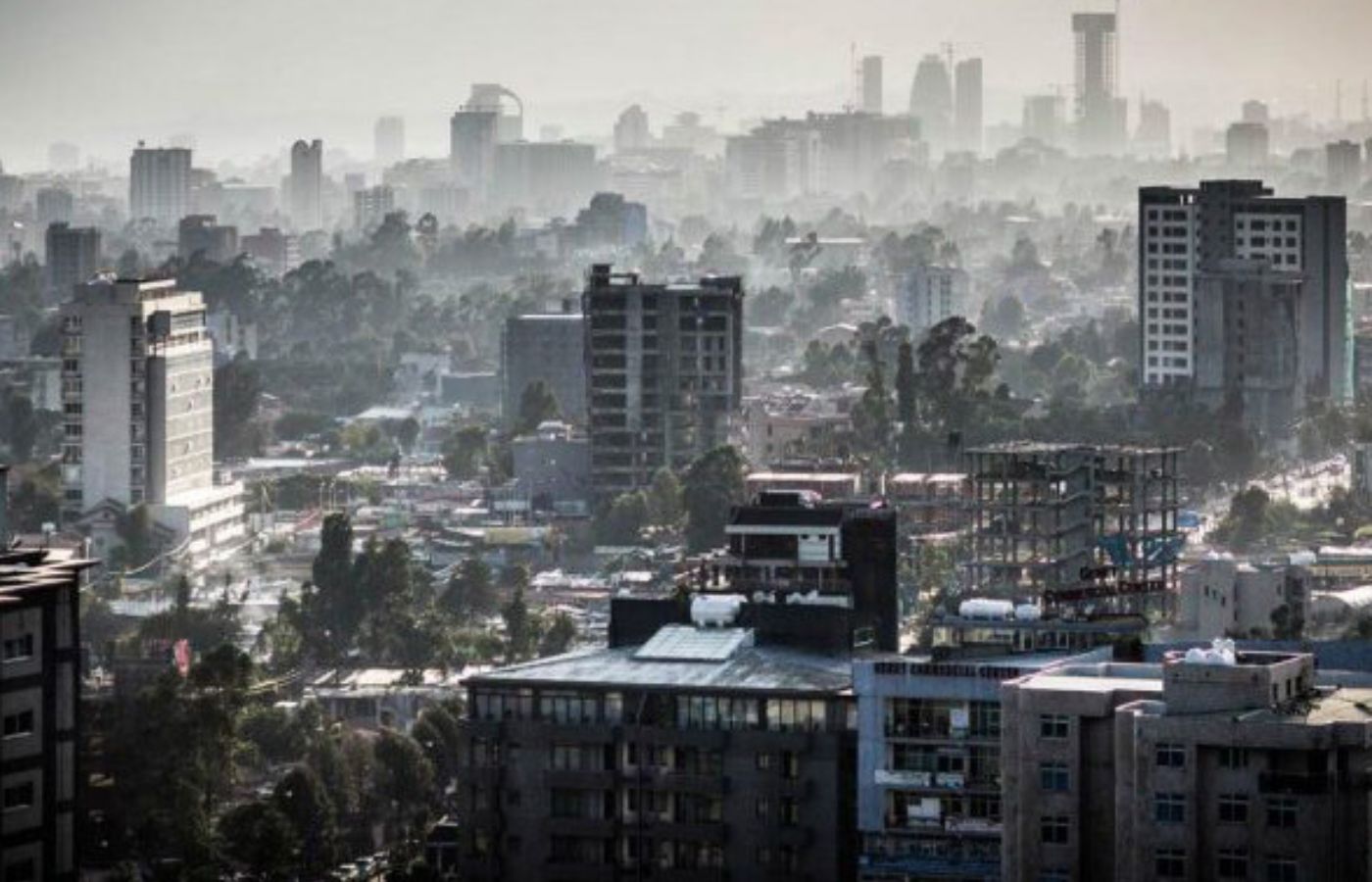
Residents of Addis Ababa are breathing air containing black carbon at levels four to nine times higher than those measured in three major U.S. metropolitan areas monitored by NASA, according to a new study that offers one of the most detailed assessments yet of the pollution burden facing Ethiopia’s rapidly expanding capital.
The NASA-funded research, released by the U.S. space agency on Monday, found that Addis Ababa recorded an average fine-particulate-matter concentration of 30 micrograms per cubic metre over three years, more than three times the U.S. Environmental Protection Agency’s annual health-based standard. The findings come despite an increasingly aggressive push by the Ethiopian government to green and remake the capital through electric-vehicle policies, bicycle lanes, parks, pedestrian infrastructure and a multibillion-birr corridor-development programme.
The research analysed data collected between 2022 and 2025 from 10 air-quality monitoring stations installed across Addis Ababa by NASA’s Multi-Angle Imager for Aerosols, or MAIA, project. The study, published in the American Chemical Society journal ES&T Air in July and highlighted by NASA on August 17, measured both PM2.5 — microscopic particles no larger than 2.5 micrometres in diameter — and black carbon, the soot produced by diesel engines, fires and other combustion sources.
The most striking comparison concerned black carbon. NASA said data from the MAIA ground sensors showed that average black-carbon concentrations in Addis Ababa were approximately four to nine times higher than those measured in Los Angeles, Atlanta and Boston, the three U.S. metropolitan areas included in the mission’s monitoring network. The comparison does not mean Addis Ababa’s overall air pollution is nine times worse than those cities; the four-to-nine-times figure applies specifically to average black-carbon concentrations.
The broader measure of fine-particle pollution was also high. Addis Ababa’s three-year average PM2.5 concentration stood at 30 micrograms per cubic metre, NASA said, more than three times the current U.S. EPA annual standard. It is also six times the World Health Organization’s annual PM2.5 guideline of 5 micrograms per cubic metre.
“To our knowledge, this is the first long-term, multisite study of continuous PM2.5 and black carbon measurements in Ethiopia,” Sina Hasheminassab, a co-author of the paper and deputy principal investigator of MAIA at NASA’s Jet Propulsion Laboratory, said in NASA’s release. He said the measurements provide an important baseline for understanding how pollution changes across space and time in rapidly growing cities where long-term monitoring has often been limited.
The monitoring found that pollution in Addis Ababa varied considerably according to the time of day and season. Concentrations increased around rush-hour traffic, but the city’s pollution did not disappear when its roads became quieter. Researchers detected high emissions at night linked to the burning of charcoal and other fuels, suggesting that Addis Ababa’s air-quality problem extends beyond vehicle exhaust.
“Even at night, when traffic dies down, you see high emissions from the burning of charcoal and other fuels,” Araya Asfaw of Addis Ababa University, a co-author of the study and MAIA’s lead Ethiopian collaborator, said.
The sensors also detected increases in black carbon during two major Ethiopian holidays involving bonfires. NASA said the network was capable of distinguishing particles originating from those fires from those associated with fossil-fuel combustion, demonstrating how more sophisticated monitoring could eventually allow policymakers to identify which pollution sources should be targeted rather than treating the city’s dirty air as a single problem.
The findings add hard measurements to a pollution problem that other researchers have increasingly documented. A 2025 study modelling pollution sources in Addis Ababa found annual average PM2.5 concentrations ranging between 20 and 60 micrograms per cubic metre and identified road transport, residential and commercial cooking, construction and road dust, heating, open waste burning and industrial activities among the main sources. Vehicle exhaust alone was estimated to account for as much as 29 percent of PM2.5, followed by biomass combustion in residential and industrial activities.
A separate study published in July 2026 produced an even starker assessment: none of the areas of Addis Ababa covered by its model met the WHO annual PM2.5 guideline of 5 micrograms per cubic metre. It found that dense urban areas had the highest concentrations and population exposure, while road density and proximity to waste sites were associated with higher pollution. Greater vegetation coverage, meanwhile, was associated with lower PM2.5 levels.
The emerging evidence poses a difficult environmental challenge for a capital undergoing one of the largest physical transformations in its recent history.
Addis Ababa has become the centrepiece of Prime Minister Abiy Ahmed’s urban-development agenda, with extensive corridor projects replacing or rebuilding roads, sidewalks and public spaces across large parts of the city. The projects have introduced new pedestrian walkways, bicycle lanes, recreational areas, parks, lighting and landscaping alongside expanded and rehabilitated road infrastructure.
In August 2025, Abiy inaugurated the redeveloped corridor extending from the base of Entoto to Arat Kilo Plaza, which the Prime Minister’s Office said included new walkways and bicycle lanes, improved road lighting, modern shops, children’s playgrounds, a football field and other public facilities. The government has continued the urban-renewal programme into 2026. In April, Abiy and First Lady Zinash Tayachew inaugurated Addis Sports Park as part of the corridor-development programme, incorporating 5.7 hectares of sports and green recreational space.
The NASA findings do not assess whether those projects have improved or worsened air quality, and the study’s 2022-2025 measurement period overlaps only partly with the city’s most recent wave of corridor development. But the results underline a distinction that is becoming increasingly important for Addis Ababa: making a city visibly greener is not necessarily the same as making the air its residents breathe cleaner.
Trees, parks, pedestrian areas and bicycle lanes can form part of a cleaner urban system, and the latest Addis Ababa exposure modelling found an association between greater vegetation and lower PM2.5 concentrations. But the sources identified in research on the capital range from old petrol and diesel vehicles to household charcoal and biomass use, construction and road dust, waste burning and industrial activity. Tackling those sources requires interventions extending well beyond landscaping and urban beautification.
The scale of the challenge is growing alongside the city itself. NASA puts the population of the greater Addis Ababa urban area at nearly six million and, citing United Nations projections, says it is expected to surpass 10 million by 2050. Such expansion is likely to increase transport demand, construction, household energy consumption and waste generation unless cleaner technologies and tighter environmental controls expand at the same time.
Ethiopia has already taken an unusually aggressive step on one of those fronts. In 2024, the government prohibited imports of internal-combustion-engine vehicles, a move NASA described as making Ethiopia the first country in the world to introduce such a ban. The government has simultaneously pushed electric vehicles and charging infrastructure, while new bicycle lanes have become a prominent feature of Addis Ababa’s corridor projects.
But the transition will take time to alter the composition of the existing vehicle fleet, while electrification does little by itself to address charcoal burning, road and construction dust, open waste burning or other non-vehicle sources. The NASA measurements could consequently become an important baseline for determining whether Ethiopia’s electric-vehicle transition and Addis Ababa’s physical redevelopment eventually produce measurable improvements in the city’s air.
The health stakes are considerable. PM2.5 particles are small enough to penetrate deep into the respiratory system, and prolonged exposure has been linked internationally to cardiovascular and respiratory disease and premature death. NASA’s release cites the 2025 State of Global Air Report as estimating that exposure to PM2.5 is associated with approximately 4.9 million deaths globally each year. Black carbon, which forms part of particulate pollution, has likewise attracted increasing attention over its potential health effects.
NASA’s Addis Ababa research is part of a much larger scientific programme. MAIA supports air-pollution research across roughly a dozen metropolitan areas around the world and combines the ground-monitoring networks already in operation with a space-based observatory. A camera built by NASA’s Jet Propulsion Laboratory is expected to be launched by the Italian Space Agency on an Italian satellite no earlier than late 2027. It will observe particles from multiple angles and help researchers distinguish different types of PM2.5 based on the way they reflect light.
The mission is also notable because it is NASA’s first space mission to formally include public-health researchers on its team. Scientists ultimately intend to combine detailed pollution maps produced by MAIA with health information to investigate relationships between different particle types and health outcomes.
The broader MAIA project is a substantial investment. A NASA Office of Inspector General report put MAIA’s project costs at $124.8 million as of May 2023. That figure represents the wider NASA mission and should not be interpreted as the budget for the Addis Ababa research. Neither NASA’s latest announcement nor the published study provides a separate cost for the 10-station Ethiopian monitoring component.
The space component could make the picture of Addis Ababa’s pollution considerably more detailed once it becomes operational. Rather than merely establishing how much particulate matter is present, researchers hope to identify its composition and map concentrations across different parts of the city, potentially giving policymakers better evidence about whether pollution is coming predominantly from vehicles, household fuels, fires, dust or other sources.
For Addis Ababa, however, the ground measurements already deliver an uncomfortable baseline.
At the same time that Ethiopia is banning imports of fuel-powered cars, building bicycle lanes, expanding green spaces and spending heavily to transform the physical appearance of its capital, NASA’s sensors show that millions of residents continue to live with substantial exposure to fine-particle pollution, including black-carbon concentrations several times those measured in the U.S. cities covered by the same mission.




