

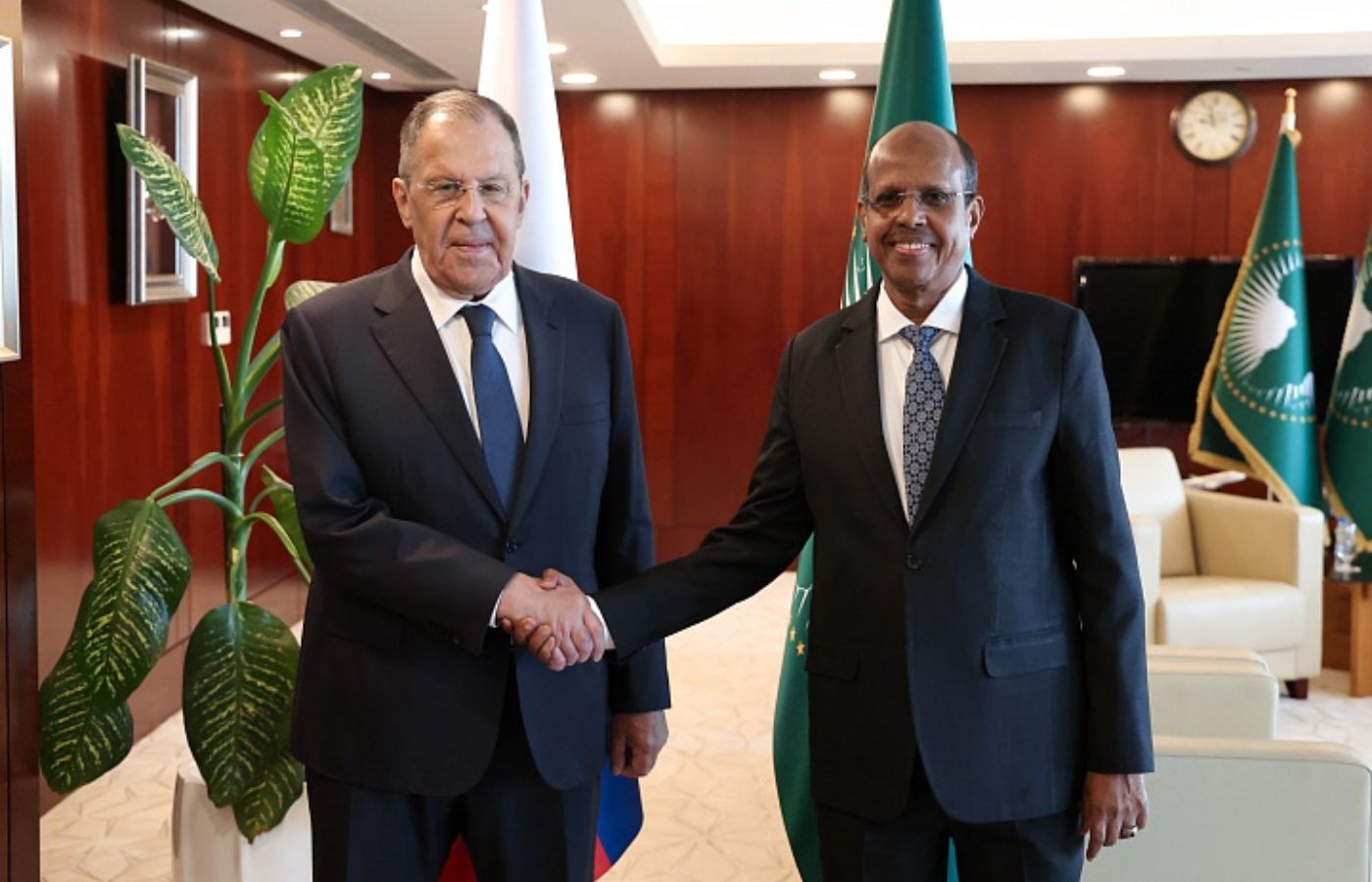
The African Union and Russia have begun shaping a new three-year cooperation framework that will guide their partnership from 2027 to 2029, as both sides prepare for the third Russia-Africa Summit scheduled for October 2026 in Moscow.
The roadmap was discussed during high-level consultations between African Union Commission Chairperson Mahmoud Ali Youssouf and Russian Foreign Minister Sergey Lavrov at the African Union headquarters in Addis Ababa on July 7, 2026.
The talks focused on reviewing progress under existing cooperation agreements and identifying areas where the two sides can deepen collaboration, including trade, infrastructure, energy, food security, peace and security, and global governance reform.
The AU and Russia reviewed implementation of the Memorandum of Understanding on Basic Principles of Relations and Cooperation signed in 2019, as well as the Russia-Africa Partnership Forum Action Plan and Russia-AU Commission Action Plan covering 2023–2026.
Both sides agreed to address gaps in existing cooperation and develop a new action plan for the 2027–2029 period ahead of the Moscow summit, which is expected to set the next phase of Africa-Russia relations.
Security cooperation featured prominently in the discussions, with the two sides exchanging views on conflicts and instability in the Sahel, Great Lakes region, Horn of Africa, Sudan, South Sudan and Libya.
Russia reaffirmed support for African-led approaches to conflict prevention, mediation, peacebuilding and post-conflict reconstruction, while the AU and Moscow stressed the need for sustainable financing for African Union-led peace support operations authorised by the United Nations Security Council.
The two sides also called for the implementation of UN Security Council Resolution 2719, which provides a framework for supporting AU-led peace operations, saying predictable funding would strengthen Africa’s ability to respond to security challenges.
Beyond security, the talks addressed Africa’s role in global governance. Russia expressed support for the African Common Position on reform of the UN Security Council, including demands for greater representation of Africa in international decision-making.
The AU and Russia also called for reforms to the global financial system to improve access to affordable financing for developing countries. They highlighted challenges facing African economies, including debt pressures, high borrowing costs and limited access to concessional finance.
Economic cooperation was another focus, with both sides identifying opportunities in infrastructure, energy, industrial development, transport connectivity and technology. They reaffirmed the importance of aligning future cooperation with Africa’s Agenda 2063 and the African Continental Free Trade Area (AfCFTA).
The two sides also discussed food security and agreed on the importance of maintaining reliable access to food, fertilisers and agricultural inputs for African markets.
Health cooperation was included in the discussions, with the AU and Russia expressing concern over Ebola outbreaks in the Democratic Republic of Congo and Uganda. They agreed to explore support for Africa CDC efforts in outbreak response, surveillance, laboratory systems and public health capacity building.
The consultations concluded with an agreement to institutionalise regular high-level political dialogue between the AU Commission and Russia, with future meetings expected to take place annually. The next high-level consultation is planned for 2027 at a mutually agreed date and venue.




