

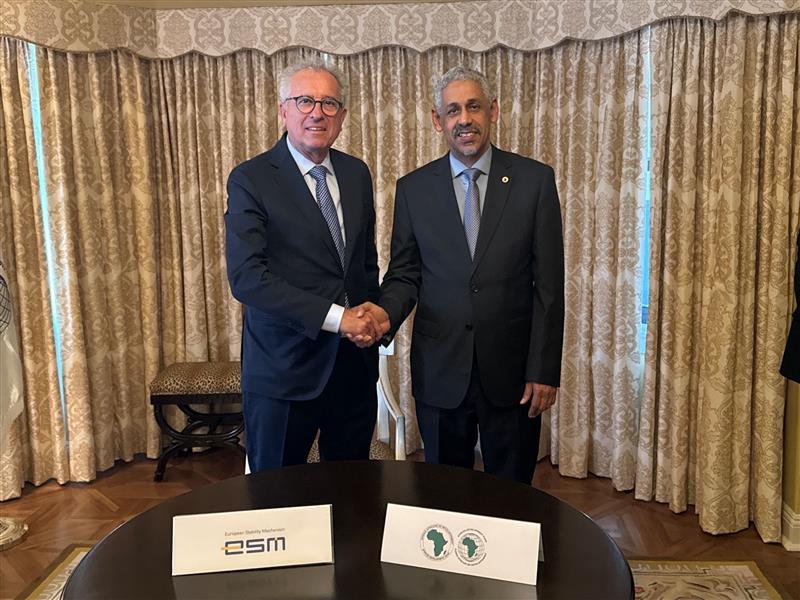
Plans to establish an African Financial Stability Mechanism have gained renewed traction after the African Development Bank Group and the European Stability Mechanism signed a cooperation agreement aimed at strengthening technical groundwork for crisis prevention and financial resilience.
The memorandum of understanding was signed on April 15 in Washington, DC, on the sidelines of the 2026 Spring Meetings of the IMF and World Bank. It establishes a framework for collaboration in capacity building, research, policy dialogue and staff-level exchanges, subject to internal procedures of both institutions.
The agreement comes as African policymakers push ahead with plans for a continental financial safety net intended to help countries manage debt pressures and external shocks. The proposed African Financial Stability Mechanism, endorsed by African Union heads of state, is designed to provide liquidity support, assist in debt refinancing and help stabilise government financing conditions during periods of stress.
Africa remains the only region without a dedicated regional financial stability mechanism, a gap that has left economies more exposed to volatile capital flows, commodity price swings and tightening global financial conditions. Recent years have seen rising debt vulnerabilities across the continent, with multiple countries assessed to be at high risk of debt distress.
The scale of the challenge is significant. Public debt across Africa has risen sharply over the past decade, increasing by roughly 170 percent over 15 years to more than 1.8 trillion US dollars, according to international estimates. Annual external debt service obligations are projected to remain elevated through the next decade, placing sustained pressure on fiscal space in several economies.
The emerging mechanism is expected to operate in a similar space to Europe’s crisis architecture, including the European Stability Mechanism, which provides financial assistance to eurozone countries during periods of market stress. African officials have pointed to the European model as a reference point for institutional design and crisis response tools.
Sidi Ould Tah, president of the African Development Bank Group, said the partnership would help the institution draw on established international practice as it advances work on the proposed mechanism. “By formalising our cooperation with the ESM, we are strengthening our ability to draw on international best practices,” he said, highlighting crisis management frameworks and governance systems.
Pierre Gramegna, managing director of the European Stability Mechanism, said closer cooperation was increasingly necessary in a volatile global environment. “In a world that has become more prone to frequent shocks, preparedness through cooperation is essential,” he said.
The agreement will focus on technical exchanges, joint seminars and policy discussions aimed at supporting institutional design work, alongside knowledge sharing on market funding and crisis management.




