

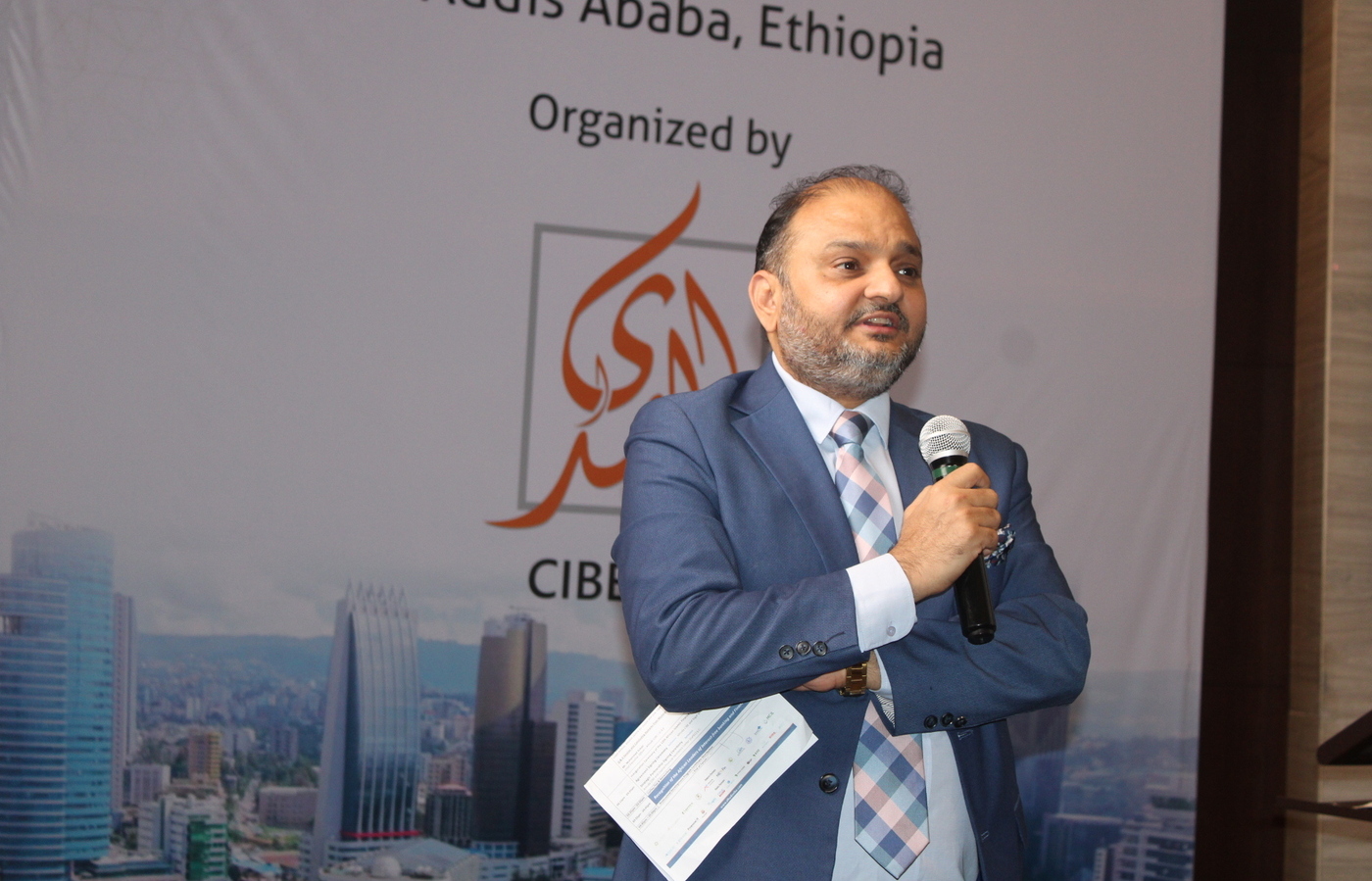
Muhammad Zubair Mughal, chief executive officer of AlHuda Centre of Islamic Banking and Economics, has spent more than a decade working on the development of interest-free finance in Ethiopia. AlHuda, which describes itself as an Islamic banking and finance advisory and training institution, has organised major industry forums in Addis Ababa and runs programmes focused on Islamic banking, takaful, fintech and Islamic capital markets.
On the sidelines of the sixth International Interest-Free Banking and Takaful Forum in Addis Ababa, Birrmetrics Editor-in-Chief Mintesinot Nigussie sat down with Mughal to discuss Ethiopia’s rapidly expanding interest-free banking market, the missing pieces of its Islamic finance ecosystem and the prospects for Sukuk and other Sharia-compliant capital-market instruments. He also discussed Ethiopia’s potential to become a regional Islamic finance hub, the interest of Middle Eastern investors in the banking sector and how the country might approach digital assets and central bank digital currency. The forum, held under the patronage of the National Bank of Ethiopia, brought together regulators and industry leaders to examine the development of interest-free finance in Ethiopia and across Africa.
Birrmetircs: Could you briefly introduce yourself and AlHuda Centre of Islamic Banking and Economics?
Muhammad Zubair Mughal: My name is Muhammad Zubair Mughal, and I am the chief executive officer of AlHuda Centre of Islamic Banking and Economics. We work in Ethiopia to support the development of interest-free banking and finance. We work with interest-free banks, takaful companies, interest-free fintechs and microfinance institutions, helping them design products, structures and the infrastructure required for interest-free banking and finance.
We have been working in the Ethiopian market for the past 12 years. Every year, we organise an interest-free banking and finance forum to bring international experience to the Ethiopian market.
We believe interest-free banking and finance has significant potential in Ethiopia. Its development can support foreign direct investment, financial inclusion, financial stability and socio-economic development.
AlHuda operates in several countries. Who are your partners in Ethiopia?
We do not have a dedicated partner in Ethiopia. We work with financial institutions, regulators and industry players.
Globally, we operate in more than 50 countries. In Africa, we work across West, East, North and Southern Africa, including Nigeria, Mauritania, Mali, Chad, Burkina Faso, Côte d’Ivoire, Somaliland, Djibouti, Kenya, Tanzania, Malawi, Uganda, Ethiopia, Tunisia, Morocco, Algeria, South Africa, Zambia and Zimbabwe.
You have been observing the Ethiopian market for more than a decade. How do you assess the development of the financial sector, particularly interest-free finance?
It is growing very well. Demand is strong. People are seeking interest-free banking and financial products, and as a result, the market is growing rapidly.
I also believe the development of the capital market will be important. Once an Islamic capital market develops alongside the existing capital market, Ethiopia can have a more complete ecosystem for interest-free banking and finance.
What are the main bottlenecks holding back the development of interest-free finance in Ethiopia?
Awareness remains limited. I think this is the right time for universities and educational institutions to introduce and expand education in interest-free banking and finance.
Apart from that, I believe the fundamentals are developing well.
Ethiopia's capital market has been operational for more than a year. What role can government securities and Sukuk play in developing interest-free finance and financial inclusion?
For the smooth development of interest-free banking and finance, you need capital, and Ethiopia already has a growing capital market.
But you also need an Islamic capital market, which is not yet fully developed. You need Sukuk, Islamic funds, Sharia indices and other Islamic investment instruments.
With the establishment of the capital market regulator, I believe Sukuk, Islamic securities, Islamic investment funds and Sharia-compliant indices can gradually be introduced. That would help complete the ecosystem for interest-free finance.
The Ethiopian Capital Market Authority is working on Sharia-compliant instruments. What should be its main priorities?
The priority should be to establish Islamic capital market instruments, starting with Sukuk.
There should also be Islamic fund management, Islamic asset management companies, Islamic investment banking and Islamic securities.
I have observed that several existing banks have obtained capital market licences. Banks that already provide interest-free banking are therefore well positioned to introduce Sharia-compliant capital market products.
For example, banks such as Sinqe Bank and Awash Bank have obtained investment banking licences. Other banks are also entering the capital market.
These institutions already have experience with interest-free banking. Hopefully, they will bring that experience into the capital market by developing Sharia-compliant financial products.
The National Bank is developing the country's first National Interest-Free Finance Strategy. What should policymakers consider as they develop it?
I appreciate the National Bank of Ethiopia and the efforts it is making. It is among the few regulators in East Africa that are developing the industry at the regulatory level.
Kenya has been developing Islamic banking for about two decades, while Nigeria has also had Islamic banking for around 20 years. But when you compare the pace of development, Ethiopia is among the fastest-growing markets in Africa for interest-free financial products.
If the regulator continues its efforts, I believe Ethiopia can become a regional hub for interest-free banking and finance in East Africa.
With an effective national strategy, Ethiopia has the potential to surpass some of the more established African markets and become an important hub for Islamic finance on the continent.
This would also be strategically important for the government. Ethiopian Airlines has established itself as a leading airline on the continent and uses Ethiopia's geographical position to serve African markets. A similar approach could be applied to banking and finance.
If Ethiopia develops the infrastructure and regulatory framework to become a leading centre for Islamic banking and finance, it could serve markets across Africa. The country has the potential to do this.
You also work on digital assets, including crypto and NFTs. The central bank has taken a cautious approach to crypto finance. What would you recommend?
Different countries have taken different approaches. In some countries, crypto remains unrecognised or is subject to restrictions, while others, including the US and the UAE, have established regulatory frameworks for digital assets.
I believe the regulator in Ethiopia is studying the market carefully to determine how it should approach digital finance.
One possibility is a central bank digital currency, or CBDC. Around 18 central banks currently have CBDCs, and the National Bank of Ethiopia is also studying the possibility.
The central bank may begin with a CBDC before allowing other forms of crypto-related activity. Ultimately, governments are moving towards greater digitalisation of banking and finance, although the pace and regulatory approach differ from one country to another.
With Ethiopia now opening its banking sector to foreign investment, is AlHuda seeing interest from UAE-based banks or investors looking to enter the market?
We are in discussions with a couple of Middle Eastern investors who are closely watching the Ethiopian market and considering foreign direct investment in the banking and finance sector.
AlHuda itself is not directly entering the market as a banking investor. However, we are in contact with investors interested in entering Ethiopia and are providing guidance on how they can approach the market.
Can you provide details about the investors?
I cannot disclose their identities until they make an official announcement.




