

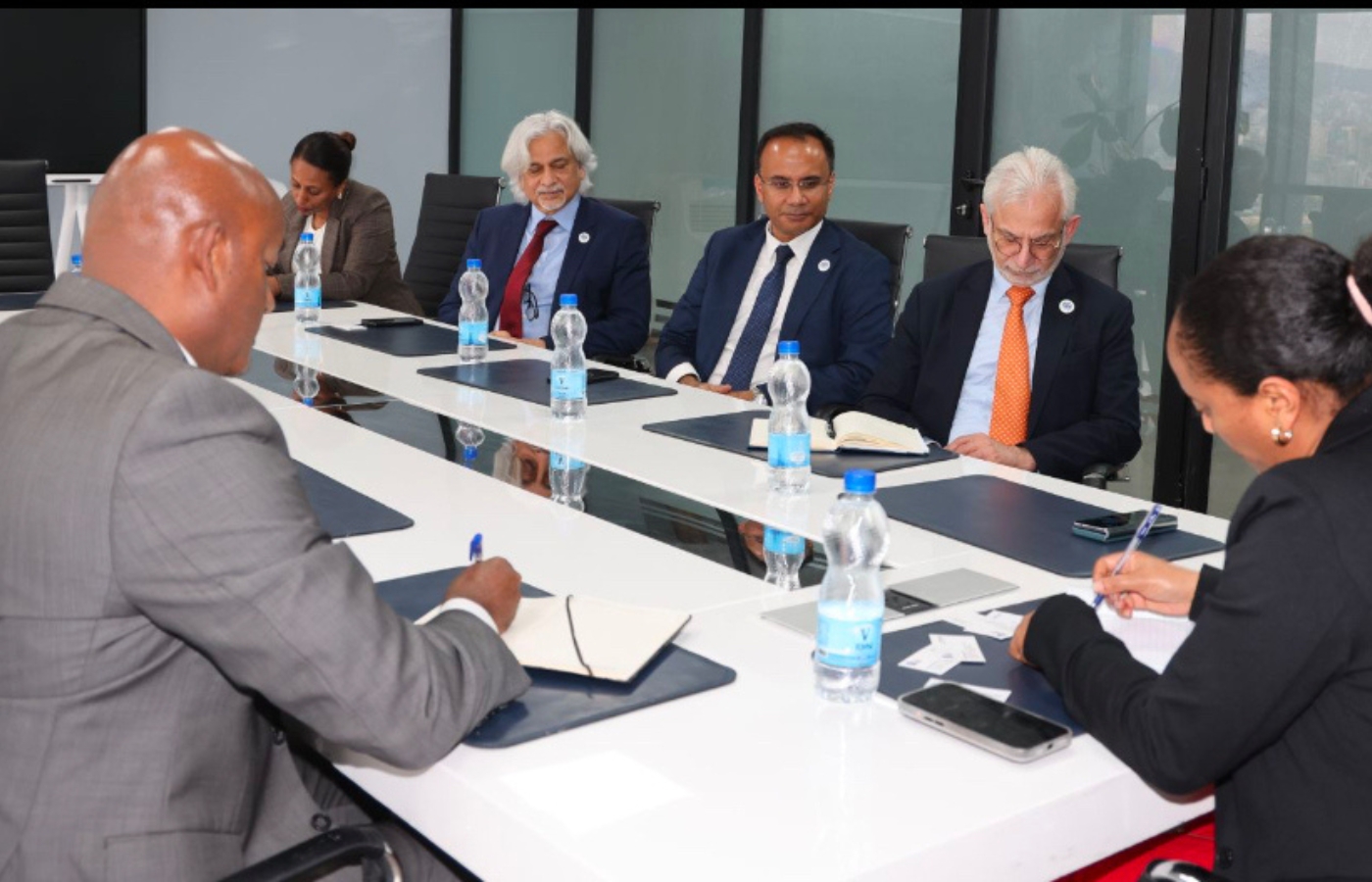
Bahrain-based Intercontinental Investment Bank, known as iib Group, is deepening its engagement with Ethiopia’s emerging capital market after securing approval from the National Bank of Ethiopia to open a representative office in Addis Ababa.
The Ethiopian Capital Market Authority held talks with a delegation from the group led by CEO Sohail Sultan, with discussions focusing on Ethiopia’s capital market landscape, emerging investment opportunities, and the regulatory and licensing pathways available to institutions seeking to participate in the market.
The engagement signals growing foreign interest in Ethiopia’s financial sector at a time when the country is opening both its banking industry and securities market to new players after decades of limited formal capital market activity.
iib Group has described its Addis Ababa representative office as part of a broader East Africa strategy. The office is expected to support the group’s engagement with Ethiopia’s financial ecosystem, cross-border investment flows, and the country’s wider financial-sector reform agenda.
The group is headquartered in Bahrain and has operations and interests across Africa, the Middle East, South Asia and the Caribbean. Its presence includes Bahrain, Djibouti, Cabo Verde and The Bahamas. Its Djibouti operation is strategically positioned around the Ethiopia-Djibouti trade corridor, a key route for Ethiopia’s external trade, while its Cabo Verde business provides commercial and transactional banking services.
The latest publicly available financial statement for Intercontinental Investment Bank S.A. in Cabo Verde shows the bank reported net profit of 393 million Cabo Verde escudos in 2024, down from 671 million escudos a year earlier. Return on assets stood at 1.10 percent, while return on equity reached 13.25 percent. The bank also reported a common equity tier one ratio of 55.4 percent and a liquidity coverage ratio of 276 percent, indicating a strong capital and liquidity position.
Beyond conventional banking, iib Group has been active in capital-market-linked transactions in Africa. Its West Africa operation has been involved in financing linked to a sovereign-guaranteed green bond planned by Cabo Verde’s electricity and water company, EDEC, as part of the country’s energy transition and power-sector modernisation agenda.
The group has also gained recognition in Cabo Verde’s capital market, where its West Africa business received an exchange operator award in the primary market category for corporate and municipal issuances.
Its interest in Ethiopia comes as the country moves from building the legal and regulatory foundations of a capital market to testing actual market activity. Ethiopia adopted its capital market proclamation in 2021, establishing the Ethiopian Capital Market Authority as the sector regulator.
The Ethiopian Securities Exchange was officially launched in January 2025, marking the country’s return to formal securities trading after decades without a functioning stock exchange. The exchange is expected to support securities trading, capital mobilisation, privatisation, and broader financial-sector modernisation.
Market activity has gradually gained momentum. Awash Bank, Ethiopia’s largest private bank, listed 37.9 million fully paid shares on the exchange in April, while Ethio telecom joined the Main Market in May after a public offering that attracted more than 47,000 investors.
The intermediary side of the market is also expanding. ECMA has licensed capital market service providers, including investment banks, as it works to build the professional infrastructure needed for trading, advisory, underwriting, custody, and other market services.
The banking sector is opening in parallel. Ethiopia’s new banking law allows foreign banks to enter through subsidiaries, branches, representative offices, or share acquisitions in domestic banks, with foreign ownership capped at 49 percent of a local bank.




