

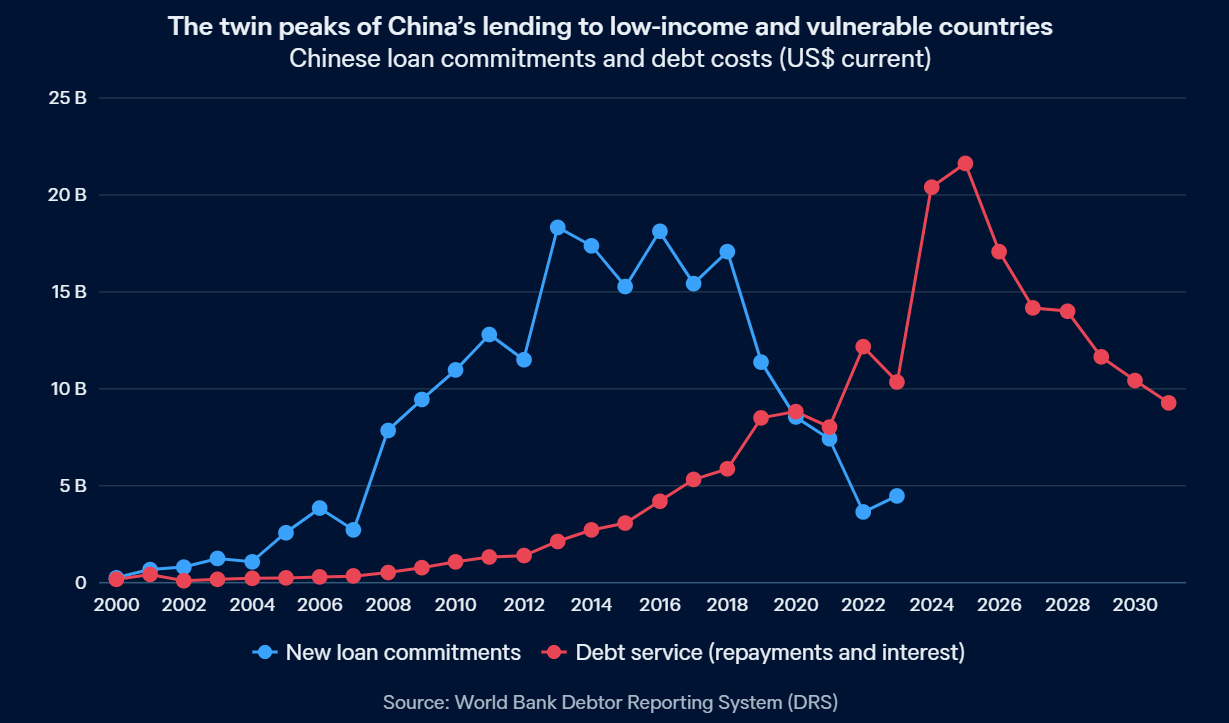
China is set to receive more in debt repayments from developing countries than it disburses in new loans in 2025, marking a major shift in its role as a development financier. This development reflects the maturing of a lending cycle that began in the early 2000s under the Belt and Road Initiative (BRI), China’s global infrastructure and investment programme.
According to new estimates from the Lowy Institute, developing countries will repay 35 billion US dollars to China this year. Of this amount, 22 billion US dollars is expected from seventy-five low-income and vulnerable economies. The repayments now exceed annual Chinese lending, which has declined to around 7 billion US dollars in recent years.
Chinese loan disbursements to developing countries peaked at over 50 billion US dollars in 2016. Many of those loans had grace periods of five years and maturities of fifteen to twenty years, and are now entering their repayment phase. In 2024, developing countries made net payments to China of 34 billion US dollars — the largest outflow on record.
As of 2025, China accounts for more than 30 percent of all bilateral debt service paid by developing countries. For low-income countries, that figure is approximately 25 percent, surpassing repayments to either multilateral institutions or private creditors. China is the largest bilateral creditor for fifty-three developing countries and among the top five for most others.
In many low- and middle-income countries, debt service obligations are placing strain on public finances. As of 2023, over 3.3 billion people live in countries that spend more on interest payments than on health or education, according to the World Bank. The International Monetary Fund reports that more than half of low-income countries are either in or at high risk of debt distress.
Development outcomes are being affected. Progress toward the United Nations Sustainable Development Goals has slowed, with only 16 percent of targets currently on track for achievement by 2030.
Some countries, such as Ethiopia, are not expected to make full debt repayments to China this year. The country is edging closer to securing a debt restructuring deal under the G20 Common Framework and has paused most external debt payments, including to bilateral creditors, as negotiations continue.
While overall Chinese lending has declined, some countries continue to receive new disbursements. These include neighbouring countries such as Pakistan, Mongolia, and Kazakhstan, as well as major exporters of minerals such as Argentina, Indonesia, and the Democratic Republic of Congo. In 2023, these and other countries received approximately eight billion US dollars — accounting for 36 percent of China’s total disbursements that year.
Some countries have also secured Chinese financing shortly after switching diplomatic recognition from Taiwan to China. These include Nicaragua, Honduras, and the Solomon Islands.
China has become a major source of bilateral development finance over the past two decades. Its lending practices — including limited concessionality and the role of state-linked commercial lenders — differ from traditional development finance institutions. While there is limited public information on loan terms, studies have noted that China’s approach typically includes confidentiality clauses and focuses on project-level financing.
China participated in the G20’s Debt Service Suspension Initiative during the COVID-19 pandemic and has taken part in debt restructuring processes in Ethiopia, Zambia, Ghana, and Suriname under the Common Framework.




