

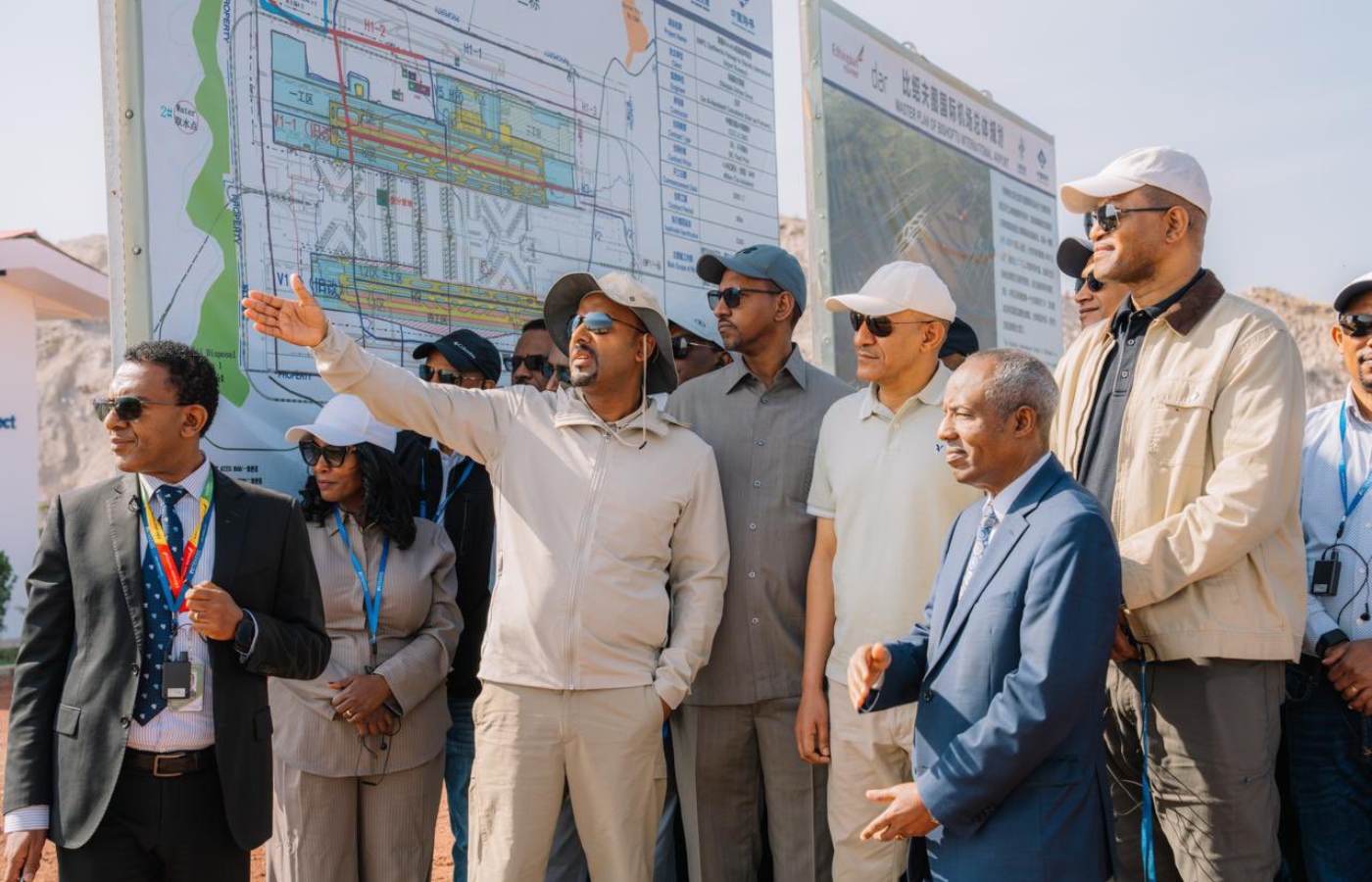
Chinese state-owned and state-linked contractors have secured 15 of the 33 shortlisted positions across the four principal construction packages for Ethiopia’s 12.5 billion US dollars Bishoftu International Airport, placing Beijing at the centre of Africa’s biggest aviation infrastructure tender while potentially complicating billions of dollars in prospective American financing.
An analysis of the prequalification results originally released by Ethiopian Airlines Group shows applications involving Chinese companies account for 45.5 percent of all positions on the shortlist. Chinese contractors appear in every one of the airport’s four main packages—main facilities, support facilities, airfield and infrastructure, and offsite transport links.
The figures do not represent 33 separate companies because several contractors and joint ventures were shortlisted for more than one package. Instead, 10 Chinese companies appear repeatedly, alone or through different consortiums, in 15 of the 33 available shortlist positions.
They include China Communications Construction Company, China Construction Eighth Engineering Division, China Road and Bridge Corporation, China Civil Engineering Construction Corporation, Beijing Construction Engineering Group, Beijing Urban Construction Group, China First Highway Engineering Company, China National Aero-Technology International Engineering Corporation, China Railway Beijing Engineering Group and Shandong Luqiao Group.
The concentration gives Chinese contractors the largest single-country presence in the competition, well ahead of companies from France, Italy, Türkiye, Qatar, South Korea, Portugal, India and Russia. No standalone Ethiopian private construction company appears on the shortlist. The only locally connected participant is the Ethio-Djibouti Railway, which is bidding for the offsite-links package in partnership with China Civil Engineering Construction Corporation.
The Chinese presence is strongest in the support-facilities and airfield packages, where Chinese-linked applicants occupy four of eight positions in each. They account for three of seven positions in the main-facilities package and four of 10 in the offsite-links package.
The shortlist does not mean contracts have been awarded. Ethiopian Airlines concluded only the prequalification stage and invited the selected applicants to submit detailed technical, financial and construction proposals. The final outcome will depend not only on construction costs and technical capacity but also on whether bidders can bring financing.
That financing requirement makes the composition of the shortlist more consequential than an ordinary construction tender. The airport is being procured under an engineering, procurement, construction and financing—or EPC-F—model, under which contractors must help mobilise export-credit and commercial financing alongside delivering the physical works.
Project documents previously disclosed by Ethiopian Airlines indicated that bids would be evaluated with a 70-percent weighting for construction costs and 30 percent for financing costs. Contractors are expected to submit committed financing proposals from export credit agencies, effectively linking the nationality of the winning contractor with the source and conditions of the project’s debt.
The arrangement could turn the contractor selection into a test of how Ethiopia balances competing Western and Chinese financing offers.
An official United States Department of Commerce project brief said the U.S. International Development Finance Corporation had indicated potential support of USD one billion in financing and another USD one billion in political-risk insurance—but expressly stated that this was “assuming no Chinese involvement.”
The same document said the U.S. Export-Import Bank had no predetermined financing ceiling but would require at least 51 percent U.S. content.
No final DFC commitment has been announced, and the presence of Chinese firms on the shortlist does not itself trigger the condition because no winner has yet been selected.
Washington had already attempted to bring more American companies into the project. The U.S. Commercial Service held a virtual matchmaking programme on March 24, 2026—just eight days before Ethiopian Airlines published the shortlist—to connect U.S. companies with prime contractors and international partners. However, no major independent American construction company emerged on the principal shortlist.
Connecticut-based Lane Construction Corporation appears in three packages, but only as part of consortiums led by its Italian parent company, Webuild, alongside Türkiye’s IC İçtaş. Washington is consequently concentrating on potential subcontracting, aviation technology and equipment opportunities involving American companies such as Boeing and GE Aerospace.
The competition is unfolding while Ethiopian Airlines is still trying to close the airport’s enormous financing gap. Group CEO Mesfin Tasew said the airline needs more than nine billion US dollars in external financing. Although expressions of interest from lenders had reached approximately USD 8.5 billion, no binding loan agreement had been signed as of late July because financiers were conducting due diligence.
The African Development Bank has indicated that it could provide USD 500 million and is leading efforts to mobilise USD 8.7 billion from other lenders. Interest has also come from the DFC, the U.S. Export-Import Bank, JPMorgan and financial institutions in Europe, the Middle East and China.
Ethiopian Airlines has postponed contractor selection from August 2026 to early January 2027 after shortlisted applicants requested additional time to complete proposals, negotiate with lenders and identify subcontractors. Financial institutions are expected to complete their internal assessments by March 2027.
Mesfin has maintained that the delay will not affect the airport’s overall implementation schedule. However, it underscores the central vulnerability facing the project: construction has been formally launched, but most of the money required to complete it has not yet been secured.
Ethiopian Airlines has already allocated approximately USD 610 million for earthworks. The first phase is intended to handle 60 million passengers annually by 2030, while the full four-runway development is projected to accommodate as many as 110 million passengers and park 270 aircraft.
The airport is expected to take over most international traffic from Bole International Airport, which Ethiopian officials say is approaching its physical capacity.
The airport’s estimated cost has already risen substantially—from around USD 10 billion during earlier planning to USD 12.5 billion at the construction launch. Separate technical assessments have placed the eventual cost of both phases as high as USD 13.9 billion, including terminals, runways, utilities and external road and rail connections.
Against that scale, the contest is no longer simply about which company can pour concrete at the lowest price. The winning contractors could help determine who finances the airport, which country supplies its technology and equipment, and whether Ethiopia’s largest infrastructure undertaking tilts toward Chinese capital or retains access to competing Western funding.




