

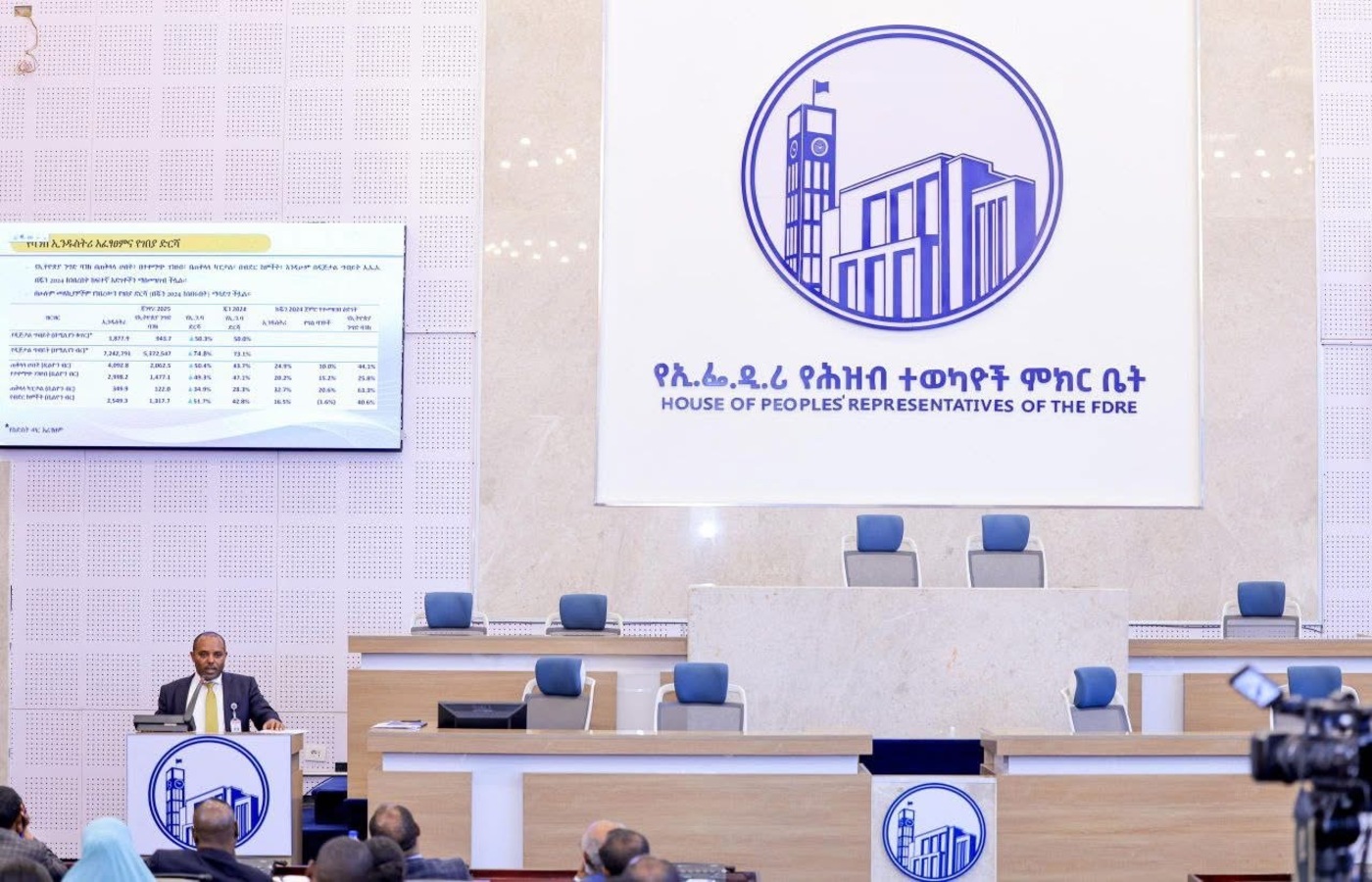
The Commercial Bank of Ethiopia (CBE), the country’s state-owned banking giant, has solidified its dominance, lifting its market share in total assets to 50.4 percent as of January 2025, up from 43.7 percent in June 2024 and a notable leap from 39.2 percent a year earlier in June 2023.
Total assets of CBE now at two trillion birr, according to President Abie Sano, who briefed the House of Representatives’ Standing Committee on Government Enterprises Affairs on the bank’s eight-month performance.
Ethiopia’s banking sector has long been a tightly controlled arena, with CBE towering over a handful of private players since its founding in 1963. Historically, it has served as the financial backbone for state-led development, managing everything from infrastructure loans to foreign exchange.
But since July 2016, when Prime Minister Abiy Ahmed’s administration began unwinding decades of economic insularity, the landscape has shifted. Reforms, including plans to open the sector to foreign banks and float the birr, have injected urgency into CBE’s strategy.
Abie cast the bank’s latest gains as a direct response to this flux. “The CBE has spent the past eight months sharpening its edge in a transforming economy,” he told lawmakers.
Deposits soared to 1.541 trillion birr, nudging its market share to 49.3 percent from 47.1 percent in June 2024 (and 45.6 percent in June 2023), while its loan and bond portfolio hit 1.393 trillion birr, driving its loan share to 51.7 percent from 42.8 percent over the same period.
The backstory is one of scale and adaptation. A year ago, CBE’s total assets stood at 1.784 trillion birr, a figure that, while formidable, left it with a 39.2 percent slice of the asset pie amid growing competition from private banks like Awash and Dashen.
The past eight months have seen it widen that gap, capitalising on a lending boom and a digital push that now accounts for over half the market’s transactions.
Yet context matters. Ethiopia’s reforms, while promising in sectors such as trade, have brought volatility—currency depreciation and inflation have squeezed borrowers and savers alike.




