

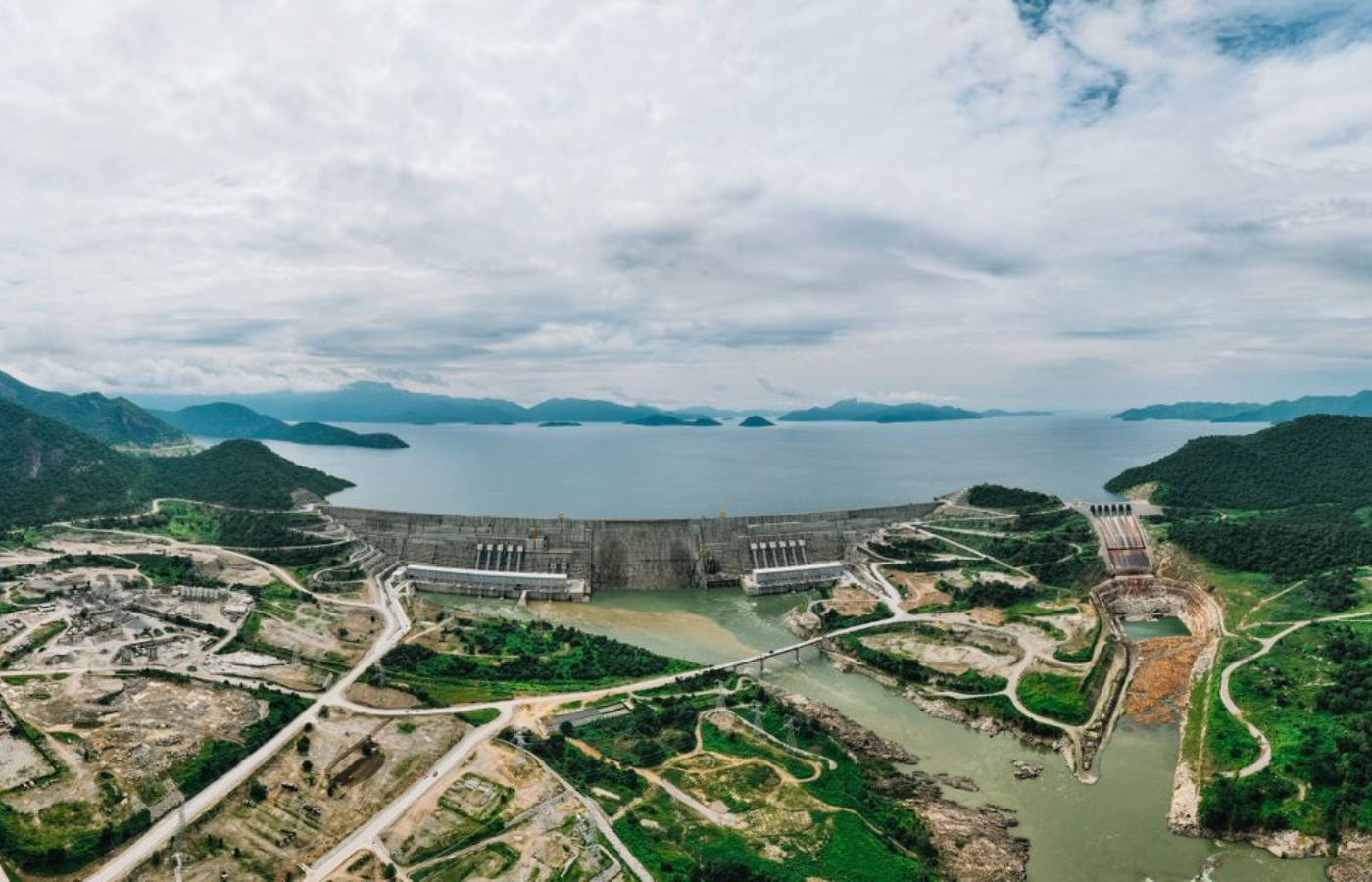
In the coming weeks, Ethiopia will inaugurate the Grand Ethiopian Renaissance Dam (GERD), Africa’s largest hydroelectric project and one of the continent’s most ambitious infrastructure undertakings. With a capacity of 5,150 megawatts and an expected annual output of 15.7 terawatt-hours, the dam represents a profound shift in Ethiopia’s energy landscape. For a country where just over half the population had access to electricity, the project carries implications that extend well beyond energy supply, touching on economic development, social equity, and regional politics.
The origins of GERD are as important as its scale. First proposed in the 1960s but only realised in 2011, the dam was built without external financing. Its five billion US dollar cost was covered through domestic bonds, salary deductions, and direct public contributions, an unusual financing model that reflected both necessity and a broader political objective: to demonstrate Ethiopia’s ability to mobilise its own resources in pursuit of a long-deferred national ambition. This context has given GERD a symbolic weight that far exceeds its technical specifications. For many Ethiopians, it is not simply an energy project but an assertion of sovereignty over the Nile, a river historically governed by treaties that excluded Ethiopia from meaningful participation.
Symbolism, however, does not generate electricity. The question is whether GERD can provide reliable power to households and industries while also contributing to regional energy trade. The stakes are high. Ethiopia’s per capita electricity consumption averaged 126 kilowatt-hours—among the lowest in Africa and far below South Africa’s 3,800. Chronic shortages have hampered industrial development and constrained the growth of small enterprises.
By contrast, if GERD’s output is fully integrated into the grid, it could raise national access to as much as 70 percent by 2030, lower the cost of power relative to diesel generation, and support industrialisation by providing a more predictable supply of energy at competitive tariffs. In addition, power exports to Sudan, Djibouti, and Kenya could generate up to two billion US dollars annually, easing Ethiopia’s balance-of-payments pressures and financing further infrastructure.
Yet the gap between generation and access remains substantial. Transmission and distribution systems have not kept pace with capacity expansion, leaving large areas of the country beyond the reach of the grid. Only about 60 percent of the existing network is electrified, and losses remain high. Without significant investment in transmission lines, substations, and rural connections, much of the electricity GERD produces could remain underutilised. From an energy systems perspective, the priority now is not simply to generate power but to deliver it reliably and equitably. That will require earmarking revenues for grid expansion and complementing large-scale hydropower with decentralised solutions, including solar mini-grids, to reach rural populations more quickly.

Financing is another constraint. Ethiopian Electric Power carries debts of around five billion US dollars, and tariffs remain far below cost recovery levels. Raising tariffs is unavoidable for long-term financial sustainability. A tiered tariff structure that preserves affordability for low-income households while charging higher rates to commercial and industrial users is already being implemented, and represents a pragmatic attempt to balance equity with solvency. This system, if properly maintained and refined, can help strengthen the utility’s finances while extending the social and developmental benefits of electrification.
Governance also matters. The technical achievement of constructing GERD will not automatically translate into efficiency in operation. Transparent regulation, improved planning, and a professional management structure for the power sector are essential if the project is to deliver on its promise. Linking energy supply explicitly to national development objectives—such as electrifying schools, health centres, and irrigation projects—would also help ensure that electricity serves as a foundation for social and economic transformation rather than merely a commodity.
The regional dimension adds another layer of complexity. Egypt and Sudan, which rely heavily on the Nile for water, have long expressed concern about GERD’s potential impact on downstream flows. Ethiopia will need to pursue sustained diplomacy if it is to combine domestic benefits with the goal of becoming a regional energy exporter. Stability in the Horn of Africa depends in part on managing such shared resources in a way that is predictable and rules-based.

GERD thus embodies both opportunity and risk. Its inauguration will be celebrated as a national milestone, but its legacy will be determined not by the volume of water impounded or turbines installed, but by whether ordinary Ethiopians gain access to reliable power. The measure of success will be found in households able to cook with electricity instead of firewood, in small businesses that can operate without interruption, and in public institutions that can rely on modern energy services.
Mikiyas Mulugeta G. Yohannes (PhD) is a Consultant and Director of Training and Development, Centre for African Leadership Studies (CALS) and XHub-Addis. He can be reached at mikiusc2017@gmail.com.




