

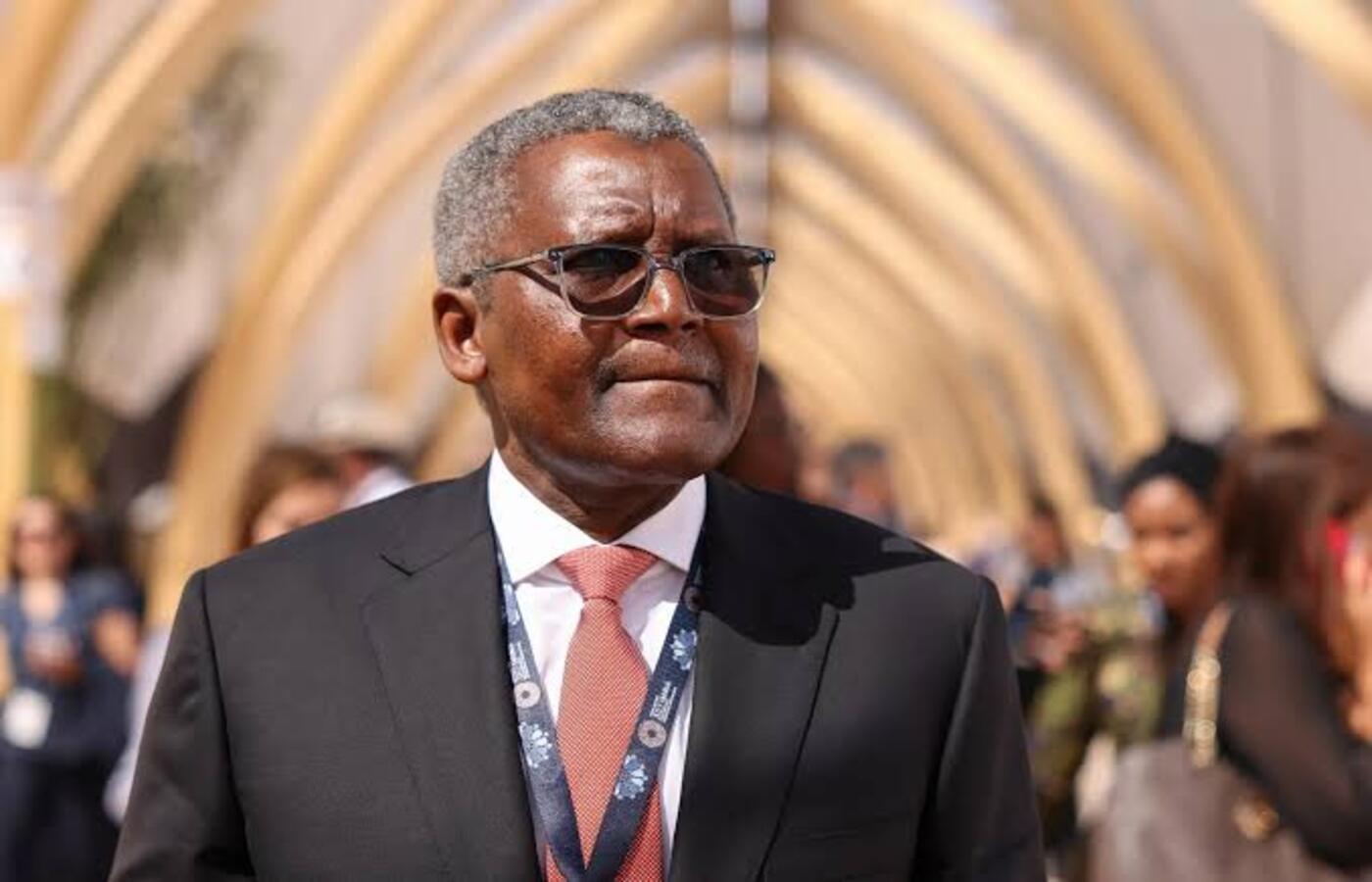
Aliko Dangote, Africa’s wealthiest businessman, has projected a more than sevenfold increase in annual group revenue to 30 billion US dollars by 2026, buoyed by a combination of ramped-up fertiliser exports, the long-awaited commissioning of his Lagos-based oil refinery, and a favourable geopolitical twist in U.S. trade policy.
The Dangote Group, a sprawling industrial conglomerate with interests spanning cement, sugar, flour and petrochemicals, currently generates an estimated $4bn in yearly sales.
But speaking to ThisDay, Dangote revealed plans to raise that figure aggressively within two years, underpinned by what he described as “full vertical integration” across his business empire.
At the heart of this expansion is the 20 billion US dollars Dangote Refinery, which began operations in early 2024 after multiple delays. With a refining capacity of 650,000 barrels per day, the facility is not only the largest in Africa but also one of the biggest single-train refineries in the world.
The project aims to reduce Nigeria’s reliance on imported petroleum products, a structural weakness that has long plagued Africa’s top oil producer despite its crude abundance.
Meanwhile, a different kind of windfall is emerging from the Dangote Fertiliser Plant, a 2.5 billion US dollars facility situated on a 500-hectare stretch of land in the Lekki Free Trade Zone. Commissioned in 2022, the complex is the largest granulated urea production facility on the continent, with an annual capacity of three million metric tonnes.
Roughly 37 percent of that output is exported to the United States. Yet, when the U.S. government, under former president Donald Trump, introduced a 14 percent tariff on Nigerian urea imports last month, alarm bells rang in Lagos. The move was widely interpreted as part of a broader protectionist lurch in Washington’s trade posture toward emerging markets.
But Dangote, in remarks that appeared as much strategic as sanguine, said he remained “comfortable” with the tariff. “We’re competing with Algeria, and Algeria got slapped with a 30 percent tariff,” he said. “So luckily for us, that puts us in a better position.”
Indeed, the disparity in tariff rates may allow Nigerian urea to retain a pricing edge in the U.S. market—at least over the 90-day suspension period currently in place for Nigeria’s exports. The development underscores how global trade frictions, often seen as disruptive, can yield asymmetric advantages for certain players.
Beyond the United States, Dangote exports fertiliser to Brazil—whose fertiliser imports have been shaken by sanctions on Russia—as well as to India and Mexico. The group is also in early stages of exploring investment options in the U.S., a move that could serve as a hedge against future trade volatility and as a platform for global branding.
Industry analysts remain cautiously optimistic. “Dangote is building an African industrial juggernaut,” said an economist. “But the group’s ability to scale revenues to 30 billion US dollars will depend on operational efficiency, macroeconomic stability in Nigeria, and its ability to navigate growing global protectionism.”




