Rising fuel, wheat and fertiliser prices are making Ethiopia’s import bill more expensive just as coffee prices retreat, putting renewed pressure on inflation and foreign exchange. Gold remains the country’s strongest buffer.
Ethiopia is facing a less favourable global commodity environment after oil prices surged 40 percent in two months, wheat and maize became more expensive and fertiliser prices remained elevated, while the international benchmark for Arabica coffee fell sharply in September.
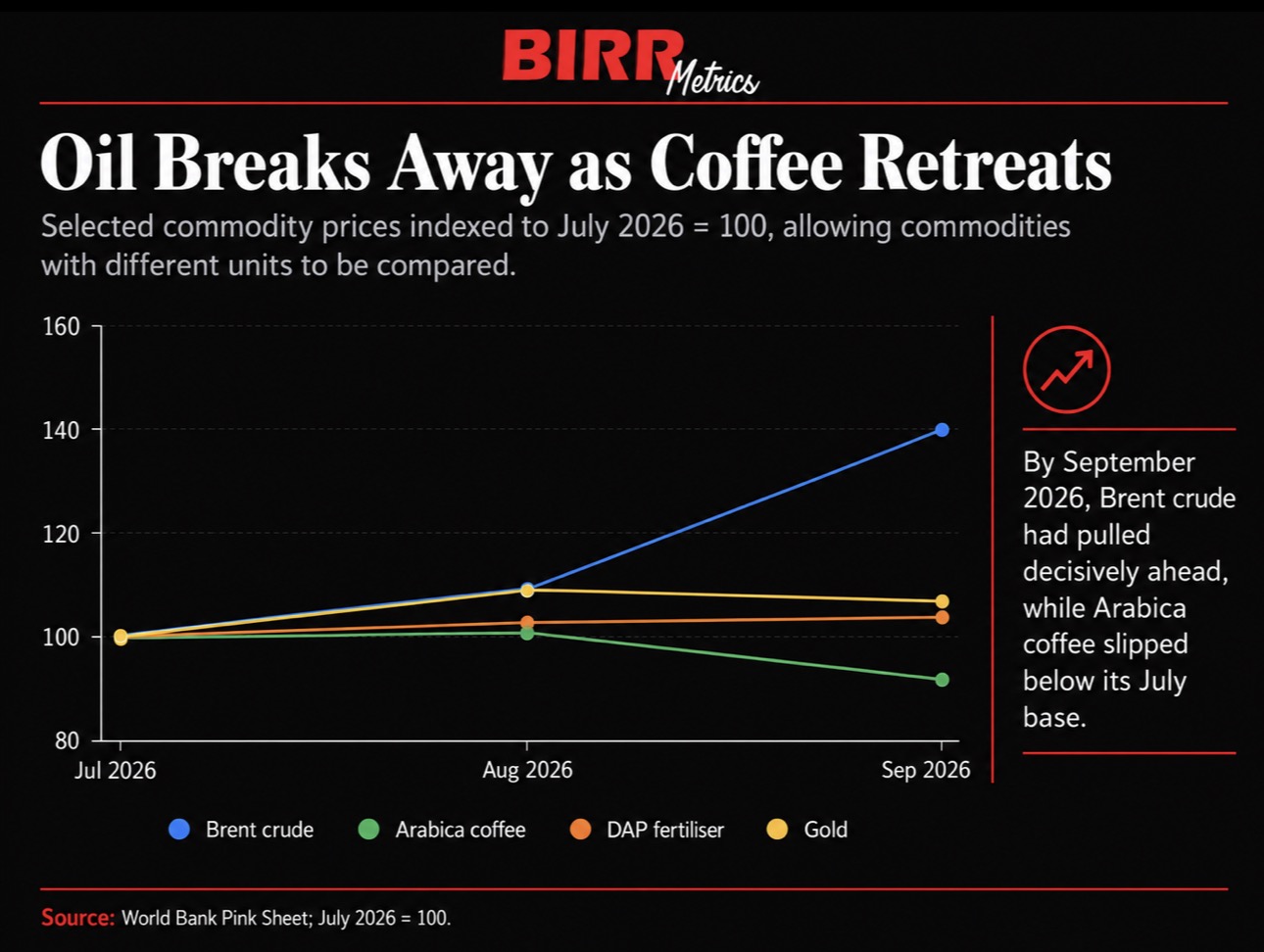
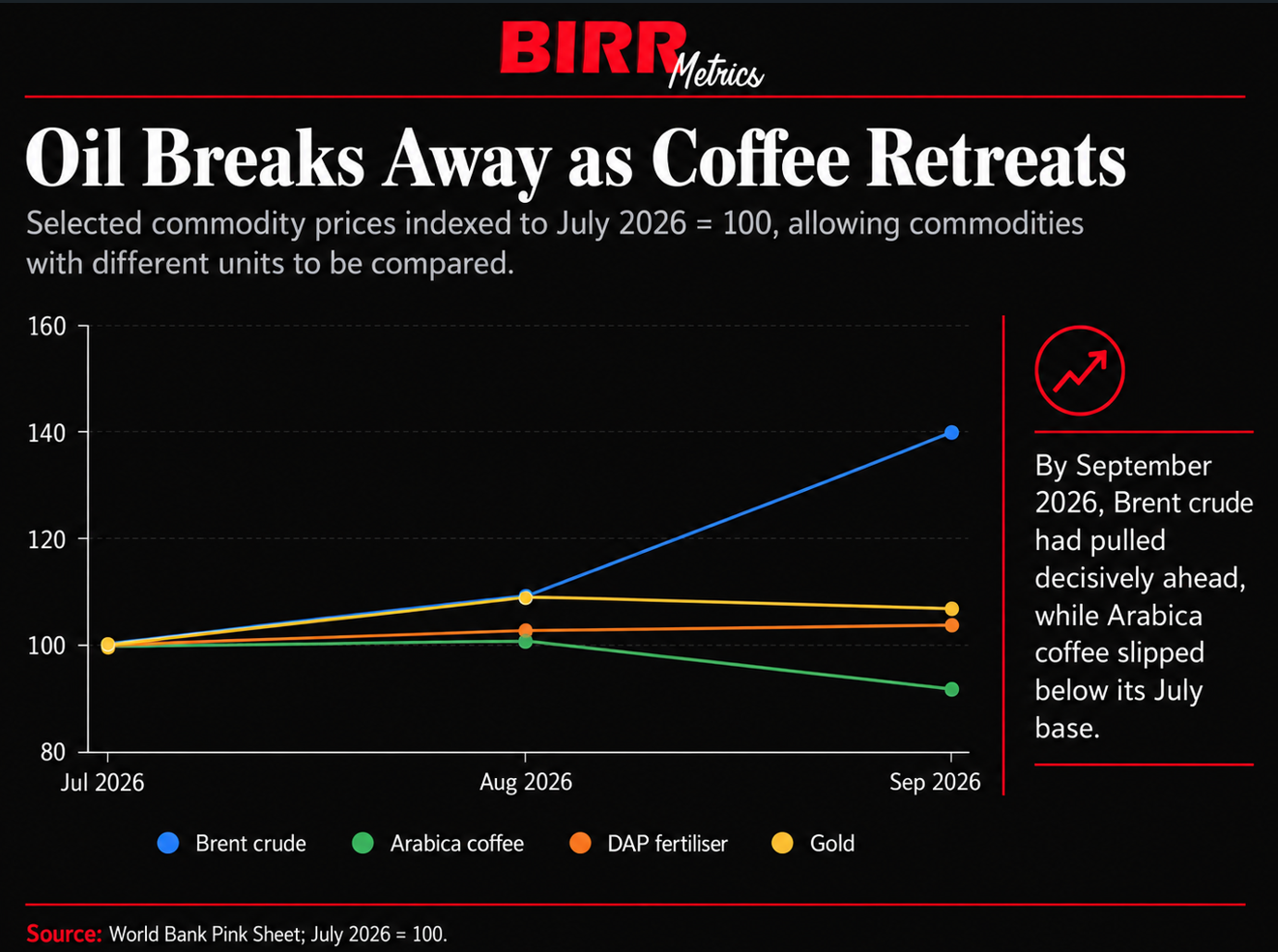
World Bank commodity data released on October 2 show Brent crude averaging 116.8 US dollars a barrel in September, up from 83.4 US dollars in July. Arabica coffee moved in the opposite direction, falling to 7.26 US dollars a kilogram from 7.91 US dollars over the same period.
The divergence matters for Ethiopia because petroleum is one of its largest import requirements while coffee remains one of its most important sources of foreign currency. At the same time, prices of wheat, maize, sugar and DAP fertiliser—all economically important to Ethiopia—have also moved higher.
The result is an emerging commodity squeeze: Ethiopia is paying more for several things it imports while the global benchmark for one of its principal exports is weakening.
| Commodity | Change in percent |
|---|---|
| Brent crude | 40 |
| World sugar | 20.6 |
| Maize | 12.3 |
| U.S. HRW wheat | 11.9 |
| Gold | 6 |
| DAP fertiliser | 2.5 |
| Arabica coffee | -8.2 |
Source: World Bank Pink Sheet, October 2, 2026; calculations from monthly averages.
Oil is the biggest immediate risk
The most dramatic movement has been in energy.
Brent crude increased from 83.4 US dollars a barrel in July to 90.9 US dollars in August before jumping to 116.8 US dollars in September. That represents a 28.5 percent increase in September alone and a 40 percent rise in two months.
The World Bank's broader energy index tells the same story, rising from 108.8 in July to 148.9 in September.
For Ethiopia, this is not an abstract movement on international markets. The country imports all petroleum fuels, according to the IMF, leaving its balance of payments directly exposed to international prices and supply disruptions. The Fund projects fuel imports at 4.8 billion US dollars in 2026/27, compared with 4.1 billion US dollars in 2025/26 under its baseline.
A sustained oil price around current levels could therefore increase Ethiopia's demand for foreign exchange just as the authorities are attempting to build reserves and deepen the country's market-based foreign-exchange system.
The IMF has already warned that a prolonged fuel-price shock could create substantial balance-of-payments and fiscal financing gaps. In one stress scenario, it estimated a 2.9 billion US dollar financing shortfall by 2027/28 if elevated imported fuel prices persisted. The scenario was not a forecast, but illustrates Ethiopia's exposure to energy prices.
Coffee is moving in the other direction
The pressure is more significant because coffee is simultaneously weakening.
The World Bank's Arabica benchmark averaged 7.26 US dollars per kilogram in September, down 8.9 percent from August and 8.2 percent from July. It is now about 14 percent below the 2025 average of 8.47 US dollars.
The timing matters.
Ethiopia earned a record three billion US dollars from coffee exports in 2025/26, according to government figures, after earnings of about 2.65 billion US dollars in the preceding year.
A decline in the World Bank benchmark does not mean Ethiopian exporters are automatically receiving 8.9 percent less. Ethiopian specialty coffees command different prices, export contracts may have been agreed earlier and realised prices depend on quality, origin and destination.
But the direction of the global benchmark matters. If lower prices persist, Ethiopia would need to export larger volumes or capture higher premiums merely to maintain the same foreign-exchange revenue.
The IMF was already expecting coffee prices to weaken in 2026/27, while projecting coffee exports to remain close to 3 billion US dollars because of volumes and other factors.
Food commodities are adding another layer
Oil is not the only pressure point.
Hard red winter wheat rose from 310 US dollars per tonne in July to 347 US dollars in September, an increase of almost 12 percent. Maize increased 12.3 percent to 239.6 US dollars a tonne, while the world sugar benchmark rose more than 20 percent to 0.41 US dollars a kilogram.
That comes as Ethiopia continues trying to contain domestic price pressures. The Ethiopian Statistical Service reported annual headline inflation of 14.1 percent in August 2026. Ethiopian Statistics Service
Higher international prices do not translate one-for-one into Ethiopian inflation. Domestic harvests, exchange-rate movements, transport costs, taxes and government purchasing arrangements all influence the final price paid by households.
But simultaneous increases in fuel and internationally traded food commodities create multiple transmission channels.
More expensive fuel raises transport and distribution costs even for domestically produced food. Higher grain prices raise the cost of imports when shortages have to be supplemented from abroad. A weaker birr can amplify both effects.
The numbers behind the squeeze
| Commodity | July 2026 | September 2026 | Change | Why it matters for Ethiopia |
|---|---|---|---|---|
| Brent crude | 83.4 US dollars/barrel | 116.8 US dollars/barrel | +40.0% | Higher fuel-import and FX requirements |
| Wheat, US HRW | 310 US dollars/tonne | 347 US dollars/tonne | +11.9% | Food-import and inflation exposure |
| Maize | 213.4 US dollars/tonne | 239.6 US dollars/tonne | +12.3% | Food and feed costs |
| World sugar | 0.34 US dollars/kg | 0.41 US dollars/kg | +20.6% | Import and consumer-price pressure |
| DAP fertiliser | 781.3 US dollars/tonne | 800.6 US dollars/tonne | +2.5% | Agriculture and government procurement |
| Arabica coffee | 7.91 US dollars/kg | 7.26 US dollars/kg | −8.2% | Downside risk to export earnings |
| Gold | 4,073 US dollars/oz | 4,319 US dollars/oz | +6.0% | Major FX cushion |
Source: World Bank Commodity Price Data, October 2026. Changes calculated from monthly averages.
Fertiliser is already expensive before Ethiopia's next procurement
DAP fertiliser presents a second foreign-exchange risk.
Its international price reached 800.6 US dollars per tonne in September, compared with 685.2 US dollars on average during 2025 and 563.7 US dollars in 2024. September's benchmark was therefore about 17 percent above the 2025 average and 42 percent above the 2024 average.
The timing is important.
The IMF estimates fertiliser imports are equivalent to roughly one percent of Ethiopia's GDP, with about two-thirds consisting of DAP and one-third urea. It said a new procurement round was due to begin in the fall of 2026.
If elevated DAP prices persist during procurement, Ethiopia faces three possible pressures: a larger foreign-exchange bill, greater government subsidy requirements or higher costs being passed to farmers.
Each ultimately carries implications for either public finances, agricultural production or food prices.
Gold is preventing the picture from becoming considerably worse
There is, however, one major counterweight.
Gold averaged 4,319 US dollars per troy ounce in September. Although that was below August's 4,411 US dollars, it remained around 25.5 percent above the 2025 average and more than 80 percent above the 2024 average.
That matters much more to Ethiopia than it did only a few years ago.
Government figures indicate Ethiopia produced about 44 tonnes of gold and generated 5.65 billion US dollars in gold export revenue during 2025/26, making the precious metal a major source of foreign exchange.
The IMF has similarly identified strong gold prices and export volumes as one of the main factors strengthening Ethiopia's balance of payments and reserves. IMF eLibrary
Gold therefore changes the commodity equation substantially.
Without the gold boom, rising oil prices accompanied by falling coffee prices would represent a considerably more serious external shock.
With gold, Ethiopia has a buffer—but one that is itself dependent on an unusually elevated global commodity price.
A more difficult test for the economic reform
The October data ultimately matter because they test the durability of Ethiopia's recent economic adjustment.
The country's external position improved strongly following the foreign-exchange reform. Gross reserves increased from roughly 0.7 months of imports in 2023/24 to around two months in 2024/25, while the current-account deficit narrowed substantially.
But the IMF has explicitly identified prolonged high fuel prices or lower gold and coffee prices as risks that could pressure reserves and complicate plans to continue rebuilding Ethiopia's external buffers.
The latest World Bank numbers show that two parts of that risk are already moving simultaneously: oil has risen sharply and coffee has fallen.
Gold remains strong enough to provide protection. Higher export volumes can also compensate for lower unit prices. And commodity markets can reverse rapidly, meaning three months of data should not be treated as a permanent shift.
Still, September presents a less comfortable arithmetic for Ethiopia than July.
The country entered the new fiscal year with record coffee earnings, booming gold exports and improving foreign-exchange availability. It now faces Brent at nearly 117 US dollars a barrel, DAP above 800 US dollars a tonne, more expensive grains and a coffee benchmark that has fallen below its 2025 average.
The immediate question is therefore no longer simply whether Ethiopia can increase exports.
It is whether gold and rising export volumes can continue growing quickly enough to outrun an increasingly expensive import bill.
That may become one of the first major external tests of Ethiopia's new economic regime.
For ongoing economic and regional trade coverage, read our report on Safaricom Ethiopia CEO Speaks on FX Reforms Boosting Local Manufacturing or review our analysis on East Africa's Breadbaskets Hit by Record Dry Season, Raising Food-Price Shock Risk.