

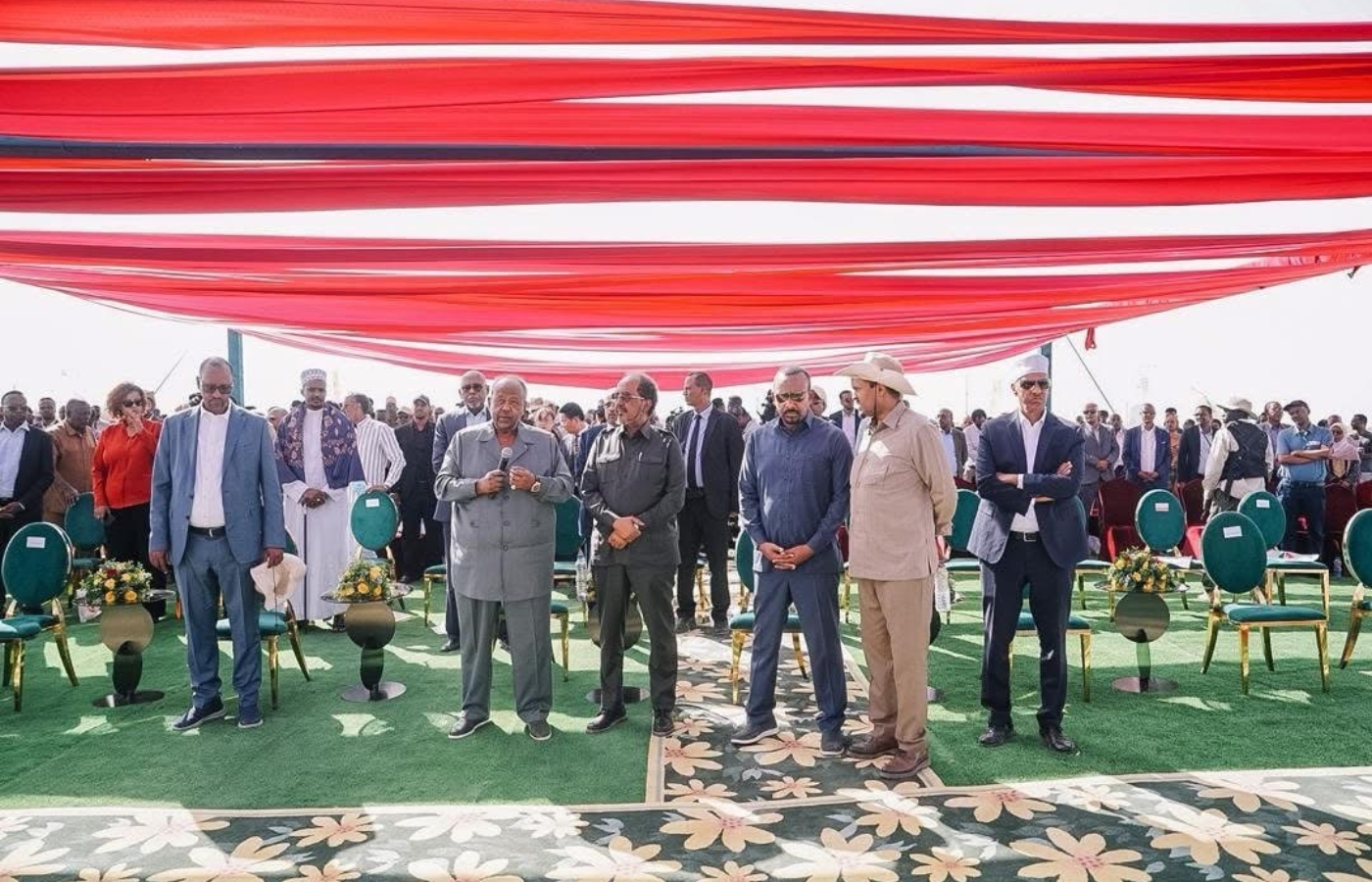
Ethiopia has inaugurated the first phase of the Aysha-II Wind Power Project near Aysha town in the Somali Region, with the presence of regional heads of state highlighting Addis Ababa’s growing focus on electricity exports even as domestic access to power remains limited.
Prime Minister Abiy Ahmed (PhD) presided over the ceremony alongside Djiboutian President Ismail Omar Guelleh and Somali President Hassan Sheikh Mohamud. Senior federal and regional officials, as well as Ethiopian Electric Power (EEP) chief executive Asheber Balcha, also attended the event.
The Aysha-II project, located about 700 kilometres east of Addis Ababa, began construction in 2017 (2009 E.C.) with total investment exceeding 257 million US dollars. The inaugurated first phase comprises thirty-two wind turbines, staff housing units, a switchyard and associated transmission infrastructure. Ethiopian Electric Power said the operational phase is currently generating 80 megawatts of electricity, with total capacity expected to reach 120 megawatts once the second phase is completed.
Prime Minister Abiy said the wind farm forms part of Ethiopia’s energy security strategy and has an annual generation potential of 467 gigawatt hours. He noted that the facility uses modern supervisory control and data acquisition (SCADA) and static var generator (SVG) technologies to support grid stability and reliable power dispatch.
The project comes as Ethiopia rapidly expands electricity generation capacity, largely through renewable energy investments aimed at supporting industrial growth and strengthening cross-border power trade. Installed generation capacity reached about 9,761 megawatts in 2025, more than double levels recorded in early 2024, driven primarily by the phased commissioning of large hydropower projects, including the Grand Ethiopian Renaissance Dam.
More than 95 percent of Ethiopia’s installed capacity comes from renewable sources, with hydropower accounting for the bulk of supply. However, reliance on hydro has exposed the system to seasonal variability, prompting efforts to diversify into wind, solar and geothermal energy.
Wind power currently accounts for just over five percent of installed capacity, at around 504 megawatts, with operational projects including Ashegoda, Adama I and II, and Aysha-II. While wind contributes a smaller share of total electricity generation due to variable output, officials view it as strategically important for balancing the grid and supporting export commitments.
Aysha’s location near Ethiopia’s eastern border places it close to existing and planned interconnections with neighbouring countries, particularly Djibouti and Somalia. Ethiopia currently exports electricity to Sudan, Djibouti and Kenya, generating much-needed foreign currency, with total interconnection capacity estimated at between 750 and 1,550 megawatts.
Electricity access at home remains a challenge, with national coverage estimated at below 50 percent. Despite the expansion of generation capacity, power interruptions persist, reflecting constraints in transmission, distribution and financing.
Officials also highlighted the role of Ethiopian Electric Power’s Engineering and Construction Business Unit, which served as project consultant—marking the first time a domestic public entity has taken on that role for a wind power project of this scale.
The Aysha-II Wind Power Project forms part of Ethiopia’s longer-term plan to raise total installed capacity to nearly 20,000 megawatts by 2030, with a rising share of non-hydropower renewables, even as the country positions electricity exports as a key pillar of its regional economic strategy.




