

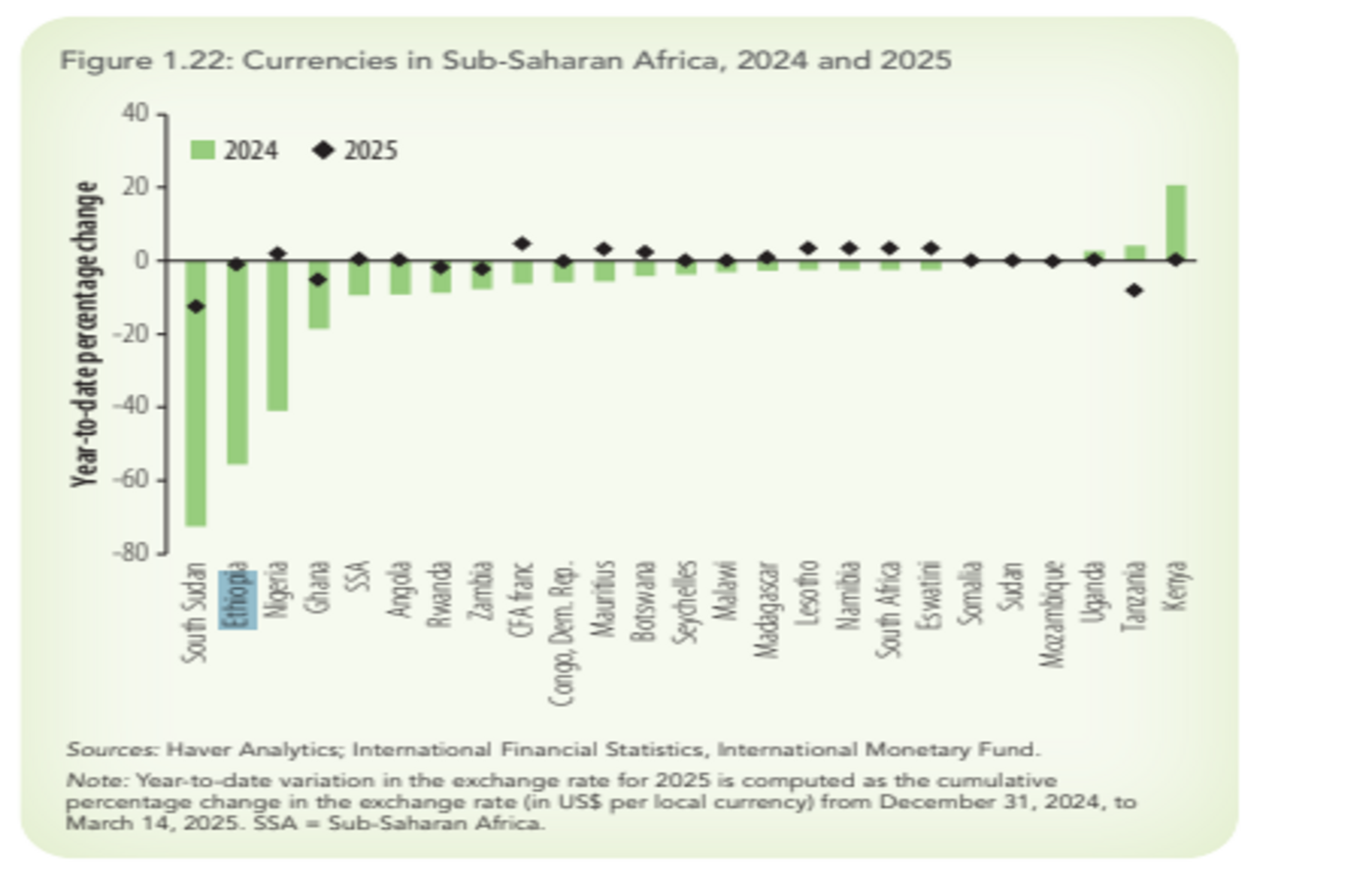
The Ethiopian birr posted the second-largest currency depreciation in Sub-Saharan Africa in 2024, falling by more than 50 percent against the US dollar, according to the World Bank’s latest Africa’s Pulse report, published April 23 during the IMF–World Bank Spring Meetings in Washington.
The annual economic update highlights that the South Sudanese pound saw the steepest decline, followed by Ethiopia’s birr and Nigeria’s naira. All three currencies suffered losses exceeding 40 percent over the course of 2024 as governments grappled with macroeconomic instability and shifting policy frameworks.
“The weakest performing currencies over the past year were the South Sudanese pound, the Ethiopian birr, and the Nigerian naira, with reductions in value that exceeded 40 percent in 2024,” the report stated.
Ethiopia’s depreciation came amid a sweeping shift in monetary and exchange rate policy. In July 2024, the National Bank of Ethiopia adopted an interest rate–based policy framework, setting a benchmark rate of 15 percent and initiating open market operations to guide interbank rates. By the end of that month, a market-based exchange rate regime had been rolled out, accompanied by limited foreign exchange intervention.
Although painful as described government officials, these measures were part of a broader strategy to restore economic stability and lay the groundwork for more sustainable growth.
The World Bank notes that countries with high external debt burdens and weak export performance were particularly vulnerable to sharp currency declines.
“African countries that experienced foreign exchange shortages—as a result of increased external debt service and subdued export revenues—saw their currencies weaken sharply, particularly in 2024,” the report said.
By contrast, some currencies benefited from improved capital flows and market reforms. “As financial conditions became less restrictive and the gains from foreign exchange market reforms began to materialize, some African currencies gradually started to strengthen,” the report noted.
The Kenyan shilling appreciated by 20 percent during 2024 and has remained relatively stable this year, while the South African rand and other currencies pegged to it have fluctuated only modestly.
For Ethiopia, the birr’s relative stability so far in 2025 marks a notable shift. Year-to-date data suggests the currency has held steady, with analysts cautiously optimistic that the reform programme is beginning to yield results.
“This is a textbook front-loaded correction,” said one economist familiar with Ethiopia’s transition. “The next challenge will be maintaining discipline and continue building reserves to defend the birr if pressures return.”




