

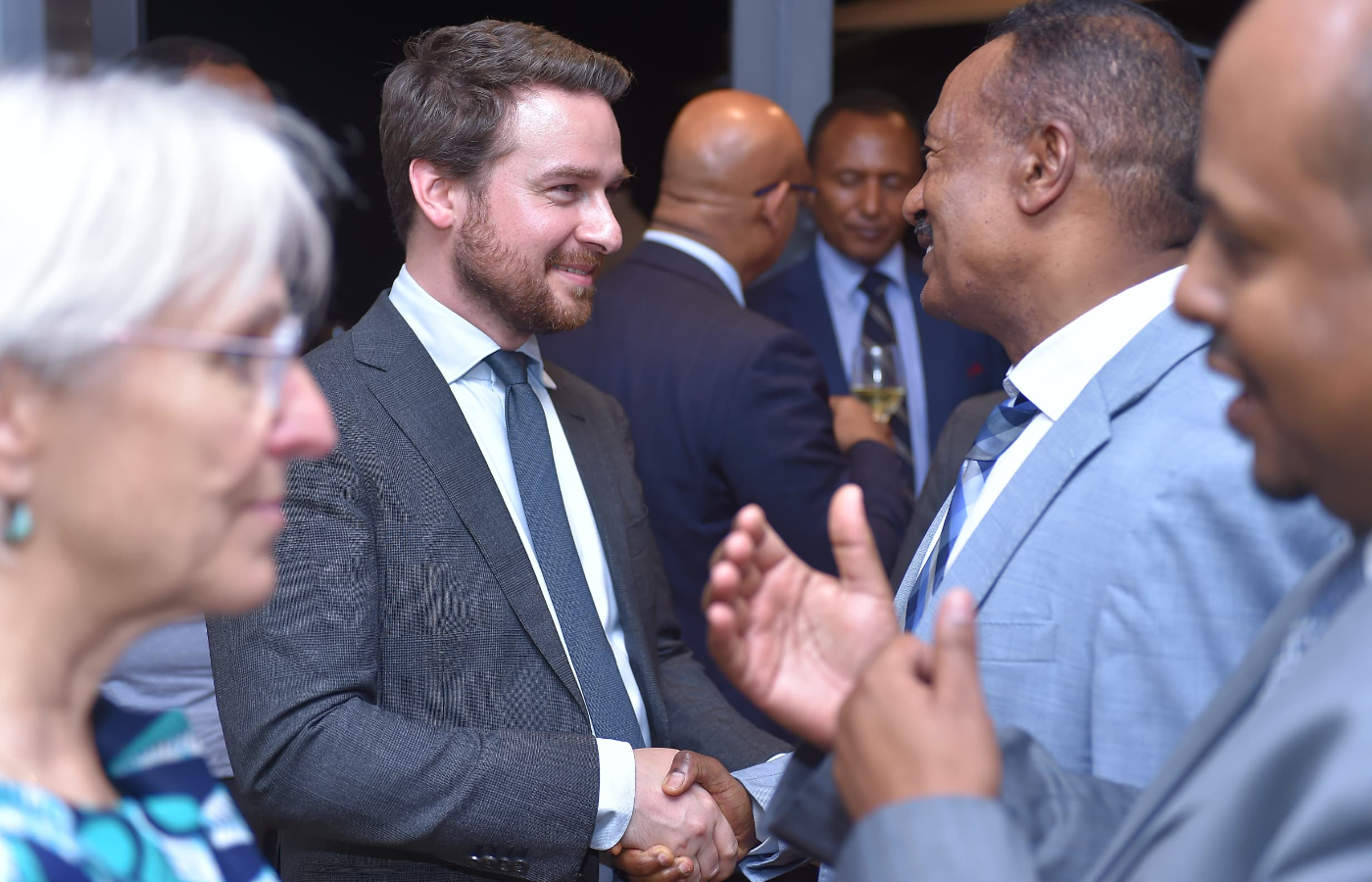
Belgian dealmaker Thomas De Beule has spent the past several years stitching together commercial ties between Europe and Africa, overseeing corporate missions and investment forums as commercial director at the Chamber of Commerce, Industry and Agriculture for Belgium, Luxembourg, Africa, the Caribbean and the Pacific (CBL-ACP), alongside his work with A-Law International Law Firm focused on the continent. In a conversation with Birrmetrics’s Mintesinot Nigussie, he casts Ethiopia as a market edging into a more investable phase. European firms are circling, he suggests, encouraged by reforms in banking, foreign exchange and capital repatriation, and by a calendar of business missions that is growing denser by the month. Yet the picture is not uncomplicated. Persistent foreign-currency shortages, slow payments and limited transparency still cloud decision-making. The relationship, long diplomatic, is now being recast in commercial terms: less symbolism, more structure, with trade expected to seed investment and, in time, anchor a deeper European presence in one of Africa’s largest economies.
Birrmetrics: Let’s start with Ethiopia’s commercial ties with the European markets you work with, particularly Belgium. How have these links developed in recent years?
De Beule: Belgian companies already have a visible footprint in Ethiopia, particularly in food production, industrial supply chains and manufacturing support.
Puratos, a Belgian bakery and food ingredients company, for instance, has been operating in the country for over 6 years, where it is also involved in training local staff and building technical capacity within its operations.
Other firms with Belgian links are also active in the market. Boortmalt, with French shareholdersheadquartered in Antwerp, Belgium, and deep historical roots in the region, supplies hop/inputs to beer factories in Ethiopia.
Beyond individual companies, there is also a steady presence of Belgian professionals in senior management roles across different firms operating in Ethiopia, contributing technical and managerial expertise in various sectors.
The relationship between Ethiopia and Belgium also carries a long historical thread, with economic and diplomatic contacts extending back 120 years through early exchanges and visits between the two countries.
Current engagement is being reinforced through a series of structured business and investment initiatives. A business mission was held last June, and next month, the Ethiopia – Benelux Business Forum is set to take place in Luxembourg on 18th of May and Belgium on 19th of May.
Looking ahead, a larger reception is expected in November to mark 120 years of diplomatic relations. That occasion will also host an investment roundtable, bringing together Ethiopian financial institutions, regulators, and development actors, alongside existing and prospective investors from Belgium and Luxembourg.
The discussions are expected to include companies already active in Ethiopia, such as SES Satellites from Luxembourg and Puratos, alongside other firms assessing entry into the market.
When we had a meeting with the director general of the Ethiopian Capital Market Authority, they mentioned that they are developing new frameworks for company listings and digital platforms intended to improve access to corporate information for foreign investors.
The idea is that European companies should be able to find all relevant details about Ethiopian companies more easily. What we want to achieve is to build more confidence among European stakeholders to invest in Ethiopia, in the right way, with the right partners, including through our chamber, CBL- ACP.
Our chamber has been around for more than 63 years. It is the biggest chamber between Belgium and Luxembourg focused on Africa, the Caribbean and the Pacific. We have more than 130 members, many of whom are major players with long experience in Africa, in some cases over 50 years.
There is already a very strong foundation of Belgium, Luxembourg and Ethiopia trade and investment. But there is still more to be done.
Ethiopia is currently introducing a range of reforms across various sectors. How is this reshaping the trade relationship between Ethiopia and Belgium-Luxembourg?
There have been significant reforms in Ethiopia in recent years, and the changes are quite striking. I was in the country last June, and before that, my first visit was about 11 years ago. The difference is remarkable. Even visually, the capital has changed, but more importantly, the business environment has evolved.
On the policy side, reforms such as opening up the banking sector, allowing greater flexibility in exchange rate management, and easing conditions for repatriating capital are important steps. These are already producing results in terms of investor interest and engagement.
At the same time, there is still a need for further progress if the goal is to build stronger confidence among European stakeholders. A number of additional reforms are already in the pipeline. In discussions with Ethiopia’s capital market leadership, the direction of upcoming changes over the next 12 months was particularly encouraging.
What stands out is the emphasis on transparency. European companies are used to operating in environments where information on ownership structures, financial performance and company governance is easily accessible online. Strengthening this kind of transparency in Ethiopia would make it easier for larger European firms to engage more confidently and at scale.
There are already signs of increased engagement. The EU-Ethiopia Business Forum is one example of growing European interest, supported by broader initiatives such as the EU’s Global Gateway strategy, which places greater focus on investment links with Ethiopia.
So I would say the reforms have already achieved a lot. We can also see that more is coming, and that is definitely positive. It helps to further boost confidence among European stakeholders.
You mentioned the economic mission held last June was successful. What exactly does that mean, and what were the key outcomes?
Yes, definitely. Last June, we signed an MoU with the Addis Ababa Chamber of Commerce. We also brought around 12 companies from Belgium and Luxembourg to Ethiopia as part of that mission.
One of the most concrete outcomes has been what followed after the mission itself. It helped lay the groundwork for a business forum now being organised in Luxembourg and Brussels, in strong collaboration with the Addis Ababa Chamber of Commerce and other Ethiopian stakeholders.
Within less than a year of signing the MoU, we are now moving towards a major business forum that is expected to bring together around 50 Ethiopian companies, alongside government officials. That, in itself, shows a very tangible follow-up to the mission and not just a symbolic engagement.
So in that sense, the economic mission acted as a starting point. It triggered a series of initiatives that are now continuing, both in Europe and in Ethiopia, including more structured business events aimed at improving investment linkages and the overall framework for cooperation.
There has also been strong support from the Ethiopian Embassy in Brussels, particularly the Ambassador, whose engagement has been very active in facilitating these initiatives. The same applies on the Belgian side, with the Belgian Ambassador also playing a constructive role.Aswell the Embassy of Luxembourg.
We also work closely with the Chargé d’Affaires from the Embassy of Luxembourg in Addis Ababa, as well as the Embassy of the Netherlands in Addis Ababa. So overall, there is a coordinated effort across institutions on both sides, which has helped move the process from a single mission into a broader, ongoing programme of engagement.
As part of Ethiopia’s ongoing economic reforms, one of the key shifts is the import substitution strategy. This could potentially affect export volumes, especially since Belgium’s exports to Ethiopia are largely concentrated in areas such as pharmaceuticals. Have you seen any impact on export volumes, particularly in industrial goods?
Well, for Belgian and broader European companies exporting to Ethiopia, the key issue is ensuring a smooth and predictable payment system. That remains an important factor in sustaining trade flows.
We are seeing some progress in that direction, but at the same time, some European companies still face delays in payments and challenges in settling invoices on time. That naturally affects the ease of doing business.
If there is further improvement in facilitating more seamless foreign currency transactions and a more predictable payment environment, it would have a direct positive effect on trade volumes.
What is often the case is that investment tends to follow trade. European companies typically start by exporting products, then move to establishing warehouses and maintaining local stock. After that, the next step is usually partnerships with local investors, and eventually joint ventures or even local manufacturing.
So it is a gradual process. But once European companies are fully established in a market, they tend to stay for the long term, often decades. The key is building that foundation step by step, with consistency and predictability.
On another note, there is also growing attention to recycling and circular economy initiatives. Among the companies that joined the delegation, Ecoplast is active in plastic recycling, including polyethylene terephthalate, or PET, bottles.
The company converts recycled plastic into products such as school materials for children and office supplies. There is also interest in exploring how such products could be introduced into the local market, particularly where volumes and demand can support scaling.
Overall, the focus is increasingly not only on trade and investment flows, but also on how sustainability and reuse models can be integrated into broader economic cooperation.
What would it take for European companies to move beyond market entry and trading relationships into long-term manufacturing or industrial investment in Ethiopia?
There is still some degree of bureaucracy in Ethiopia, although it has improved quite a lot in recent years. In some cases, processes that should move fast still take some time. That said, outcomes often depend on working with the right local partners.
From the European side, speaking from Belgium and Luxembourg, we usually encourage companies to engage through structured channels. This includes institutions such as the chamber, the Ethiopian Investment Commission, the Addis Ababa Chamber of Commerce, the Southern Chamber of Commerce, and other European business networks already active on the ground.
Foreign exchange availability remains another key factor. When a European company is selling products such as pharmaceuticals or construction materials, delays in payment can create operational challenges. These delays are rarely intentional, but they do affect business planning.
For companies not familiar with African markets, this can become a major hurdle. There is sometimes a gap in understanding when payments are delayed due to foreign currency constraints, which can be difficult for European firms to immediately interpret within their usual business frameworks.
At the same time, progress has been made, and the environment is gradually improving. But further work on predictability would help reduce friction in the system.
Another practical issue relates to planning and coordination. European companies typically operate with long-term schedules, often setting business calendars and commitments a year in advance. In more flexible environments, that is not always the case.
For effective engagement, early planning is important. In many cases, at least six months’ notice is needed for major business events or investment missions, so that companies can properly align participation and mobilise decision-makers.
Belgium is considered a key player in the EU’s MAV+ initiative on Manufacturing and Access to Vaccines, Medicines and Health Technology Products in Africa. How has the initiative progressed so far, and how has it translated in Ethiopia?
There are some concrete examples already. A Belgian company, Unizima, has signed a contract with the Institut Pasteur in Dakar. That institution is often compared to the Tropical Institute in Antwerp, where many Ethiopian doctors have studied over the years, particularly in areas such as tropical diseases and vaccination.
So there is already a foundation of knowledge exchange, with Ethiopian medical professionals training and studying in Belgium and engaging in broader scientific cooperation. That aspect is well established.
The longer-term objective, however, is local production of vaccines in Africa, including in Ethiopia. Some countries are already moving ahead in that direction. Senegal, for example, is developing early-stage manufacturing capacity, while Rwanda has made more advanced progress in setting up vaccine production facilities.
In Ethiopia, there has also been growing engagement. A recent example includes discussions involving B Medical Systems during a business forum linked to EU cooperation initiatives. These kinds of engagements point to increasing interest in strengthening health infrastructure and supply chains.
At the European level, including through mechanisms under MAV+, there is strong support for expanding local manufacturing capacity. The rationale is both economic and strategic. Local production can reduce costs, improve access, and strengthen supply security.
The COVID-19 pandemic highlighted the limitations of global vaccine distribution, particularly in terms of availability and equity. Local manufacturing capacity is seen as a way to respond more quickly in future health emergencies, not only for domestic needs but also for regional supply.
Many of the companies with relevant technology and production capability are based in Belgium and other EU countries, including Luxembourg. The broader direction of policy is to support partnerships that allow this capacity to be deployed locally.
Overall, the foundation is in place through existing cooperation and technical exchange, but the expectation is that implementation needs to accelerate. Local production of vaccines and health technologies is increasingly viewed as a strategic necessity rather than an option.
The EU deforestation regulation is currently at the centre of debate in the coffee sector. How are you working with different stakeholders to ensure its fair and practical implementation?
The EU deforestation regulation is an active area of engagement, and the Ethiopian Embassy in Brussels is already closely involved. There are ongoing consultations with European partners to better understand the requirements and how they can be applied in practice.
From a broader perspective, the regulation is achievable, but it requires significant capacity building and technical understanding to implement effectively. This includes traceability systems, compliance mechanisms and awareness across the value chain.
There are already examples on the continent. Countries such as Ghana have made progress in aligning with deforestation-related standards, which shows that implementation is possible within an African context.
AfCFTA is often described as Africa’s biggest trade opportunity. From a European business perspective, is it already functional in practice, or still largely aspirational?
It is already in practice. We have already seen some African countries shipping goods under the African Continental Free Trade Area framework.
At this stage, most countries have ratified the agreement through their parliaments and it has been adopted into law. The focus now is on implementation.
The main challenge, however, is that in many countries implementation remains uneven. That is where bottlenecks are still emerging.
Once fully implemented, it has the potential to create a trading environment that could, in terms of goods movement, resemble something closer to a single market model as we have in the EU. Not necessarily in terms of movement of people, but in the circulation of goods across borders.
There are already early examples of cross-border trade taking place under the framework, but the key issue now is ensuring consistent application across countries.
From a strategic perspective, Ethiopia has an opportunity to play a leading role, given its historical position in continental institutions, including its role in the formation of the Organisation of African Unity by Haile Selassie, alongside other founding leaders of African independence movements.
The agreement itself represents an opportunity to deepen commercial ties across the continent. Intra-African trade remains relatively low, but that is also where significant growth potential lies in the short to medium term.
For European companies operating in Ethiopia, including those from Belgium and Luxembourg, effective implementation could also open up wider regional access. If goods can be produced in Ethiopia and then exported smoothly to markets such as Kenya, Djibouti, Somalia, the Democratic Republic of Congo, South Africa and West Africa, it would strengthen the case for deeper investment.
It would allow companies to view Ethiopia not only as a national market, but as a regional hub within a larger integrated trade system.
That said, the process is still at an early stage. While progress is visible, full implementation will take time, and the priority now is ensuring that the framework works consistently in practice across all member states.
Development aid is under increasing scrutiny worldwide. How is that changing how you operate in Africa?
From our perspective as a chamber of commerce and a private sector organisation, the trajectory has already been clear for some time: trade first, then aid. Many countries have moved towards what Ghana once described as “beyond aid”, placing greater emphasis on trade and investment as the more sustainable path.
Trade and investment tend to create longer-term value compared to traditional development assistance. At the same time, development agencies themselves have been adjusting their approach. There is now a stronger focus on blending support with private sector participation.
Some abrupt shifts in aid models in recent years have had consequences in certain countries, particularly where critical services were affected. That experience has contributed to a broader rethink of how external support is structured.
We are also seeing a shift in approach from partners such as the European Union, particularly through initiatives like the Global Gateway, which place greater emphasis on mobilising private companies and investment alongside public funding.
From the Belgian side, there are also institutions such as Enabel, the development agency, which is increasingly focused on structured partnerships with governments. In Ethiopia, discussions around formalising such cooperation are ongoing through existing institutional channels.
What is becoming more central now is the idea of “development collaboration” rather than traditional aid. The focus is shifting towards practical cooperation, particularly in supporting small and medium-sized enterprises.
There are already examples of this approach in practice. In countries such as Senegal and Côte d’Ivoire, SME entrepreneurs have been brought to Belgium to meet counterparts, exchange experience and explore business partnerships. The idea is to build capacity through direct business-to-business engagement.
This is important because in Belgium, SMEs form the backbone of the economy, alongside larger multinational firms. The same is true in many African economies, including Ethiopia and Nigeria, where SME growth is closely linked to job creation and the expansion of the middle class.
Strengthening SMEs is therefore seen as central to broader economic development. A more balanced SME ecosystem helps reduce structural gaps between large corporations and smaller businesses, and supports more inclusive growth over time.
In that sense, the direction of travel is less about aid in the traditional sense and more about building ecosystems where trade, investment and enterprise development reinforce each other.
You have mentioned the Ethiopian Capital Market Authority several times since the beginning of our discussion. What exactly are you doing with ECMA, and which other sectors are you considering entering following Ethiopia’s recent economic reforms?
What we are doing with the Ethiopian Capital Market Authority is mainly focused on support and connection. That includes capacity building, linking them with the Luxembourg Stock Exchange, and also facilitating engagement with their counterparts in Brussels.
At the same time, we are identifying European companies that may be interested in collaborating with the Authority and the broader capital market ecosystem in Ethiopia. This is also part of the reason we are organising an investor roundtable in November, which will take place during the same week as the 120-year diplomatic anniversary celebrations.
For us, this is a very important moment in the relationship. There is already a strong foundation of more than 120 years between Ethiopia and Belgium and Luxembourg (100 years), but we see this as a phase where the relationship can be elevated further.
A key focus now is to highlight the recent policy reforms in Ethiopia and present them more clearly to European stakeholders. That includes using major platforms such as the business forum scheduled for next month.
For example, the Ethiopia-focused event in Luxembourg will be one of the largest Africa-related business gatherings hosted there in recent years, taking place at the Luxembourg Chamber of Commerce. A similarly large engagement is also planned in Brussels.
The aim is to ensure these reforms are better understood in Europe and to bring in more structured participation from European companies and institutions.
From my engagement with the Capital Market Authority, including a detailed discussion with its director, I would say there is strong preparedness and a clear understanding of what needs to be done. That level of readiness gives confidence in the direction of the reforms.
You’ve mentioned a business forum in Luxembourg next month. What should we expect from it in practical terms?
The forum is structured as a multi-day programme taking place between Brussels and Luxembourg, bringing together Ethiopian and Benelux stakeholders across government and the private sector.
The Ethiopian delegation is expected to arrive on May 17, before moving to Luxembourg on May 18, where the main full-day forum will be held. The programme begins with keynote remarks from the Ethiopian Ambassador, the Luxembourg Ambassador, senior Luxembourg officials, and representatives of the Luxembourg Chamber of Commerce, Luxembourg private sector and Ethiopian Airlines.
The day will include several panel discussions focused on investment and trade cooperation, followed by business-to-business meetings in the afternoon. These sessions are designed to allow direct engagement between Ethiopian companies and their European counterparts.
A networking reception will follow later in the day, after which the delegation will return to Brussels.
On May 19, a similar programme will take place in Brussels. This session will include participation from the Belgian Ministry of Foreign Affairs, as well as representation from the Benelux Union and other institutional partners. B2B meetings are also scheduled as part of the agenda.
From May 20 to May 22, the programme continues with company visits across Belgium. Ethiopian firms will meet Belgian companies directly at their offices to explore business opportunities and advance discussions initiated earlier.
Ahead of the forum, Ethiopian and Benelux companies have already been introduced to each other to facilitate early-stage discussions. The expectation is that some of these engagements could result in memorandum of understanding during or shortly after the forum.
The programme also brings together a range of institutions, including the European Investment Bank in Luxembourg and LuxDev, the Luxembourg development agency. On the Belgian side, agencies such as Enabel and BioInvest are expected to participate, alongside other investment-focused organisations.
You have been visiting Addis Ababa for nearly a decade. What has stood out most about Ethiopia over that time?
What stands out most is the country’s deep history. Ethiopia has a civilisational legacy that stretches back thousands of years, and a long tradition of statehood and imperial history.
It is also a country that, in its own narrative, has defended its sovereignty at key moments in history, including the Battle of Adwa and later during the Second World War. That sense of independence is often central to how Ethiopia is perceived in historical terms.
Beyond history, there is also the cultural and architectural landscape of Addis Ababa itself. Places such as the National Palace and Unity Park reflect that layered history in a very tangible way.
On a personal level, visiting Ethiopia has also been meaningful. Experiencing the country together with family, and being able to share its history and landmarks, adds another dimension to that connection.
The interest in Ethiopia is not recent. It has been shaped over many years, including early reading about the country’s history and its former emperors, which helped build a long-standing personal connection.
The history of Ethiopia is so rich that it should feature prominently in publications everywhere. It is a history widely known across Africa and beyond, and one that continues to attract global attention.
For me, it is always a pleasure to be in Ethiopia. Over time, it has become something of a second home.
What’s your favourite Ethiopian dish?
Of course, it is injera. I am a vegetarian, so I usually have it with vegetables, sauces and spinach, and sometimes fish.
Ethiopian coffee is also a favourite. I was happy to have it again during my visit, and I also went to one of the oldest coffee places in Addis Ababa, which is marked as a protected heritage site.




