

By the time the smell of incense drifts through Addis Ababa’s neighbourhoods and the soft chant of Christmas hymns fills the early morning air, Ethiopian households know that Genna has arrived. It is a season of renewal, family, and tradition — anchored, as always, by food.
Yet this year, the Christmas table tells a different story.
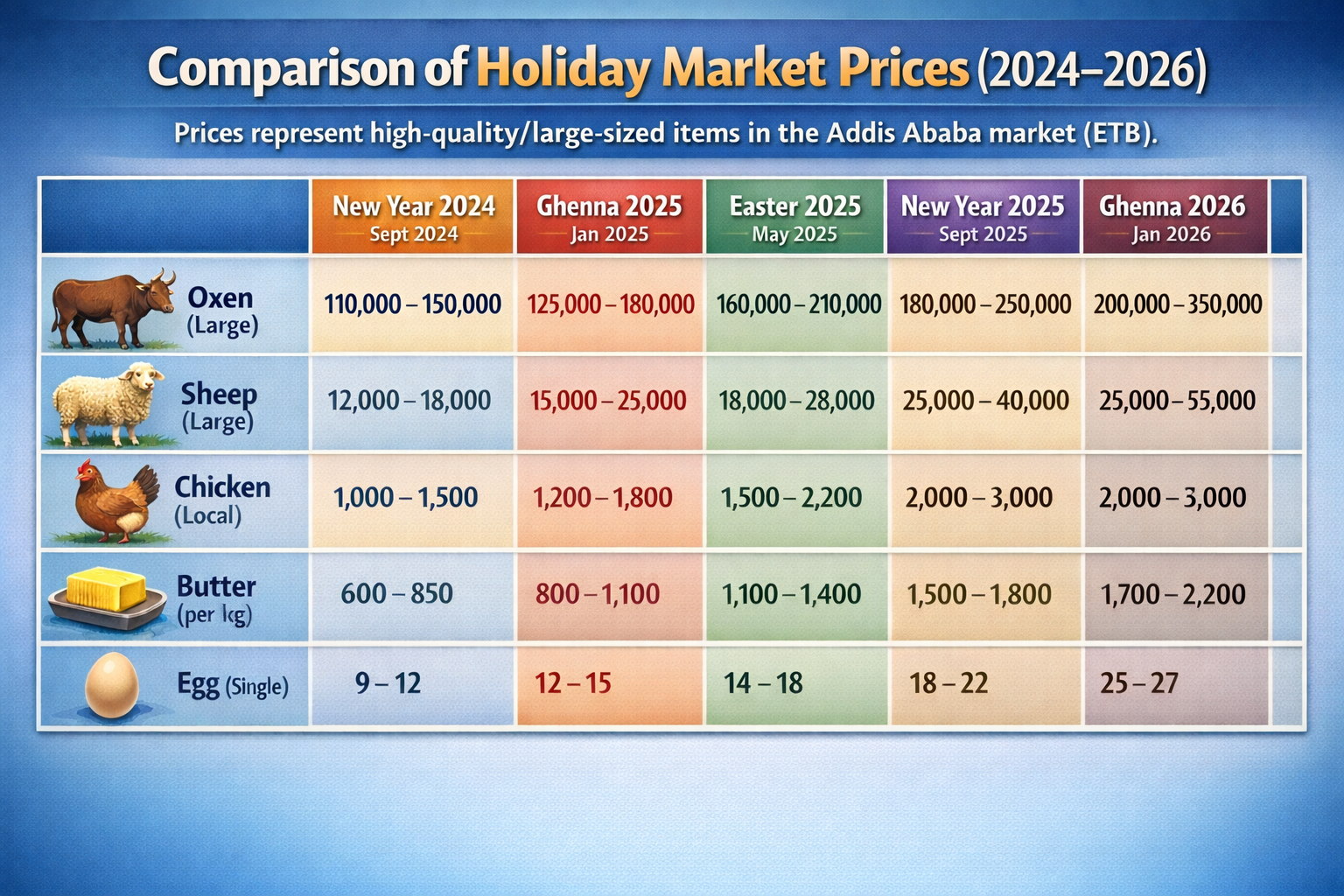
At neighbourhood markets and supermarkets alike, prices have climbed to levels that are reshaping how families celebrate. Chicken — the heart of doro wot — now sells for between 1,500 birr and 3,000 birr, depending on size, with larger birds largely sourced from southern Ethiopia. In supermarkets, processed chicken is priced at 1,500 birr per kilogram, placing it beyond the reach of many low-income households.

Butter, essential for both cooking and ritual, ranges from 1,700 birr to 2,200 birr per kilogram. Eggs sell for 25 to 27 birr each, while onions — one of the few relative holdouts — are priced at about 50 birr per kilogram.
For families, these figures are no longer abstract.
“I paid 7,500 birr for a sheep, and yet my overall cost has not changed,” said Kassahun Gizachew, a father of two shopping for the holiday. “What has changed is the quantity.”
Kassahun said that just a few years ago, his Genna shopping basket included sheep, chicken, and even kircha — a shared portion of an ox — all within a 20,000 birr budget.
“Now the budget remains the same,” he said. “But nothing else has.”
Livestock: The centrepiece under pressure
Nowhere is the shift more visible than in livestock markets.
According to a Birrmetrics market assessment, large goats are selling for about 55,000 birr, while medium-sized goats fetch between 30,000 and 35,000 birr. Oxen prices show an even sharper divide. Large oxen are trading at around 200,000 birr, while smaller ones are priced at roughly 85,000 birr.

At Kera livestock market, one of Addis Ababa’s busiest hubs ahead of the holiday, traders say this Genna feels markedly different.
“This year is not like last Christmas, and not even like the New Year,” said Belay, a livestock trader. “Supply is tight.”
An ox he was offering for sale was priced at 110,000 birr, up from around 90,000 birr during the last New Year period. The reason, he said, is not demand alone, but cost.
“Transport has become very expensive,” Belay said.
Hiring a large FSR truck to transport oxen now costs between 80,000 and 100,000 birr per trip, while an Isuzu truck charges 50,000 to 60,000 birr, carrying a maximum of twelve animals. Fuel prices, risk premiums along conflict-affected routes, and longer distances have all fed into final market prices.
Most of the cattle arriving at Kera this season are coming from Bahir Dar, Gondar, Harar, Jimma and Welega, traders say — routes that have become costlier and more uncertain over time.
The quiet transformation of tradition
These changes are not limited to one season. They are part of a deeper structural shift that has unfolded over the past five years.
Since 2022, Ethiopia’s agricultural markets have been shaped by inflation, conflict-related disruptions, and a historic change in the exchange rate regime. In July 2024, the National Bank of Ethiopia moved towards a market-based foreign exchange system, triggering a sharp devaluation of the birr.
While livestock feed on grass, nearly everything that moves them — fuel, veterinary medicine, transport equipment — is tied to foreign currency. When the birr weakened, the cost of moving animals from pastoral regions to urban markets rose sharply.
The impact has been lasting.
Oxen, long the “gold standard” of Ethiopian celebrations, now require collective purchasing on an unprecedented scale. Where four or five households once shared an animal, ten to fifteen families now pool resources. A bull that sold for 50,000 birr in 2022 has a new baseline of 130,000 birr or more in 2026.
Sheep, once the middle-class alternative, have followed a similar trajectory, pushed higher by drought in eastern pastoral regions and rising demand as oxen become unaffordable.
Poultry tells another story. Local Habesha chickens, prized for flavour, now command a premium driven by opportunity cost. Industrial poultry, dependent on imported feed, has been squeezed by soaring maize and soy prices. Eggs, once an everyday protein, have quietly crossed into luxury territory.
Butter, too, has become symbolic of the moment. Producing one kilogram requires more than 20 litres of milk, and as feed costs rise, so does qibe. Premium varieties from Gojjam and Sheno are now status items, with prices rivaling imported goods.
Festive wear in a divided market
Beyond food, Genna is also a season of white cotton, embroidery, and ceremony. Yet even here, the market speaks in different voices.
“The traditional clothing trade has been very sluggish,” said Mulgeta Ashenafi, owner of Gonder Fashion. “I have only sold two pieces. I have never seen such a cold market.”
Mulgeta noted that Christmas used to be the strongest season for cultural clothing — stronger even than other holidays.
“Now,” he said, “it is no longer the same.”
Others see a more mixed picture.
“Overall, this Christmas is better than previous years,” said Daniel Ababu, manager of Danny Fashion. “Christmas, more than other holidays, is a market for traditional attire.”
Daniel said orders linked to weddings and births, especially with January approaching, have helped sustain demand.
At Woleba, a traditional clothing shop catering to both women and men, owner Samrawit Alemayeu said supply is not the problem.
“The challenge is inflation,” she said. “On average, one traditional garment now sells for 12,000 to 15,000 birr.”
Even in New Market, long known for affordability, prices have risen sharply.
For Haile Ketema, owner of HK Cultural Clothing, the cost pressure is upstream.
“The thread used to make traditional clothing has doubled in price,” he said. His garments sell for between 10,000 and 18,000 birr, depending on quality and design.
A new normal for the holiday table
Behind these shifts lie powerful forces: urbanisation, a growing broker-driven livestock trade, export demand pulling high-quality meat out of domestic markets, and a macroeconomic reset that has permanently altered price expectations.
Between 2022 and 2026, oxen prices have risen by more than 250 percent, butter by over 300 percent, and eggs by more than 200 percent. What were once seasonal spikes have hardened into a new baseline.
For families like Kissaun’s, Genna remains sacred — but it now requires careful trade-offs.
“You still celebrate,” he said, adjusting his shopping bag. “You just celebrate with less.”
As churches fill and candles are lit, Ethiopia’s Christmas endures. But in kitchens across the country, the feast has become smaller, more deliberate, and more expensive — a reflection of an economy where tradition survives, even as the cost of keeping it grows heavier each year.




