

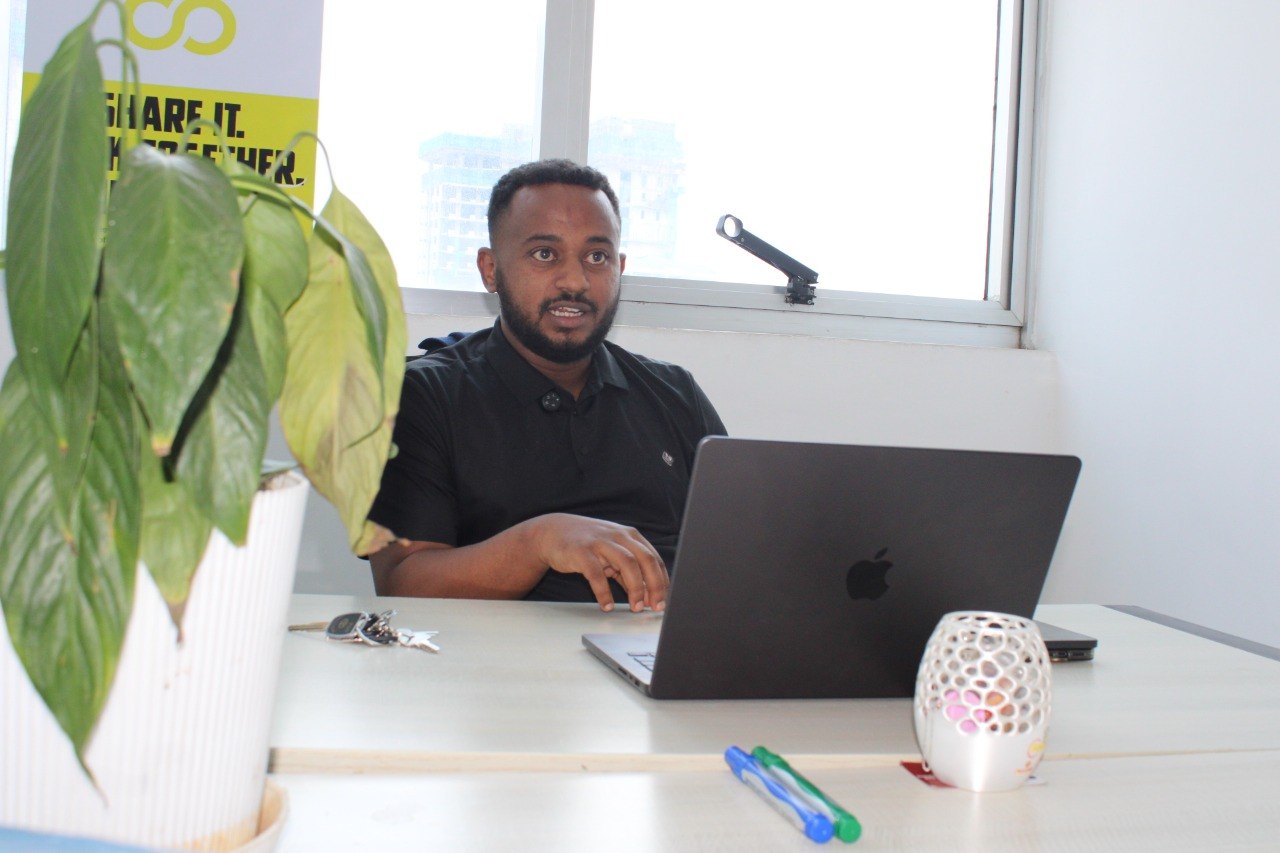
Ethiopia’s outsourcing industry is still finding its footing, but a new generation of startups is attempting to position the country as a destination for global digital services. Blih Intelligent Operations, founded by Nebiyat Teklu, is among the ventures betting that Ethiopia’s young workforce can become a competitive advantage in a market increasingly shaped by technology and artificial intelligence.
Built around a combination of business process outsourcing, technology services and AI-enabled operations, Blih is seeking to move beyond the traditional outsourcing model by pairing Ethiopian talent with structured systems, automation and international delivery standards. The startup’s model draws from Nebiyat’s earlier experience across Ethiopia’s digital economy, including his work at M-Birr, one of the country’s pioneering mobile money companies, as well as roles spanning payment systems, API integration, web development and digital marketing.
In an interview with Birrmetrics Editor-in-Chief Mintesinot Nigussie, Nebiyat highlighted infrastructure as one of the major challenges facing the sector. Reliable internet connectivity and electricity, he said, are essential for outsourcing companies that serve overseas clients and operate across different time zones. Any disruption, he noted, can affect not only individual companies but also confidence in Ethiopia as an outsourcing destination.
He also discussed the impact of artificial intelligence on the future of outsourcing. While AI could replace some repetitive tasks, Nebiyat believes the technology will create new opportunities for workers who can adapt, develop new skills and work alongside emerging tools. For Ethiopia, he sees the rapid development of AI as an opportunity to compete in a technology shift that is still unfolding.
For him, the opportunity in outsourcing goes beyond exporting services. He believes the sector can create globally competitive jobs for young Ethiopians, reduce pressure for migration, and position the country as a participant in the next generation of digital industries rather than a follower of technologies already built elsewhere.
Birrmetrics: Can you introduce yourself and tell us about Bilh’s journey from inception to where it is today?
Nebiyat Tekilu: Bilh Marketing and Communications has been operating in the market for about four years. We started with a focus on marketing and communications services, but over time, the company has evolved by adding new services and expanding its client base based on changing market needs.
Currently, we have three main service areas. The first focuses on market localisation and foreign direct investment (FDI). We support international companies entering Ethiopia by assisting them throughout their market entry journey, from legal registration and market research to developing market strategies and understanding the local business environment.
The second area is digital transformation. We support both public and private sector organisations that want to modernise their operations and transition into the digital economy. Our services in this area include marketing strategy, data, artificial intelligence and technology-related solutions.
The third pillar is business process outsourcing (BPO). Through this area, we aim to leverage the skills and capabilities of talented professionals to provide services to international markets.
The startup ecosystem is evolving, but founders still face significant barriers. From building Blih, what have you learned about navigating the realities of starting a company in Ethiopia, and what opportunities do you believe emerging founders should be paying attention to?
Building a startup in Ethiopia is becoming easier compared with the past. Of course, there are still many challenges, but things are no longer the same as they were before. The environment is gradually improving, and we are seeing progress.
When we started building this company, although it has only been a few years, the experience was very different from what founders have today because many things have changed over time.
One of the biggest challenges we faced was the lack of awareness and information. At that time, there were not many platforms where founders could learn about building companies in Ethiopia. With the growth of platforms such as TikTok and other social media channels, people can now easily find videos and content about starting and running businesses in Ethiopia.
Back then, however, there were fewer content creators and limited experience-sharing among entrepreneurs. Ethiopia also has a unique legal and business environment, meaning that many international videos and resources were not always directly useful or applicable.
So, one of the biggest challenges I faced when establishing the company was the lack of information. Today, government institutions such as business offices and revenue authorities are gradually becoming more modernised. Their websites are improving, and more information is becoming available online. When you look at articles, LinkedIn posts and experiences shared by other founders, you can now find much more information.
There is still a lot that needs to improve, but at least compared with the past, the situation is better.
Another major challenge is access to finance. No matter how big an idea is, even if it is an idea that can change a country or create global impact, without finance, it is difficult to establish a company and turn that idea into reality.
Access to finance is not something that comes only because you have a good idea. There may be opportunities or organisations that can provide financing, but if you do not have the right information, you may not know where to find them or how to access them.
Another challenge is the process of establishing a company. Hopefully, as the startup proclamation is implemented, many of these issues will improve. Some of the requirements currently needed to establish a company are not necessarily practical for young entrepreneurs who are simply trying to bring their ideas to life.
For example, one requirement is that you need to rent an office space, even at a basic level, before establishing a company. I do not know the reasoning behind why this requirement exists, but from a founder’s perspective, it represents a significant expense for someone who is just starting with an idea.
If a young entrepreneur cannot meet that requirement, they cannot establish the company. Without establishing the company, they cannot provide services. And without a business licence from the relevant authorities, they may not be recognised as a formal company.
There are many blockers along the journey of building a company, and founders have to overcome them one by one.
My concern is that many promising ideas may become discouraged and disappear along the way. There may be young people with ideas far better than ours, but they may give up because of these challenges before they have the chance to build something.
As Blih expands into the BPO sector, how has this shift changed the company’s structure, operations and internal systems?
Moving into the outsourcing sector has been a complete shift for our company. Previously, we were mainly providing marketing and communications services to local companies and foreign investors coming into Ethiopia.
Outsourcing, however, is a very different business environment. When you are based in Ethiopia but providing services to companies in Europe and the United States, your standards have to match the expectations of those international markets. Otherwise, it becomes difficult to compete.
Because of this shift, we had to make significant internal changes. Previously, when providing services locally, many processes were managed through experience, internal knowledge and the culture we built within the company. Some procedures and ways of working were understood internally without necessarily being formally documented.
However, serving international clients requires a much higher level of structure and standardisation. There are many requirements around documentation, processes and compliance with international standards.
Another major change is related to talent. In the outsourcing sector, talent is the most important component. To provide services to companies in other countries, you need highly skilled professionals. This requires an organisational structure that is strongly focused on talent management.
You need systems that can identify and recruit talent, actively search for capable professionals, hire them, train them, develop their skills and prepare them to deliver services based on international standards and excellence.
Therefore, we needed to build a more structured and, in some areas, automated internal system that can consistently create and manage high-performing talent. This transition has pushed us to evolve and transform our organisational structure.
Which markets and industries are you targeting as Blih Ops expands its international client base? What types of services are you providing to these clients?
Our main target market is Europe. We chose Europe because there are already many companies like ours in Ethiopia that focus on serving the North American market. We wanted to position ourselves differently by focusing on European markets, particularly companies in Germany and Eastern Europe.
This decision was influenced by several factors, including time zones. Ethiopia and many European countries have relatively similar working hours, which makes collaboration easier. When you target markets such as North America, the time difference can become a challenge and affect communication and operational efficiency.
There are also other considerations, including competition. Some countries have stronger advantages in the outsourcing sector, so we wanted to focus on markets where we believe we can compete effectively and create value.
In terms of the services we provide, our main focus is technology-related services. Within that space, we are particularly moving towards artificial intelligence and automation.
We work with companies that want to modernise their operations, automate their processes and adopt AI-based solutions. For many companies in Europe, hiring locally for certain operations can be expensive. We help them by providing these services from Ethiopia and supporting them in automating parts of their operations.
The perception of BPO is often tied to call centres, yet the global industry has expanded into technology, knowledge and AI-enabled services. How is the outsourcing market changing, and where does Bilh Ops see its opportunity in this transformation?
Outsourcing can happen between two companies within the same country, which is referred to as onshore outsourcing. When the service is provided across different countries, it is called offshore outsourcing.
The outsourcing industry is generally divided into three main categories: BPO, ITO and KPO. BPO stands for Business Process Outsourcing, ITO refers to Information Technology Outsourcing, which focuses on IT-related services, and KPO stands for Knowledge Process Outsourcing.
Because BPO is the longest-established part of the outsourcing industry, when people talk about outsourcing, they often refer to BPO. Traditionally, BPO has included services such as call centres, customer assistance and other business support functions. In particular, call centre services have been one of the oldest and most recognised areas of outsourcing.
India was one of the countries that significantly developed and advanced this service sector, and countries such as the Philippines and others have followed the same path.
Ethiopia is still at an early stage in the outsourcing sector. However, it is a very promising industry. Many companies are now being established in Ethiopia, and there are also several support programmes helping local companies enter the outsourcing space. We have also received support in different ways as we have entered this sector.
But considering the potential we have, it is somewhat disappointing that we have not moved faster. This is a sector that can generate significant foreign currency inflows for the country.
The biggest advantage we have in this sector is talent. As I mentioned earlier, talent is the most important resource for outsourcing. Ethiopia has a population of more than 120 million people, possibly over 130 million, with a large proportion of young people. We also have many university graduates entering the market every year.
At the same time, unfortunately, there is a shortage of employment opportunities, and many young graduates are unable to find jobs. We also have expanding internet access, although many young people are currently using the internet in ways that do not create enough value, and sometimes in harmful ways.
If you have internet access, talent and a young population, those are the core resources needed for the outsourcing sector. Many countries that rank much higher than Ethiopia in global outsourcing rankings do not necessarily have all these resources.
If we can properly utilise these advantages, the sector has significant potential. It can become a major source of foreign currency, comparable to some of the traditional exports we rely on, such as agricultural products and coffee.
Another reason I am personally interested in this sector is its potential to address migration pressures. Many young people take dangerous journeys to Western countries because they are seeking better economic opportunities. They go through difficult experiences, cross deserts and put their lives at risk because they want a better future.
However, through outsourcing, young Ethiopians can potentially earn similar incomes while remaining in their own country, staying with their families and working within an environment they are familiar with.
That is why I strongly encourage more young people to enter this sector and encourage more companies to focus on developing Ethiopia’s outsourcing industry.
What other strengths, beyond its young talent pool, does Ethiopia have in the outsourcing sector, and what gaps must be addressed to build a workforce capable of competing in global markets?
Having a young population is one of our biggest strengths. Another major advantage is our time zone. Ethiopia is in a very favourable time zone, particularly for serving European markets.
The outsourcing sector is built around collaboration between companies that may be located in different parts of the world. If your working hours are significantly different from those of your client, it becomes difficult to manage your day, collaborate effectively and handle the pressure that comes with serving international customers.
With Europe, however, Ethiopia has at most about a three-hour time difference. With some countries, the difference is only one or two hours. That is a significant competitive advantage for us.
Another strength is our young people. I believe Ethiopian graduates have the potential to compete internationally if they receive the right level of polishing through the education system. For reasons I cannot fully explain, many young Ethiopians are also able to develop strong English-language skills with relatively limited additional effort. It may partly be because English is introduced early in our education system.
With some additional training and refinement, many of our young people can communicate very well in English. That said, as a country, we still have considerable work to do on communication skills, including how we express ourselves, present ourselves and communicate effectively in international professional settings.
That brings me to your second question. While Ethiopia has clear competitive advantages, we also have significant disadvantages that prevent us from becoming a stronger player in the global outsourcing industry.
The first is that many university graduates do not leave university with the skills needed to compete internationally. After graduation, they often have to invest in additional courses and training before they are ready for international opportunities.
At the same time, there are still limited opportunities for graduates to access training that exposes them to international standards in an accessible and comprehensive way. If you look at countries such as Rwanda and Kenya, for example, there are many programmes specifically designed to prepare young people for international markets. Ethiopia is only beginning to move in that direction.
Another challenge is that much of what students learn at university remains quite generic. Graduates often leave with limited soft skills, yet these are among the capabilities that international employers value the most. Institutions that focus on developing these skills are only now beginning to emerge, and they are not yet widespread.
The policy environment has also been changing, with reforms ranging from foreign exchange liberalisation to the Startup Proclamation and the government's Digital Ethiopia agenda. How do you assess the current business environment for technology and outsourcing companies? And where do you think the remaining policy gaps lie?
Of course, we cannot predict the future, but based on where Ethiopia has come from, I believe there has never been a better time for the technology sector than now.
Is it promising? Absolutely. In particular, the progress made over the past two years has been very encouraging.
One initiative I always highlight is the Digital Ethiopia 2030 strategy. It gives us a great deal of optimism. If you look at the priority sectors identified in that strategy, outsourcing is one of the key focus areas. The government's decision to recognise the sector and develop a dedicated five-year strategy around it is very encouraging for companies like ours. Recognition itself creates opportunity.
Secondly, the government's efforts to attract foreign investors into the country are another positive development. Because there are many large global outsourcing companies. If those companies establish a presence in Ethiopia, it effectively puts the country on the global outsourcing map. These companies have significant capacity to promote the markets in which they operate.
Today, I do not think many large companies in Europe are even aware that Ethiopia has an outsourcing sector. As a country, we have not yet done enough to position ourselves internationally.
The arrival of these global companies, attracted by Ethiopia's young population and talent creates opportunities not only for them but also for local companies. It helps position Ethiopia as an outsourcing destination.
By the way, I do not see the competition as being between us and the multinational companies entering Ethiopia, or even between us and other local technology companies.
The real competition is between Ethiopia and countries such as Kenya, Rwanda, the Philippines and India.
If we can build trust and establish a reputation that Ethiopian professionals consistently deliver high-quality work and execute projects with excellence, then European and American companies will become more confident in outsourcing work to Ethiopia.
The opportunities that would create go far beyond any single company. They would benefit the entire ecosystem.
Let me give you an example.
Companies in Eastern Europe have long been active in the outsourcing industry. Much of this has taken the form of nearshoring, where companies in Western Europe outsource work to firms in Eastern or Central Europe.
Today, however, many of those same companies are themselves beginning to outsource work further to Africa and Asia.
If Ethiopia can address its remaining challenges and become internationally competitive, this shift presents a significant opportunity. It is an opportunity that would benefit not only companies like ours but many businesses across the country.
That is why developments such as these give us real optimism about the future of Ethiopia's outsourcing industry.
Your services are heavily technology-driven, yet Ethiopia’s technology ecosystem is still developing, with many businesses only recently beginning to adopt digital solutions. In this environment, how is Blih positioning itself to compete in international markets?
I believe the biggest factor is the willingness and ability of our young people to learn and adapt.
Even in the digital age, accessing resources and acquiring new skills can still be challenging. But one of the biggest opportunities we have today is that when a new technology is launched in the United States or elsewhere, someone in Ethiopia can access information about that technology and start learning about it almost immediately. That creates an opportunity that previous generations did not have.
If our young people have the motivation, and they do, they can quickly adapt themselves and build the skills needed to compete globally.
Another major opportunity is the rise of emerging technologies, particularly artificial intelligence. Historically, Ethiopia and many other developing countries have had to follow developments created elsewhere. We missed opportunities in technologies such as automobile manufacturing, camera production, and many other industries because those innovations had already matured before we could participate.
However, AI is different. It is still being developed and evolving. The accessibility of the internet and digital learning resources means that young people in Ethiopia can learn, experiment, and contribute alongside their peers anywhere in the world.
This creates a chance to compete on a more equal footing. If the challenges we discussed earlier are addressed, and if companies, young people, and the government work together, I believe Ethiopia has the potential to produce significant innovations in the future.
Do you think the infrastructure currently deployed in Ethiopia is sufficient to support the growth of the BPO sector? What are the areas that still require improvement?
Of course, there is still a lot of work to be done. As I mentioned earlier, Ethiopia is still at an early stage in this sector. If we want to become globally competitive, we need to address several critical areas.
For the outsourcing sector, two major resources are essential: reliable internet connectivity and stable electricity. The nature of this business requires intensive communication. When you are operating from Africa and serving a company based in Europe or elsewhere, your client expects to reach you whenever needed. Therefore, fast and uninterrupted internet connectivity is not negotiable.
Even for us, despite being located in a central business area like Bole Road, maintaining consistent and high-speed internet remains a major challenge. It is one of the issues we continue to face as a company.
The second major issue is electricity. When power interruptions occur in a communication-intensive business, it does not only affect the company’s reputation; it also affects Ethiopia’s reputation as an outsourcing destination. International clients have many alternatives. They can easily move their operations to companies in Kenya, India, or other countries.
This is what makes the outsourcing sector different from many other industries. If all stakeholders play their respective roles and work together, it can become a sector that helps elevate Ethiopia’s position globally.
That said, there are also encouraging developments. The ICT Park is increasingly focusing on the BPO and outsourcing sectors, and some companies are already moving into that space. From what I understand, efforts are being made to provide more reliable internet and electricity infrastructure within the park.
There are also initiatives to develop additional facilities and attract more outsourcing companies into the country. These are positive steps that give us confidence about the future of the sector.
Artificial intelligence has moved from being a future concern to a current business reality, with companies increasingly exploring automation and AI-driven efficiencies. As some roles become vulnerable to automation, how do you see AI shaping the long-term future of the outsourcing sector? Which services are most likely to be disrupted?
I see AI as a very fast-moving train. If you get on that train, it can take you forward, but if you miss it, catching up will be very difficult. The difference between AI and previous technologies is that it is happening right now. It is not something that will arrive in the distant future; it is already transforming industries.
One positive development is the growing attention Ethiopia is giving to AI. The government’s focus on artificial intelligence, including the establishment of the AI Institute and efforts to encourage innovation and AI-related initiatives, is encouraging. Even the fact that we are having national discussions about AI is significant. There are countries where AI has not yet become part of government-level conversations, so I see Ethiopia’s growing focus on the technology as a positive step.
When it comes to employment, I do believe some types of jobs will disappear. However, I think the jobs most vulnerable are repetitive and routine tasks that can easily be automated. Work that remains the same today, tomorrow, and in the future is more likely to be replaced.
At the same time, AI will create new opportunities. Jobs related to innovation, problem-solving, and developing new solutions will continue to emerge. AI itself requires data, and there will be increasing demand for people who can prepare, manage, and provide quality data for AI systems. Many new roles connected to data and AI will continue to develop.
So, I do not see AI simply as a technology that removes people from jobs. I see it as a force that requires people to shift, adapt and upgrade their skills faster.
If we look back at history, every major technological change created similar concerns. When machines were introduced into industries such as garment production, some jobs disappeared. But new opportunities emerged for people who learned how to operate, maintain, and improve those machines.
The same principle applies to AI. Those who resist change and do not adapt may struggle, but those who learn how to work with AI will find new opportunities. For Ethiopia and other African countries, AI represents a major opportunity because it allows us to participate in a technology revolution that is still developing rather than simply trying to catch up with technologies that have already matured.




