

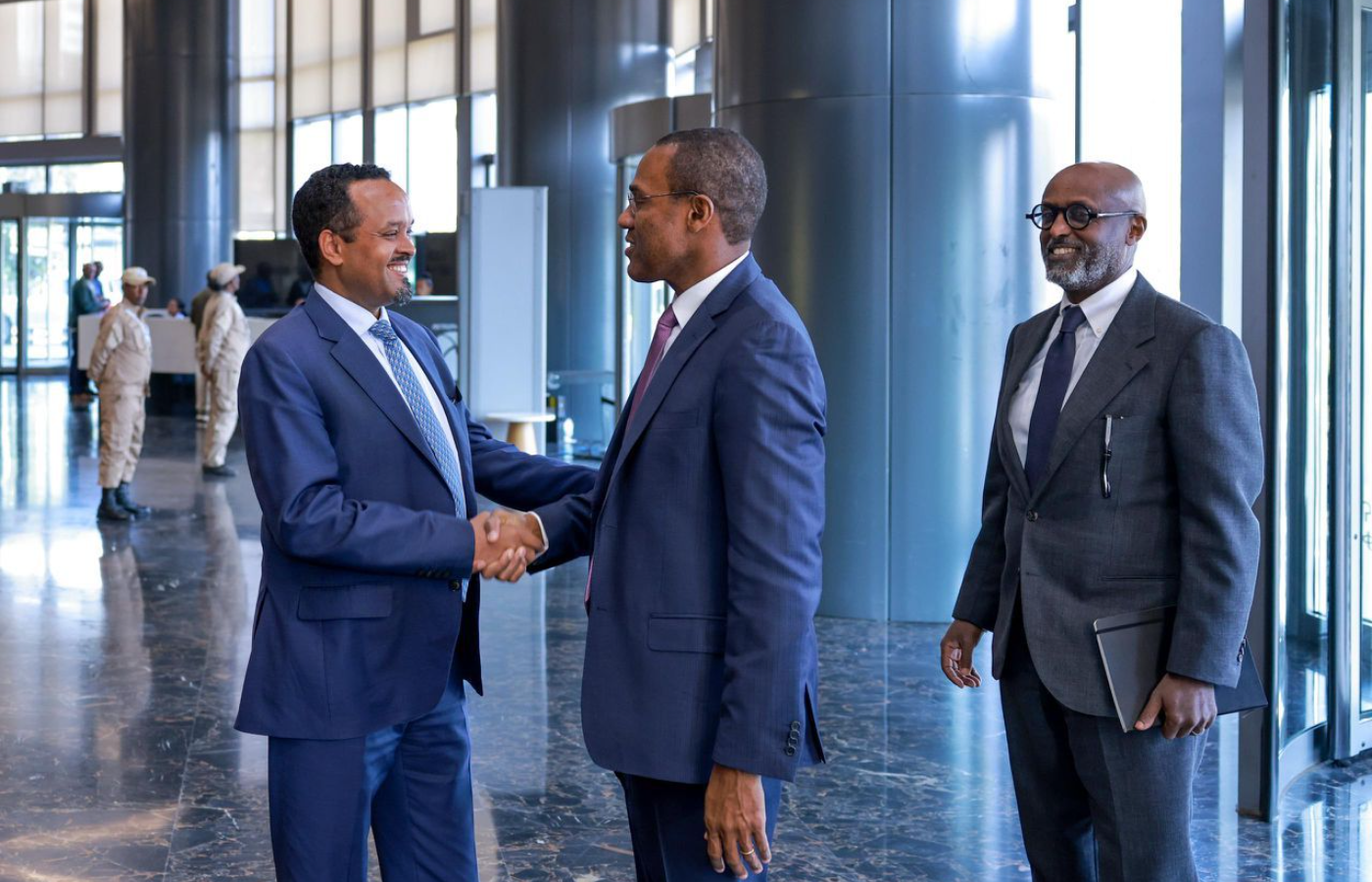
IMF Deputy Managing Director Nigel Clarke arrived in Addis Ababa to meet senior Ethiopian officials as discussions continue on the fourth review of the country’s 3.4 billion US dollars Extended Credit Facility (ECF).
Clarke held meetings with Finance Minister Ahmed Shide, National Bank of Ethiopia Governor Eyob Tekalign (PhD), Minister of Planning and Development Fitsum Assefa (PhD), and other senior officials. The discussions focused on Ethiopia’s ongoing economic reforms, IMF support for the reform agenda, and potential areas for collaboration.
Ahmed Shide outlined the government’s reform programme, emphasising efforts to consolidate recent gains and maintain a strong partnership with the IMF. Clarke noted progress under the Homegrown Economic Reform Program and highlighted the coordination required to advance fiscal, monetary, and structural reforms.
An IMF mission led by Alvaro Piris previously held consultations in Addis Ababa from October 30 to November 13, meeting senior officials and representatives from the banking sector and private firms. At the time, Piris said in a statement that the IMF staff team had made good progress towards a staff-level agreement on the fourth ECF review and that discussions would continue virtually in the following weeks.
The visit follows three prior reviews under Ethiopia’s four-year ECF arrangement. The first review, completed in October 2024, unlocked 340.7 million US dollars, followed by a second review in January 2025 releasing 248 million US dollars. The third review, in July 2025, released 262.3 million US dollars after IMF assessments highlighted improvements in inflation, export performance, and international reserves.
Observers have broadly acknowledged the stabilising effect of IMF-backed reforms, noting improvements in foreign reserves, inflation management, and external credibility. Some analysts see the programme as a framework for deeper structural reform and private‑sector-led growth.
Others, however, caution that the measures mirror typical IMF-style adjustments, potentially constraining social spending and public-sector capacity. Analysts also warn that lingering challenges, including limited private-sector lending, state dominance in banking, and exposure to external shocks — could undermine progress if reform momentum is not maintained.
While analysts view the impact of the IMF-supported programme as largely short term, the cost of living has risen noticeably since its introduction, putting pressure on households across urban and rural areas. Businesses have reported rising import costs, which have compounded existing operational challenges, including supply chain constraints and limited access to affordable credit. Local firms are further affected by changes to the taxation system, with recent reforms increasing the overall fiscal burden.




